
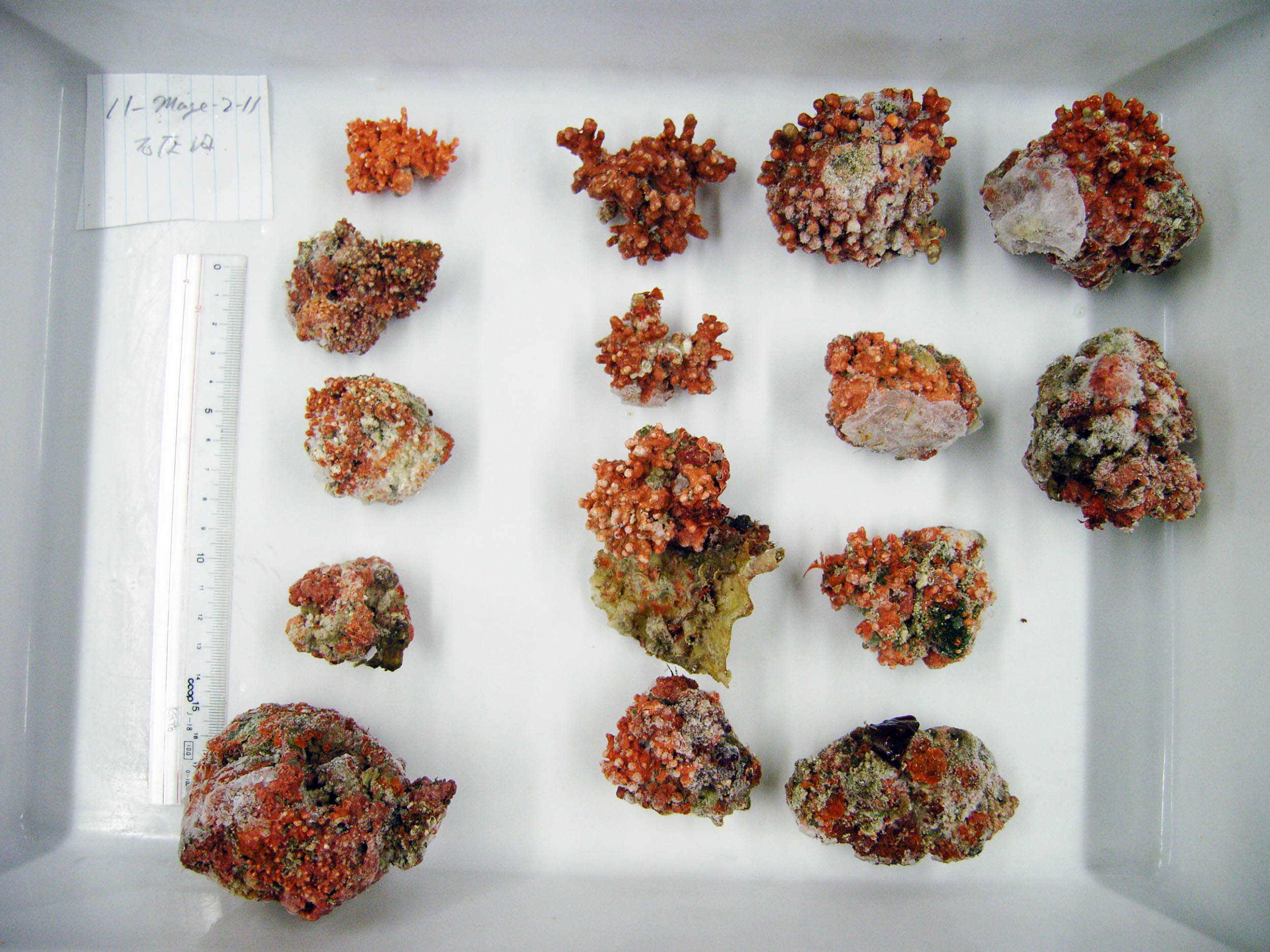
Some species are so easy to overlook that they can spend centuries hidden in plain sight. That is the case with rhodoliths, which resemble small pink rocks on the seafloor but are actually living algae.
These unusual organisms help support marine ecosystems, provide shelter for countless sea creatures, and even contribute to long-term carbon storage.

Now, researchers studying deeper waters off Japan’s Tanegashima Island have uncovered a surprisingly rich community of these living structures.
Their work revealed four species never seen before and showed that life in deeper waters can be dramatically different from what exists just a few dozen feet above.
Rich ecosystems in deep waters
Tanegashima Island lies south of Kyushu in Japan’s Kagoshima Prefecture. The area is already known for its impressive marine biodiversity.
Warm water carried by the Kuroshio Current and the region’s unique underwater landscape create ideal conditions for a wide variety of sea life.
The most recent discoveries came from the mesophotic zone, a region of the ocean that receives limited sunlight and stretches from about 98 to 492 feet deep. Although scientists have spent years studying this zone, many of its algal species remain poorly understood.
Researchers from Hiroshima University identified four previously unknown species of calcifying red algae, commonly called coralline algae, which form rhodoliths.
The team also updated scientific descriptions for two coralline algal groups, adding new details to scientists’ understanding of these organisms.
Natural engineers of the seafloor
Rhodoliths are unattached, pebble-like nodules formed mainly by coralline algae, and their beds represent the largest seaweed habitat by area in marine ecosystems.
“These ecosystems occur across a wide depth range, from shallow waters to deep environments, and provide essential habitat that supports marine biodiversity,” said the study’s corresponding author, Aki Kato, an associate professor at Hiroshima University’s Seto Inland Sea Carbon-neutral Research Center.
“Due to their calcified structures, rhodoliths contribute to long-term carbon storage in marine sediments, making them increasingly relevant in the context of blue carbon and climate change.”
Rhodolith beds are often compared to underwater habitat builders because they create complex surfaces where small animals, fish, and other marine organisms can live.
Their role in carbon storage has also attracted growing attention as scientists look for natural systems that help capture carbon over long timescales.
New algae species emerge from depths
The research team collected samples from seafloor locations roughly 6.2 miles off Tanegashima’s western coast at depths between about 98 and 131 feet.
After preserving the samples, they used DNA sequencing and microscopic analysis to identify the algae.
The scientists examined several genetic markers commonly used to determine evolutionary relationships among algae. When the DNA suggested an organism might represent an unknown species, the team closely studied its physical structure using both light and scanning electron microscopes.
Their investigation identified at least 12 coralline algae species belonging to five genera. Four species turned out to be completely new to science: Orientalilithon compactum, Roseolithon aggregatum, Roseolithon sparsituberculatum and Sporolithon variotuberculatum.
In describing O. compactum, the researchers also documented both male and female reproductive structures in the genus Orientalilithon for the first time.
“Taxonomy provides an essential framework for making biodiversity visible and for defining the biological units that are the subject of scientific investigation,” said Kato.
The work extends beyond DNA analysis to identify distinguishing traits, define species and genera, and formally describe new taxa.
Different depths, different alage species
One of the study’s most surprising findings involved where these algae live. The team identified 12 species of coralline algae forming rhodoliths in deeper waters around Tanegashima Island.
However, researchers found only three of those species in the nearest shallow rhodolith bed, located just 3.3 feet deep.
“A striking finding of this study is that completely different biological communities can exist at different depths within the same marine area,” said study first author Min Khant Kyaw, a postdoctoral researcher at Hiroshima University’s Seto Inland Sea Carbon-neutral Research Center.
 Pebble-like rhodoliths resemble “pink rocks” that form a hidden seaweed ecosystem, collected from a depth of 38 m in the waters off Tanegashima Island, Kagoshima Prefecture, Japan. Credit: Aki Kato / Hiroshima University. Click image to enlarge.Why coralline algae stand out
The pattern differs sharply from what scientists have observed in other seaweeds. Previous studies found that roughly 80 percent of fleshy red algae species in the region occur in both mesophotic and shallow-water habitats.
The findings suggest coralline algae follow a distinct ecological pattern. Their species composition changes dramatically across depth gradients rather than remaining relatively consistent.
According to the researchers, factors such as light, temperature, ecosystem characteristics, dispersal barriers, and interactions among species may all contribute to these shifts.
Understanding how those forces shape coralline algae communities could help explain their unusually distinct distributions.
Mysteries beneath the seafloor
The researchers suspect that warm water near the seafloor helps explain the exceptional diversity found around Tanegashima Island. Unusually clear conditions that allow sunlight to penetrate deeper may also play an important role.
Many mysteries remain. Scientists still do not know how extensive the rhodolith beds are in the region or whether the four newly identified species exist anywhere else.
“We aim to reassess the species diversity of coralline algae, focusing on Japanese taxa, using molecular and morpho-anatomical data,” said Kato.
Scientists have identified more than 700 species of coralline algae worldwide, but they classified many of them using only physical characteristics and have not yet confirmed them through genetic analysis.
The researchers hope their work will provide a more complete picture of coralline algal diversity and strengthen the foundation of marine biodiversity research.
The full study was published in the Journal of Phycology.
—–
Like what you read? Subscribe to our newsletter for engaging articles, exclusive content, and the latest updates.
Check us out on EarthSnap, a free app brought to you by Eric Ralls and Earth.com.
—–
AloJapan.com