
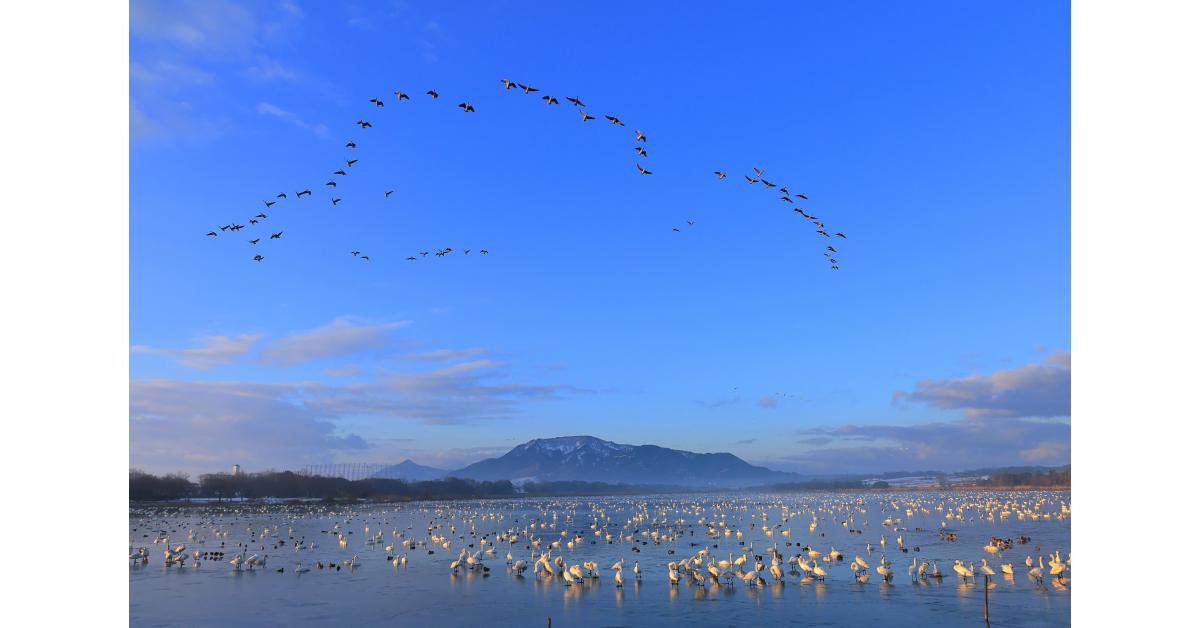

Sakata Lake in Niigata City: A Ramsar-designated Wetland of International Importance

Fukushimagata Lake: the largest lake within Niigata City

The vibrant ecosystem of Fukushimagata Lake today

Mt. Kakuda and Mt. Yahiko reflected in the still waters of newly planted rice fields

Historical illustration of the Ohkouzu Diversion Channel (Archival scroll)
Niigata City, set to host the “Roundtable of Wetland City Mayors” in November, is an agriculture hub visited by 10,000 swans.
NIIGATA CITY, NIIGATA, JAPAN, June 11, 2026 /EINPresswire.com/ — Niigata City (Mayor: Yaichi Nakahara) will host the 5th Roundtable of Wetland City Mayors from November 30 (Monday) to December 2 (Wednesday), 2026. This marks the first time the event is held in Japan. Mayors and experts from cities worldwide holding the Ramsar “Wetland City Accreditation” will gather for this summit. Ahead of the conference, this release introduces the history and landscapes of ” Wetland City Niigata,” which in 2022 became the first city in Japan to receive this accreditation.
A Global Summit for Sustainable Cities
The upcoming conference serves as a platform for 74 accredited cities to exchange vital strategies for the sustainable wise use utilization of wetlands. To help the global community understand why Niigata was chosen as the host, it is essential to look at the city’s unique harmony between its natural environment and its status as a thriving agricultural and urban hub.
Niigata: Where Urban Sophistication Meets Natural Serenity
Located two hours from Tokyo via Shinkansen, Niigata City faces the Sea of Japan and is enriched by two major rivers: the Shinano River and the Agano River. It serves as a major transportation hub with an international airport, seaport, Shinkansen, and highway networks. Simultaneously, it is a massive agricultural city with the largest rice paddy area in Japan. This “proximity between urban life and nature” makes Niigata City unique on a global scale.
As a symbol of this environment, Niigata City boasts the highest number of wintering swans in Japan. Every year, over 10,000 swans fly in from Siberia to rest in lakes, rivers, and rice paddies. It is internationally rare for these birds to overwinter so close to a city center. Citizens see swans as part of their daily landscape. This synergy where urban life, agriculture, and the environment support each other without compromise defines Wetland City NIIGATA.
Shaped by Water: The History and Transformation of Niigata’s wetlands
Niigata City has long flourished as a river port for the Shinano and Agano Rivers flowing through the Echigo Plain. The Port of Niigata at the river mouth has historically connected inland water transport with maritime shipping. It developed further into a Hub International Port in 1995 and an International Strategic Bulk Port in 2011.
In the past, numerous lakes of various sizes dotted the Niigata region. These lakes served as transportation routes, fishing grounds, and reed harvesting sites. While providing bountiful resources, the environment also carried the constant risk of flooding. From the 18th century onward, large-scale civil engineering projects laid the foundation for the region to become a rice-producing heartland. Around 1870, most of the city area was dedicated to rice cultivation, but much of it consisted of marshy
paddies prone to frequent flooding.
Triggered by the massive “Yokota-gire” flood of 1896 and the subsequent “Kizu-gire,” the national government began the Ohkouzu Diversion Channel project, completed in 1922. This significantly reduced the risk of major flooding. Following World War II, the completion of large-scale drainage pumping stations allowed for land consolidation. By 1955, the city’s rice paddies were transformed into dry fields organized by straight roads and irrigation/drainage channels.
While most wetlands disappeared due to flood control and new field development, 16 lakes remain today, including Sakata Lake, Fukushimagata Lake, and Toyanogata Lake. As lifestyles and industrial structures changed, these lakes transitioned from sites of daily labor to sanctuaries for diverse flora and fauna, serving as symbolic “hometown” spaces for relaxation and community activity.
A Milestone in Conservation: Japan’s first Ramsar Wetland City
The loss of wetlands was a global trend until the mid-20th century. Along with the wetlands, many creatures—particularly migratory birds—began to disappear. In response, nations adopted the “Ramsar Convention” in 1971 (named after the city in Iran where it was signed) to restore and conserve wetlands of importance, especially as waterfowl habitats.
In Niigata City, Sakata Lake was designated as a Ramsar Site in 1996. This renewed focus on the wetlands’ value led to conservation and restoration projects in collaboration with local residents. Recently, the Ramsar Convention established the “Wetland City Accreditation” system to encourage “wise use”—the sustainable utilization of wetlands in urban and peri-urban areas. This innovative system merges the concepts of “wetland” and “city,” which were once considered contradictory.
Niigata City received this accreditation alongside Izumi City in 2022, the first in Japan, in recognition of local conservation efforts and the fact that wildlife like swans live in close proximity to human residents. The city intends to utilize this accreditation as an international brand to promote urban development as a “Rural-Urban Environmental City,” increase tourism, and foster civic pride. Future updates will introduce the rich ecosystem of ” Wetland City Niigata,” along with its deep ties to local culture, food, and sake.
About the 5th Roundtable of Wetland City Mayors
The Wetland City Network consists of 74 cities from 27 countries that have received the Ramsar Wetland City Accreditation. Niigata City is a member of this network. The Roundtables are held to promote information exchange and cooperation among mayors, government officials, and international experts. The 5th Roundtable will be hosted in Niigata City.
Media Contact
Department: Niigata City Policy Planning Department
Representative: Tanaka / Kawakami
Email: seisakukikaku@city.niigata.lg.jp
Interviews are available upon request.
Niigata City Policy Planning Department
Niigata City
seisakukikaku@city.niigata.lg.jp
Legal Disclaimer:
EIN Presswire provides this news content “as is” without warranty of any kind. We do not accept any responsibility or liability
for the accuracy, content, images, videos, licenses, completeness, legality, or reliability of the information contained in this
article. If you have any complaints or copyright issues related to this article, kindly contact the author above.

You just read:
News Provided By
June 11, 2026, 14:00 GMT
EIN Presswire’s priority is author transparency. We do our best to weed out false and misleading content. The content above is
the sole responsibility of the author who makes it available. If you have any complaints, kindly contact the author above.
AloJapan.com