
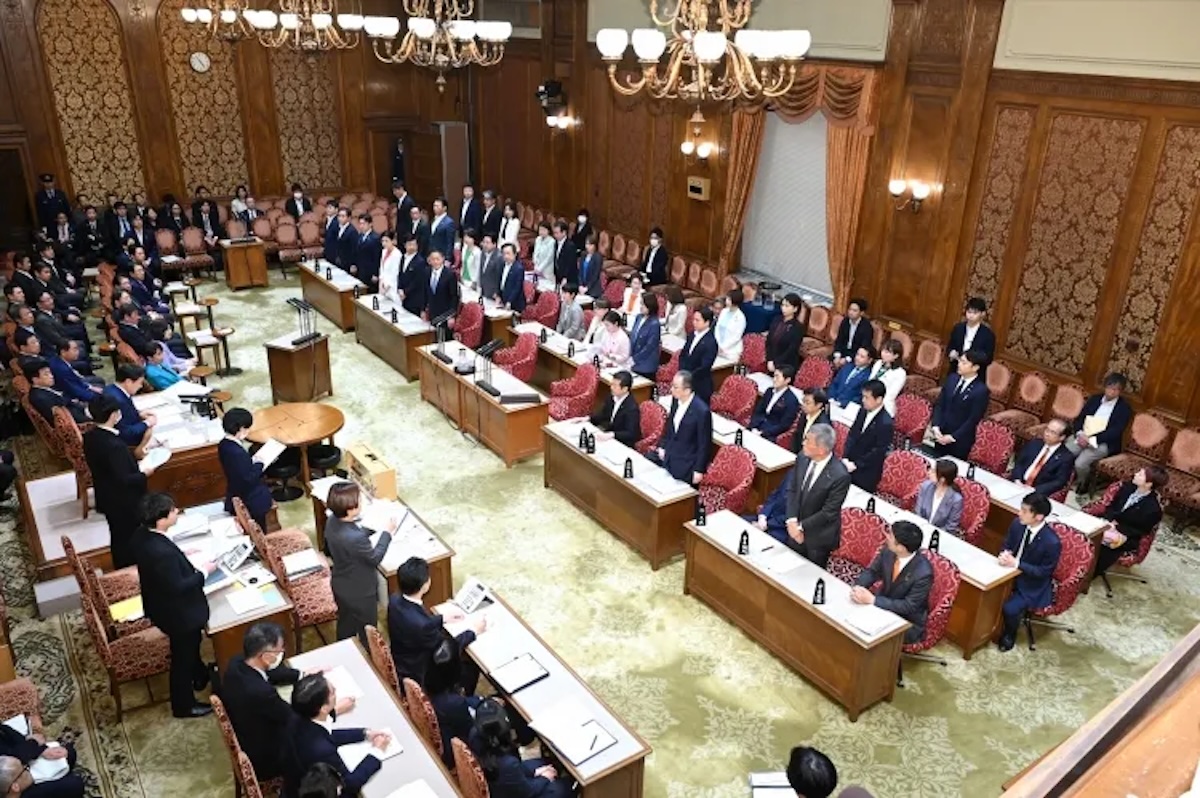
The House of Councillors passed the Takaichi government’s JPY 3.11 trillion budget on Friday, June 5, as expected, with the Democratic Party for the People (DPFP), Team Mirai, and the Conservative Party of Japan (CPJ) joining the Liberal Democratic Party (LDP) and Ishin no Kai to approve it.
The budget not only passed with extraordinary haste – the cabinet approved it on June 3 and each house deliberated on it for only a day – but it also came together quickly once Prime Minister Sanae Takaichi conceded in mid-May that an extra budget would be necessary.
While the extra budget will give the government a greater cushion for continuing fuel subsidies, the budget’s passage will do little to ease political pressure on Takaichi to indicate how she intends to exit from the costly subsidies – not least since the passage of the supplemental budget means that the Japanese government has gone from a projected surplus of JPY 1 trillion to a projected deficit of JPY 1.7 trillion in FY2026.
Government weighs support package for tax cut
Among the questions now facing the Takaichi government as it prepares to introduce a consumption tax on foodstuffs is whether and how to deliver support for businesses as they prepare to implement the tax cut.
The government could face broad demands for assistance that go far beyond supporting businesses modifying their cash registers to collect taxes at a lower rate.
For example, restaurants, which are already disadvantaged due to the 8% discounted consumption tax rate, fear that they will face a steeper disadvantage when the gap is between a 10% rate for dining in and 1% for grocery shopping or convenience store takeout. Meanwhile, food producers, who may also operate small retail operations that are exempt from paying consumption taxes they collect and who are complaining that their gross receipts will decline but their costs will remain the same, may also clamor for relief from the government.
As such, although Finance Minister Satsuki Katayama said Friday that the government will not rely on deficit bonds to fund the tax cut, it would be premature to take this claim at face value. The Takaichi government, after all, will have to account not only for the JPY 4.4 trillion or so that it could lose by reducing the consumption tax on foodstuffs to 1% but also for the various measures it introduces to compensate business interests as well as a possible rebate to households to make the tax cut equivalent to reducing it to zero.
Defamatory videos issue not going away
In the Diet deliberations on Friday, Takaichi continued to face questions over her staff’s involvement in the creation and dissemination of defamatory videos aimed at her rivals for the LDP’s leadership last year.
One day after she said that she lacked a subscription and therefore could not listen to a recording purportedly between one of her secretaries and a man who says he made videos – she said that she listened to it Thursday evening and could not discern whether it was her secretary’s voice.
She said that there was no record in her office of the meeting and took offense that a weekly tabloid article is being given more credence than her denials about having any connection to these activities. She claimed that there was something odd about the recording, implying that it was fake or manipulated. When a Constitutional Democratic Party (CDP) lawmaker suggested that she file a complaint with the publication, she replied that she was too busy with affairs of state and could not spare the time.
 CRA leader Junya Ogawa discusses the defamatory video issue in a press conference on June 5. Screenshot by author.
Despite Takaichi’s indignation, this story does not seem to be going away. Asahi notes, for example, that her responses to questioning have subtly shifted, from the prime minister and her secretary “having no acquaintance” with the man alleged to have made the videos to “not having met” the man.
On Friday, Centrist Reform Alliance (CRA) leader Junya Ogawa said that if the prime minister does not provide clear answers, her secretary should be called for questioning in the Diet. Her response to questioning has also drawn some criticism from within the LDP, albeit anonymously for now.
Asahi has a timeline of the allegations and the prime minister’s response here.
Further reading
For the second time this week, Prime Minister Takaichi used her participation in parliamentary deliberations to remark upon the value of the yen. In the upper house budget committee on Friday, the prime minister repeated her oft-stated view that yen weakness “has merits and demerits,” and argued that strengthening Japan’s international competitiveness will “ensure confidence in the yen.” She also stressed that her focus is on boosting investment and potential growth.
The Mainichi Shimbun, analyzing its recent opinion poll, notes that Takaichi’s approval among independents (35%) fell below their disapproval (37%) for the first time, with dissatisfaction with the government’s handling of inflation as a possible cause of the shift. Inflation may also be a factor in the government’s falling support among the young; Mainichi found that Takaichi’s approval from voters under 30 fell below 50% for the first time.
Takaichi hosted LDP upper house officials at the Kantei (official residence) again on Friday evening to express her gratitude for their help in moving the supplemental budget through the Diet.
The Japanese government has begun talks with the Indonesian government regarding the sale of retired Asagiri-class destroyers.
The Ministry of Economy, Trade, and Industry announced an additional JPY 150 billion investment in chipmaker Rapidus, bringing the government’s total investment to at least JPY 2.6 trillion.
LDP lawmakers continue to voice their anger over Ishin no Kai’s intent to smuggle its Osaka metropolis plan into the debate over an auxiliary capital.
Real wages rose for the fourth straight month in April – climbing 1.9% thanks in part to the government’s gasoline subsidies and other measures that have contained price increases for the moment – but consumer spending fell 0.5% year-over-year, the fifth consecutive decline.
The speakers and deputy speakers of the two houses of the Diet announced on 5 June that they have concluded a compromise plan for securing the imperial line that will be presented to a general meeting of lawmakers on 8 June.
Sanseito leader Sohei Kamiya, whose party voted against the supplemental budget, reported his growing dissatisfaction with Takaichi, stating that although he once thought that their policies were “40% overlapping,” they are now “only 20% overlapping.”
Opposition lawmakers are dissatisfied with CRA leader Ogawa for his inability to question Takaichi effectively and there is mounting frustration between the CRA and its partners in the upper house, the CDP and Komeito, over how to oppose the Takaichi government. The three parties have generally failed to coordinate their positions on major legislation.
Can Japan’s “semi-parliamentary” system contain the rise of a populist strongman?
This article is republished with permission from Tobias Harris’s newsletter Observing Japan.
AloJapan.com