

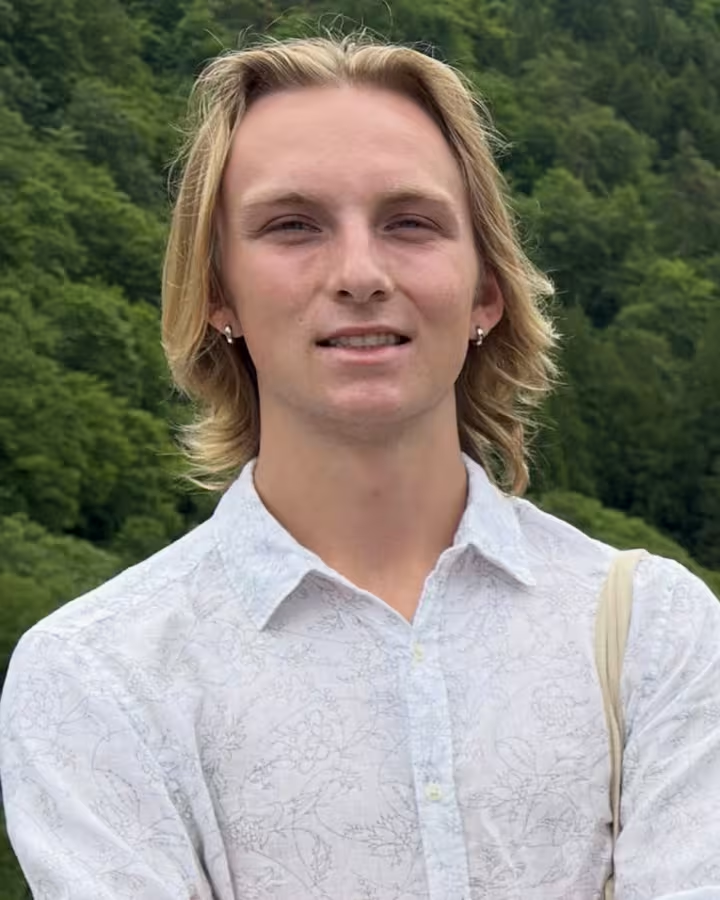
 Weston Higginbotham was found dead in a Kyoto area forest this weekend.
The death of 20-year-old Auburn University student Weston Higginbotham outside Kyoto, Japan, has sparked an outpouring of grief and reflection online. Higginbotham, who studied biosystems engineering and was known by family and friends as a passionate environmentalist, disappeared while traveling in Japan with his mother before his body was later found in a forested area near Kyoto.
His mother, Nancy Higginbotham, shared the news on Saturday that his body had been found by a volunteer search and rescue group.
Authorities have not publicly released a cause of the 20 year-old’s death, and speculation circulating online should be treated with caution. Yet amid the mourning, a deeper conversation has emerged about the emotional burden many young people carry as they confront climate change, technological disruption, and uncertainty about the future.
In some ways, Weston, a student at The Auburn University, has become a symbol of a generation wrestling with environmental and technological anxiety. Friends and family described him as deeply concerned about environmental issues. Reports also noted that he questioned the growing role of artificial intelligence in daily life, even reportedly disagreeing with his mother about her use of ChatGPT while planning travel.
 A forest in the Kyoto area. For illustrative purposes only.
For many older adults, artificial intelligence represents innovation, productivity, and opportunity. For many younger people, however, AI arrives alongside climate change, housing insecurity, political polarization, and economic uncertainty. Rather than seeing a future full of possibilities, some see a future that feels increasingly unstable.
One anonymous commenter on Reddit captured this sentiment:
“As someone who studied environmental science at university, the climate anxiety/grief is very intense. Doing four years of environmental education is extremely depressing, it’s one bleak stat another, it was mentally very challenging to be so deep into the topic, and was very isolating as other people just go on living their typical consumer lives and you learn more and more each year.
“Beyond that I think older generations are not understanding that AI is causing serious existential discomfort and despair about the future in many young people. Older people are excited to be hip to new technology. Many young people find it really fucking bleak, and that’s on top of an already very bleak picture of the future. Telling them to adapt to the inevitable is not the way.”
The comment resonates because it highlights something environmental educators rarely discuss openly: there is a difference between awareness and empowerment. For decades, environmental education has excelled at communicating problems. Students learn about rising temperatures, biodiversity collapse, ocean plastics, melting glaciers, species extinction, drought, flooding, and pollution. These are important realities that deserve attention.
But what if we have become so focused on describing the crisis that we have forgotten to teach solutions? I took environment classes at UofT in the 90s and graduated with a feeling of hopelessness for the planet and life that depends on it.
Children growing up in the 1980s often lived with the fear of nuclear war. Images of mushroom clouds and Cold War confrontation shaped a generation’s imagination. Today’s young people face a different set of fears. Climate change, artificial intelligence, and ecological decline dominate headlines and social media feeds, creating a constant sense that disaster is approaching.
Yet unlike previous generations, today’s youth are also surrounded by remarkable opportunities to build a better future.
Green hydrogen technologies are advancing rapidly (see Prologium IPO). Entrepreneurs are creating plastic-free packaging alternatives from seaweed, mushrooms, and agricultural waste. Circular economy businesses are designing products meant to be repaired instead of discarded. Secondhand fashion is becoming mainstream. Cities are experimenting with zero-waste systems. Renewable energy is now among the cheapest forms of electricity in many parts of the world. These developments rarely receive the same attention as catastrophe.
Environmental education should not become less honest. Students deserve to understand the seriousness of climate change and ecological degradation. But they also deserve to know that thousands of scientists, engineers, entrepreneurs, farmers, designers, and activists are actively building solutions. And that they can be a part of it.
Imagine an environmental curriculum that teaches not only what is broken but also how to fix it. Students could learn how solar panels are manufactured, how regenerative agriculture restores soil, how carbon-free steel is produced, how green hydrogen can decarbonize industry, and how local communities can reduce waste through repair and reuse.
The future is not something that simply happens to us. It is something we create. And these teachings should start in high-school or before.
As conversations continue about Weston Higginbotham’s life and legacy, perhaps one lesson stands out. A generation raised on warnings needs more than warnings. It needs pathways forward.
AloJapan.com