
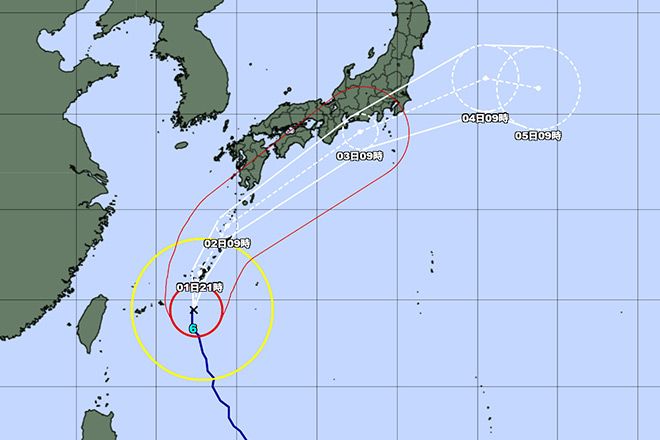
Powerful Typhoon No. 6 was expected to bring heavy rain and violent winds to Okinawa Prefecture on June 1 before veering toward the main Japanese islands of Kyushu and Shikoku.
The Japan Meteorological Agency has described the typhoon as particularly strong with an extensive area of potentially destructive winds.
Power outages and disruptions in air travel and transportation have already been reported in Okinawa Prefecture ahead of the typhoon’s arrival.
Some municipalities in the prefecture have issued evacuation orders, and shelters have been set up in various locations.
Naha Airport will remain closed for all of June 1. And bus services and the monorail on Okinawa’s main island were also suspended for the entire day.
The typhoon is expected to reach the Amami region of Kagoshima Prefecture on June 2, and then near the Kinki, Tokai and Kanto-Koshin regions on June 3.
The JMA is warning of heavy rainfall from 200 to 300 millimeters in Okinawa Prefecture and the Amami region.
Okinawa could experience winds with maximum sustained speeds of 126 kph and gusts reaching 180 kph. Winds this strong can overturn moving trucks or cause injuries from flying objects.
The agency also said strong winds and very rough seas are possible in and around the main island of Honshu.
At a news conference on May 31, the JMA and the transport ministry urged vigilance against storm surges, landslides and river flooding.
They noted that “Level 4: Urgent Warning” based on updated disaster prevention weather information that was introduced on May 28 could be announced for the first time.
Level 4 is the second highest on the five-level danger scale and corresponds to the stage at which local governments issue evacuation orders.
The typhoon surge warnings will likely remain throughout the night. The transport ministry is calling on people not to go out to check rivers or coastal conditions.
As of 10 a.m. on June 1, Typhoon No. 6 was located south of Okinawa, with a central pressure of 975 hectopascals. It was packing maximum sustained winds of 108 kph near its center and gusts reaching 162 kph.
It was moving northward toward Okinawa at a fairly slow speed of 15 kph—about the pace of a bicycle.
The JMA forecasts up to 300 mm of rain in the southern Kyushu, Okinawa and Amami regions over the 24-hour period until noon on June 2.
For the 24-hour period until noon on June 3, the agency forecasts up to 300 mm in the Kinki and Shikoku regions, and up to 200 mm in the Kanto, Tokai and Kyushu regions.
According to Okinawa Electric Power Co., a total of 4,260 households, mainly in cities such as Nago and Okinawa, were without electricity as of 11 a.m. on June 1.
Restoration work will begin only after the dangers posed by the typhoon have subsided.
All Nippon Airways Co. announced the cancellation of 104 flights arriving at and departing from Naha, Ishigaki and Miyako airports on June 1.
As of 8 p.m. on May 31, Japan Airlines Co. planned to cancel 71 flights, mainly those to and from Okinawa.
The Okinawa Expressway was closed between the Naha and Kyoda interchanges as of 11 a.m. on June 1.
After passing closest to the Okinawa and Amami areas, Typhoon No. 6 is expected to change course and accelerate northeast as it rides westerlies along the southern coast of Honshu.
It is forecast to maintain its strong intensity as it advances toward eastern Japan despite its increasing speed.
Additionally, as the typhoon moves northward, a front will approach Japan and may bring rainfall to some regions even before the typhoon arrives.
(This article was written by Wataru Netsu and Kazuyuki Ito.)
AloJapan.com