


Six-skewer yakitori set lunch. Photo: courtesy of Isehiro
Your browser does not support the audio element.
This audio is generated by AI, so pronunciation and expressions may not be fully accurate. The narration is only in English.
It All Began with a Four-Seat Counter

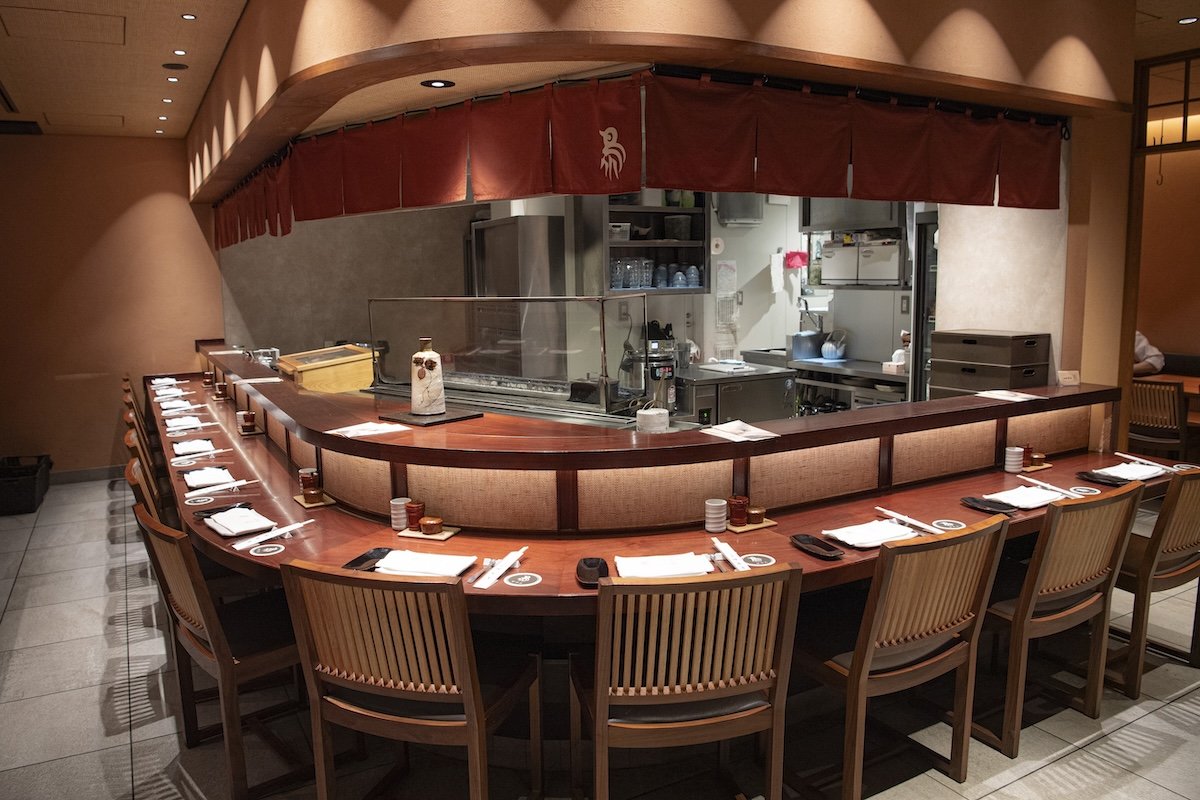
Hoshino Masanobu, proprietor of Isehiro, at the Kyobashi main restaurant, purpose-built for yakitori.
The foundations of present-day Isehiro were laid by its founder, Hoshino Akihisa, and his wife, Nao. Hoshino had worked at Isehiro, a chicken specialty shop in Nihonbashi Kakigaracho in central Tokyo, where he met Nao, the proprietress’s niece. After marrying, the couple were granted the right to carry on the name, and in 1921, they opened Kyobashi Isehiro.
While continuing their poultry business, Nao began skewering and grilling chicken for regular customers. This simple offering would mark the true beginning of Isehiro as a yakitori specialist.
It was the early 20th century, when the opening of Tokyo Station was transforming the city center. Amid these changes, the four-seat counter proved immensely popular, and before long, the yakitori side of the business came to surpass their original trade in chicken sales.
By the time the current proprietor, Hoshino, was born, the restaurant had already become a dedicated yakitori establishment. It was frequented by regular customers as well as chefs and suppliers. He grew up just across the street, where he was doted on by his grandparents—so much so that the three of them slept side by side each night.
“From the third-floor window, I could see the National Diet Building back then. I remember it looking like a robot—it felt a bit frightening,” Hoshino says with a nostalgic smile.
The name Kyobashi derives from the bridge’s position as the first crossing on the route from Nihonbashi—the starting point of the old Tokaido—toward Kyoto. As an officially designated bridge of the Edo shogunate, Kyobashi was adorned with giboshi, ornamental finials marking its status. In 1875, it was rebuilt as a stone arch bridge, later replaced by a steel arch. In 1922, it was reconstructed once again as a modern, Art Deco-style bridge. The original bridge posts from 1875 and 1922 have been preserved as cultural properties of Chuo City and now stand along Chuo-dori Street, linking Kyobashi and Ginza.
Situated between Nihonbashi and Ginza, Kyobashi is, Hoshino says with a laugh, a rather unassuming area. Yet it is also home to many long-established companies, where old and new overlap—long-standing businesses alongside cutting-edge enterprises—creating a cityscape that feels quintessentially Tokyo. It is not uncommon for regular customers to have been coming to Isehiro for three generations, dating back to its founding.

Kyobashi Isehiro was renovated into its current form in October 2020. Photo: courtesy of Isehiro
A Yakitori Course for Savoring the Whole Chicken
At a time when chicken was still relatively scarce, Isehiro devised a yakitori course that allows diners to enjoy every part of a whole bird. In seeking the best way to bring out the flavor of each cut, Hoshino’s grandparents developed these recipes through careful refinement—recipes that have been passed down to this day.
Among the most popular is Isehiro’s signature dango, made from seasoned minced chicken. Prepared without any binders, the meat is blended to a carefully balanced recipe, seasoned with salt to bring out its natural flavor, and accented with hemp seeds that add a popping texture.
Dango, Hoshino explains, allows diners to experience the full flavor of chicken in a single bite. The choice of cuts and how the meat is minced, he says, are what ultimately determine the taste.
Because it is so soft and easily loses its shape, shaping and grilling both require a high level of skill. Skilled chefs, it is said, can form uniformly sized dango by feel alone, with a margin of error of no more than two grams.
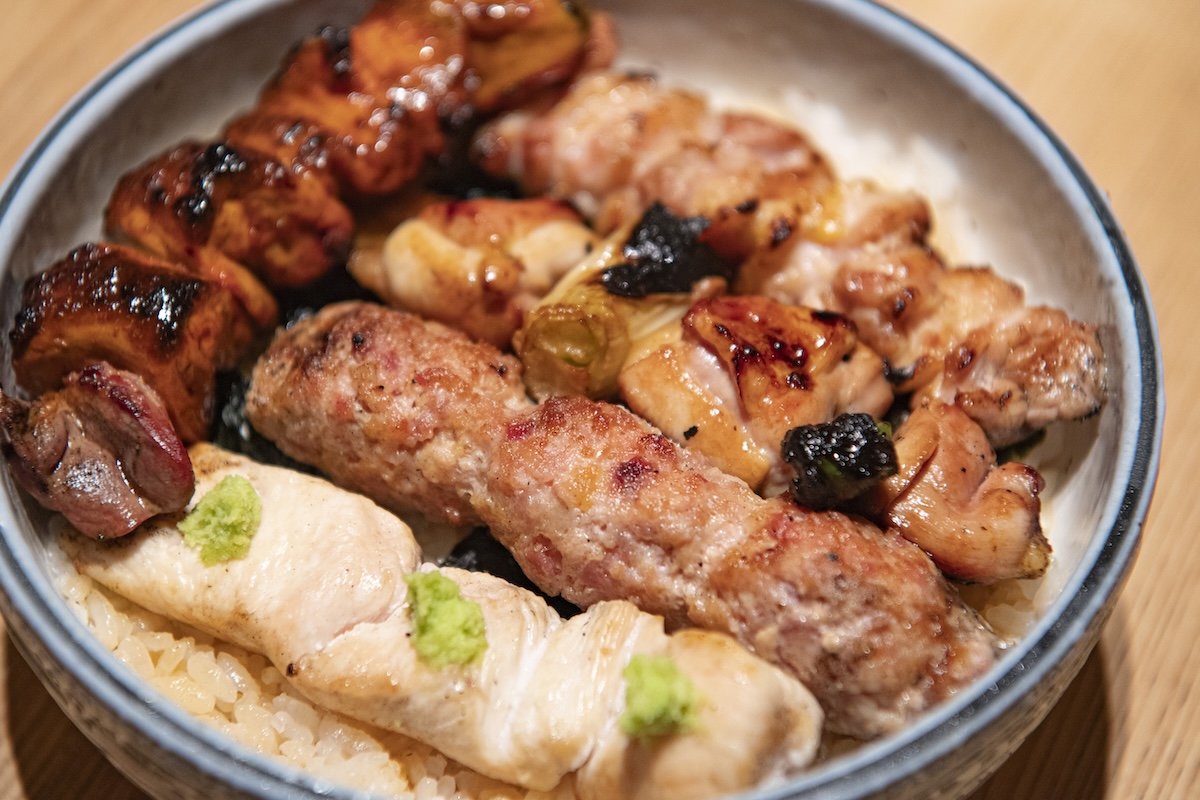
A lunch rice bowl topped with five yakitori skewers: from front, chicken tenderloin, dango, thigh, and skin, with liver at the back left.
Isehiro also offers a taste unique to the restaurant in its liver dishes. Carefully selected from roughly one in every hundred chickens, these well-developed livers have naturally accumulated fat, resembling foie gras. Rich and exceptionally fresh, they have no strong aftertaste, making them enjoyable even for those who are not fond of liver.
The only addition to the yakitori course devised by the founder is negi-maki, a skewer of thinly sliced chicken breast wrapped around a green onion, created by second-generation proprietor Hoshino Zenjiro in response to customers’ requests for vegetables.
Hoshino recalls that when he was still very young, around 1962, his father made an early version of negi-maki and let him taste it. When he told him it was good, his father was delighted.
The negi-maki is made with Senju green onions, an Edo-Tokyo heirloom vegetable. As their growth varies with the seasons, they are supplied to precise specifications for thickness and wrapping to ensure even cooking when grilled. The relationship with this supplier dates back to the founder’s time and has continued for decades.
<!— GalleryModal —>
×
<!— Gallery —>
<!— ▼▼画像開始▼▼ —>
<!— ▲▲画像終了▲▲ —> <!— ▼▼画像開始▼▼ —>

<!— ▲▲画像終了▲▲ —> <!— ▼▼画像開始▼▼ —>

<!— ▲▲画像終了▲▲ —> <!— ▼▼画像開始▼▼ —>

<!— ▲▲画像終了▲▲ —>
<!— ナビゲーションボタンの div 要素—>
<!— サムネイルエレメント注入箇所—>
Suppliers and Chefs at the Heart of the Craft
As Hoshino puts it, his family’s guiding principle was to value suppliers and chefs even above family. He recalls that when he was about three, he once spoke impertinently to one of the chefs and was sharply scolded by his father—normally a gentle man—for the first time.
Since its founding, Isehiro has followed a simple principle: never haggle and always pay the asking price. Once you bargain, suppliers will only bring ingredients that match that price from then on. As Hoshino puts it, “No matter how skilled the technique, you cannot make good yakitori without good ingredients.” At Isehiro, the quality of the chicken is the foundation of its flavor, and maintaining that quality depends above all on trust—between suppliers and the chefs who bring those ingredients to life.
Among those who have long supported the restaurant are chefs with more than fifty years of experience. As the saying goes, “Three years to learn skewering, a lifetime to master the grill,” and it takes at least 10 years to become a fully-fledged yakitori chef. Knife work, skewering, an instinctive feel for the charcoal, and grilling—each skewer reflects years of skill and experience.
Staying a Beloved Yakitori Restaurant
Continuously pursuing what customers want while delivering consistent quality—this, Hoshino says, is why he deliberately avoids becoming too set in his ways. He explains that a strong sense of commitment can at times narrow one’s perspective and bring both thinking and action to a halt.
One thing Hoshino never misses is the tasting he conducts before opening each day. He checks the color, shape, and flavor of the yakitori to be served, and immediately points out anything that seems off, not hesitating to be firm when necessary. On one occasion, he noticed that the gizzard pieces were uneven in size; by the next day, the issue had been corrected. By refining their knife work, the chefs were able to achieve consistent sizing regardless of the individual characteristics of the meat.
By adapting to changes in the times and in ingredients, and by staying focused on the taste at hand, Hoshino ensures that everything served under the Isehiro name meets its standards.
Following the renovation and reopening of its Kyobashi main restaurant in 2020, Isehiro will open a new location in Akasaka on April 1, 2026. As central Tokyo continues to evolve, the restaurant preserves its century-old flavor while continuing to take on new challenges.
For Hoshino, it is not a matter of logic but of intuition—a sense that “this will always work.” He sees this as part of what it means to devote oneself to a family business.
From an early age, Hoshino watched his grandparents and father discuss the running of the restaurant and observed their interactions with chefs and suppliers. Experiences like these, absorbed firsthand and deeply ingrained in him, may have shaped the unshakable confidence and clarity he displays today.
“Each day, I want everyone who visits Isehiro to leave saying, ‘That was delicious.’ It is by repeating that, day after day, that we have reached 100 years. If even one more person leaves thinking, ‘Chicken really is delicious,’ that, to me, is the greatest way to repay my grandparents,” Hoshino says.
As he speaks, Hoshino tastes the skewers prepared before opening, checking that the flavor remains unchanged. Unafraid of change and continually refining his craft, he nonetheless never wavers in the standards he upholds. That balance—between continuity and renewal—captures a distinctly Tokyo sensibility, where old and new coexist.
Interview and writing by Kato Natsuko
Photos by Inoue Katsuya
Translation by Luna Lys
AloJapan.com