
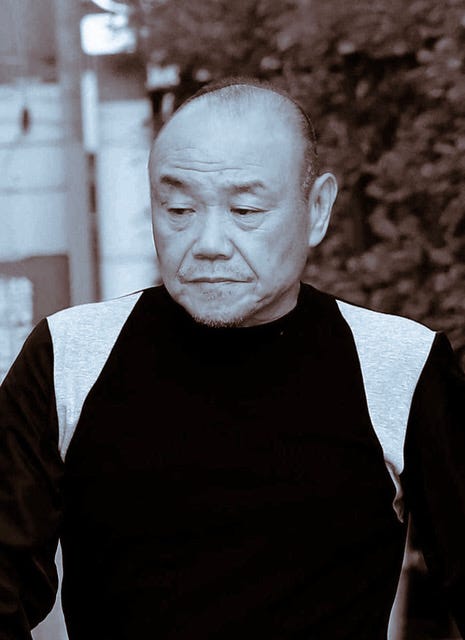
On the afternoon of May 12th, in an Osaka High Court Courtroom, Presiding Judge Ogura Tetsuhiro took roughly three minutes to shatter years of police work, shame the Hyogo Prefectural Police and Kobe District Prosecutors’ Office, and let a yakuza boss go free.
In Japan—where the conviction rate after criminal indictment is 99%— this was a stunning victory for the boss and his organization, the Yamaguchi-gumi, Japan’s largest organized crime syndicate.
67-year-old Nakata Hiroshi, the boss of the Yamaken-gumi (once the most powerful faction within the Yamaguchi-gumi) was not guilty. The Osaka High Court upheld the acquittal, supporting the Kobe District Court’s first ruling and rejecting the prosecution’s appeal.
 Nakata: an innocent yakuza boss?
Then, on May 27th, the curtain came down for good. The Osaka High Prosecutors’ Office declined to appeal to the Supreme Court before the May 26th deadline, making Nakata’s acquittal final. The spokesperson for the Osaka High Prosecutors’ Office offered a statement that must have been painful to compose: they had been “unable to find grounds for a legally valid appeal.”
This was nothing short of a miracle, especially in a Japan where prosecutors are taught that yakuza and gaijin have no human rights. (Joking! Sort of.) Almost no one saw the verdict coming because the equation is usually simple: yakuza accused of crime = guilty.
And with all due respect, that equation is probably true a great deal of the time.
The Shooting
In the evening of August 21, 2019, in Kobe’s Chuo Ward, a lone biker in a white full-face helmet and a black moped pulled up next to a car parked near a Kodokai affiliate’s building. The rider drew a gun and rapidly fired six shots into the vehicle. Five of the rounds struck a 51-year-old member of the Kodokai — a Nagoya-based faction that serves as the organizational spine of the sixth-generation Yamaguchi-gumi — nearly severing his right arm and leaving him with other injuries requiring six months of recovery. The shooter vanished into the dark of the Kobe evening on his bike.
In a country where annual shootings typically number in the single digits, this was a very big bang.
Japan is a nation of 122 million people. According to the National Police Agency’s official firearms statistics, in 2019 (Reiwa 1) there were 13 shooting incidents nationwide, causing 4 deaths and 8 injuries. Of those 13 incidents, 10 were attributed to the yakuza (暴力団) and other organized crime groups. (The remaining 3 were classified as “other or unknown.”)
It was one more murder in a gang war that had been simmering for over a decade.
The Yamaguchi-gumi split had been brewing since August 2005, when Kenichi Shinoda — better known by his yakuza name Shinobu Tsukasa — took power as the sixth-generation Yamaguchi-gumi boss. Tsukasa had previously founded the Nagoya-based Kodokai, and as his faction rose, Kobe-based groups found themselves systematically marginalized. Resentment pooled, then boiled. On August 27th, 2015, more than a dozen factions broke away to form the Kobe Yamaguchi-gumi, launching the largest split in Japan’s organized crime world in decades.
It was a year that should have been great for the organization: the Yamaguchi-gumi was celebrating their centennial as a gang. Founded in 1915, they had been in business for 100 years! And by all accounts, they were highly successful and still earning good money; they were Goldman Sachs with guns. The monthly yakuza fanzine, Jitsuwa Document (実話ドキュメント) even dedicated a special issue to the anniversary.
 A heartwarming tribute to the Yamaguchi-gumi
Yet, the HR decisions by the top dogs had triggered so much resentment that the split seemed inevitable. Not only did the Kodokai get all the plum organizational positions, lower ranking groups were relegated to odd menial tasks in addition to their regular dues, like being required to buy boxes and boxes of imported mineral water (allegedly Volvic).
The Yamaken-gumi, historically one of the most powerful Kobe-based organizations in the original Yamaguchi-gumi, became the new breakaway’s core faction.
The split triggered a series of violent confrontations: shootings, vehicle attacks, and intimidations across multiple prefectures. There were 49 incidents reported in 20 prefectures in just the first seven months. Police officially declared it an ongoing feud in March 2016. The Yamaken-gumi, straddling the front lines of this institutional war, bore the brunt. Just four months before the August 2019 shooting, the Yamaken-gumi’s then-wakagashira (its number two) had himself been stabbed by a Kodokai-affiliated member, a sign of how personal and escalating the violence had become.
Then came the shooting. By the time the smoke cleared, authorities had made up their mind about who was responsible. In December 2019, Nakata was arrested as the alleged shooter and charged with attempted murder and weapons violations under the Swords and Firearms Control Law. The arrest sent shockwaves through yakuza society.
This wasn’t business as usual. In these gang wars, it’s almost always the underlings who do the dirty work. But in this case the cops were alleging that the boss of the Yamaken-gumi, the top dog himself, had strapped on a helmet and personally pulled the trigger.
Some speculated that with the average age of a yakuza member now being 56-years-old (I’m 57) there was no one willing to die in jail for killing a rival gangster. With Japan’s strict gun laws, which forbid ownership of a gun or even bullets, and where shooting at someone will almost always be prosecuted as murder (or attempted murder, if you fail to finish them off) — firing a pistol at someone means you are likely to be sent to “the pig-box” for 20 years at least.
And there’s no guarantee that your organization will be around to take care of you when you get out.
Just to emphasize the point, shooting a rival gang boss is not a job for the boss.
What Bosses Usually Do When They Want Someone Gone
When Tadamasa Goto, (Yamaguchi-gumi Goto-gumi) wanted a real-estate broker killed for blocking the sale of a property he wished to acquire, he most certainly didn’t do the job himself. On the night of March 5, 2006, three of his underlings chased KazuokiNozaki down a street in Kita-Aoyama, Minato Ward, Tokyo, and stabbed him to death. The Tokyo Police were almost certain that Goto had ordered the hit but they failed to get him.
The getaway driver, Yamamoto Masayuki, was arrested in December 2010 and sentenced to 13 years. The man who wielded the knife, Kondo Takeshi, had fled abroad after the murder. The police issued an international arrest warrant. He kept moving through China and across Southeast Asia — and was shot dead in the mountains of northern Thailand on April 26, 2011, before he could stand trial. Police suspected that the man who gave the direct orders, Goto-gumi affiliate boss Hideya Matsumoto, may have arranged Kondo’s death to silence him.
Matsumoto was arrested in October 2011 and eventually sentenced to life in prison. But Goto was untouchable.
The family eventually sued Goto Tadamasa under the doctrine of employer liability (使用者責任). Goto paid them approximately ¥110 million (at the time, roughly $1.4 million USD), and apologized. Then he fled to Cambodia and set up a new criminal empires.
$1.4 million. That’s still pretty much the cost of getting away with murder in Japan as a yakuza boss. He gets away with it because he’s like a CEO: he’s almost never doing the work of the foot soldier.
So you can see why Nakata doing the hit himself, if he did, came a a surprise.
It would be like the head of United Healthcare, walking into a hospital and personally pulling the plug of someone on life-support, rather than letting the branch managers kill the patient by denying treatment.
The Trial, the Silence, and the Surveillance Camera That Wasn’t Enough
Nakata’s approach to the proceedings was a masterclass in the only yakuza legal strategy that has ever consistently worked in Japan: say nothing. Throughout the trial, Nakata maintained complete silence, refusing to answer questions meaningfully during defendant examinations. The defense, mirroring this approach, did not present new exculpatory evidence but instead attacked the weaknesses in the prosecution’s case.
The prosecution’s case rested almost entirely on circumstantial evidence, particularly what they called a “relay analysis.” They stitched together footage from multiple security cameras in sequence to track the suspect’s movements. Prosecutors argued that the suspect’s clothing matched Nakata’s. But the Kobe District Court ruled that it could not exclude the possibility that another person had committed the crime. The court’s language was careful and devastating: it found that while the defendant might well be the perpetrator, it could not say so with certainty sufficient to convict. The ruling held that the person visible in the CCTV footage and Nakata could not definitively be declared the same individual — “the possibility that the perpetrator was a different person cannot be excluded.”
The Osaka High Court looked at the prosecution’s appeal, rejected all 65 pieces of new evidence the prosecution submitted, closed the session in three minutes, and ruled the same day. Three minutes. The prosecution spent years building a case that a high court dismantled in less time than it takes to drink a hot matcha latte.
The prosecutors demanded 20 years. They got nothing.
Nakata is now a free man in every legal sense of the word — which, for someone who runs one of Japan’s most powerful criminal organizations, means something rather different than it does for you and me.
The acquittal carries institutional weight. By December 2025, Nakata had already been attending the Yamaguchi-gumi’s year-end ceremonial gatherings alongside top leadership, including Tsukasa himself. In the tribal culture of the yakuza, a boss who went through years of detention, maintained total silence throughout two trials, and emerged without a conviction has earned something closer to legend status than mere exoneration.
What he will not escape is ongoing scrutiny. Japanese organized crime law — specifically the bōtaihō, the anti-organized crime exclusion statutes — continues to constrict yakuza operations financially. The war that spawned this shooting has largely wound down. The Kobe Yamaguchi-gumi, which had 2,800 members at the time of the 2015 split, had dwindled to only 120 members by the end of 2024. (My book The Last Yakuza is, at large, about the decline of the yakuza.)
The Yamaken-gumi, the faction that was the heart of the rebellion, returned to the main Yamaguchi-gumi fold in 2020. Nakata went with it. The Yamaguchi-gumi unilaterally declared victory last year and called off the war. The acquittal is just a postscript.
The Hyogo Prefectural Police and Kobe District Prosecutors’ Office will move on, publicly. Privately, this stings. The Japanese police rarely bring charges they don’t expect to win. A conviction rate north of 99 percent is not an accident — it reflects a charging philosophy that borders on the paranoid, an institutional refusal to indict unless the outcome is already considered settled. Nakata’s acquittal, twice, is the kind of result that gets people transferred to the courts of frozen Akita Prefecture.
The Bigger Question: Should Prosecutors Even Get a Second Chance?
In most common law countries, double jeopardy protections mean that an acquittal is an acquittal — the state cannot keep trying to get the verdict it wants. Japan bans double jeopardy in the strict sense: the Code of Criminal Procedure does not permit retrials against a defendant’s interests after a final judgment. But there is a carve-out, and it is a significant one. In Japan, the prosecution retains the right to appeal an acquittal through the standard appellate process, up through the High Court and to the Supreme Court.
Simply put, the accused can be acquitted and still the state can simply try again at a higher level, using largely the same evidence.
Legal experts have long debated whether this should change, particularly since the introduction of the lay judge system in 2009, which placed ordinary citizens in the deliberating room for serious criminal cases. The Supreme Court itself said in 2012 that appellate courts must provide concrete reasons to override a lay-judge acquittal, but critics say that standard has been applied inconsistently and erodes the meaning of citizen participation.
The Hakamada case — in which a man spent nearly half a century on death row for a crime he didn’t commit, and where prosecutors fought every step of his eventual exoneration — pushed reform advocates to renew calls for limiting prosecutorial appeals of acquittals, especially in lay judge trials. Japan’s parliament has taken incremental steps toward reviewing the retrial system following Hakamada’s 2024 exoneration. But in the conservative world of Japanese politics, substantive limits on prosecutorial appeals remain politically toxic.
The Justice Ministry, the National Police Agency, and the prosecutors’ guild are not going to support legislation that limits their own power. In Japan, as in most places, institutional reform that requires institutions to voluntarily constrain themselves proceeds at roughly the speed of the great-grandmother in front of you at the Family Mart. Legal scholars will write papers. Defense attorneys will give speeches. Bar associations will issue statements. Diet members will nod thoughtfully during committee hearings. And then nothing will change.
What the Nakata case adds to this conversation is an uncomfortable data point: the lay judge panel that acquitted him in 2024 reached a reasonable verdict based on the evidence presented. The Osaka High Court agreed. The Supreme Court was not even asked to weigh in because the prosecutors themselves, in the end, couldn’t construct a legally sufficient basis for further appeal. The system, in this case, worked. That’s the argument reformers will use; it’s also the argument the prosecutors’ office will use to claim no reform is needed.
In the Zen tradition, we talk about the concept of: mu — nothingness. But sometimes, it’s just a code word for the absence of something expected. For the Japanese state, which has rarely met a yakuza defendant it couldn’t convict, the Nakata acquittal is precisely that. Two trials. Two courts. One result.
Mu.
The Yamaguchi-gumi, for its part, will hold its December ceremonies as planned, the boss of the Yamaken-gumi attending in full formal wear, untouched by the law. The police will keep watching. The prosecutors will find other cases to build. The debate over reforming the appeal system will continue in law review articles that most Diet members will not read.
And Nakata Hiroshi, 67 years old, walks free. Maybe this time that’s a sign of progress.
We’ve been being crossposted, so by way of introduction: Jake Adelstein is an investigative journalist, author of Tokyo Vice, The Last Yakuza, The Devil Takes Bitcoin, Tokyo Noir and the upcoming Code Blue. He is also a contributing editor at Japan Subculture Research Center. He has been covering Japanese organized crime for over 30 years and has been a low-ranking, bumbling Zen Buddhist priest for nearly a decade.
Reference for anyone curious about Japanese reporting on the story
Nikkei Shinbun
ビル管理元役員殺害容疑で組幹部を逮捕
2011年10月20日 13:27
東京都港区の路上で2006年3月、元ビル管理会社役員の野崎和興さん(当時58)が刺殺された事件で、警視庁組織犯罪対策4課は20日、埼玉県八潮市八潮7、山口組旧後藤組(現良知組)系幹部、松本英也容疑者(52)を殺人容疑で逮捕した。同課によると、松本容疑者は事件の指示役で、「弁護士と相談してから話す」と話している。
逮捕容疑は06年3月5日午後9時45分ごろ、港区内の路上で野崎さんの背中などを刃物で刺し殺害した疑い。旧後藤組は当時、渋谷区の雑居ビルの所有権を巡り、管理していた野崎さんの会社とトラブルになっていた。
同課は昨年12月、殺害に関与したとして逃走車両の運転役とみられる旧後藤組系の組員を殺人容疑で逮捕。別の組員も共犯として国際手配したが、今年4月にタイ北部で殺害されていたことが判明している。同課はこの組員の殺害も松本容疑者が指示していた可能性があるとみて調べている。
ビルを巡っては刺殺事件後の06年5月、ビルの所有権登記を不正に移転させたとして、旧後藤組組長の後藤忠正被告らが電磁的公正証書原本不実記録・同供用容疑で逮捕、起訴された。東京高裁は昨年5月、後藤被告に懲役2年、執行猶予4年の有罪判決を言い渡し、後藤被告側が上告中。
AloJapan.com