
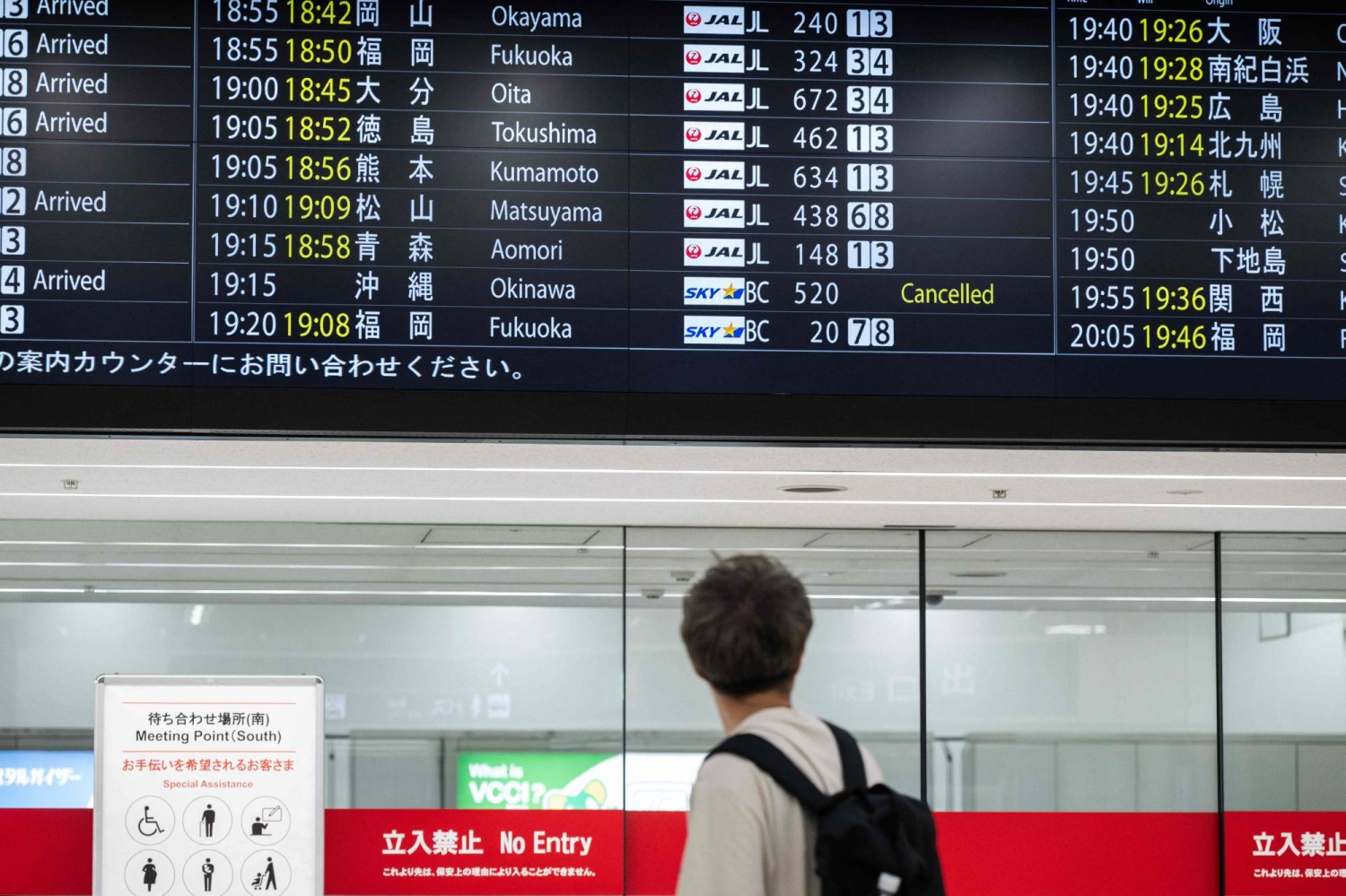
Tropical Storm Jangmi was bearing down on Kyushu on Tuesday, and was expected to bring heavy rain and strong winds across the region and into Kanto through Wednesday, according to the Meteorological Agency.
The storm injured at least 16 people Tuesday and left nearly 48,000 homes in Okinawa and Kagoshima prefectures without power, local media reported.
As of 4 p.m. Tuesday, the storm — known in Japan as taifū No. 6 — was located about 30 kilometers north of Tanegashima, and moving northeast at a speed of 35 kilometers per hour with a central pressure of 980 hectopascals. It was packing, with sustained winds near the center of up to 25 meters per second and gusts up to 35 meters per second.
In the city of Nichinan, Miyazaki Prefecture, a level 4 flood warning was issued for the Hiroto River after heavy rains caused water levels to rise dangerously high. Under a level 4 flood warning, everyone in a risk zone is urged to evacuate.
It was the first time a level 4 warning had been issued since a new system was put in place Thursday.
According to NHK, Kagoshima and Okinawa prefectures saw partial damage to at least 15 buildings, flooded roads, fallen trees and other objects blown down by the storm.
Chief Cabinet Secretary Minoru Kihara told reporters Tuesday that power outages had affected nearly 48,000 households in Kagoshima and Okinawa prefectures, while transport networks, including expressway routes and rail lines, had been disrupted.
A total of 331 flights, mainly to and from the Kyushu region, were canceled Tuesday. Ferry and other maritime services were also affected, with 64 routes operated by 57 companies suspended in the Kinki, Shikoku, Kyushu and Okinawa areas.
Kihara said the government was working closely with local authorities to provide information, gather damage reports and carry out emergency disaster response operations.
He also warned that transportation in the Tokyo metropolitan area could be disrupted from Wednesday morning.
“In areas affected by the storm, we ask people to pay close attention to evacuation information issued by local governments, evacuate early where necessary and remain vigilant while taking action to protect their lives,” he said.
The agency has warned of violent winds, high waves, storm surges, landslides, flooding in low-lying areas and rising or overflowing rivers in affected areas.
The typhoon was expected to gradually change its course eastward and, while maintaining similar strength, was approaching the Amami Islands and southern Kyushu Tuesday night. It was then forecast to move northeast along the southern coast of Honshu, with rain and winds peaking in the late hours of the night in Shikoku, Kinki and Tokai, and in the Kanto region during morning commuting hours Wednesday.
Because well-developed rain clouds are located north and east of the storm’s center, heavy rain is expected across a wide area even before the center approaches, and very strong winds are possible even outside the center. Some areas could see torrential downpours.
In the 24 hours through 4:50 p.m. Tuesday, a rain gauge in the town of Tano, Miyazaki Prefecture, recorded 304.5 millimeters of heavy rain, the most on record for the area for the month of June.
In the 24 hours through Wednesday morning, rainfall is forecast to reach up to 350 mm in the Tokai and Kinki region; 300 mm in the Izu islands; 250 mm in Shikoku; 200 mm in northern Kyushu and Kanto-Koshin; and 180 mm in southern Kyushu.
In the following 24 hours through Thursday morning, up to 150 mm of rain is expected in the Kanto region, while the Tohoku area could see 100 mm.
Seas are expected to become extremely rough, with swells. Wave heights on Tuesday are forecast to reach 9 meters in southern Kyushu and the Izu Islands and 8 meters in Amami, as well as in the Shikoku, Tokai, Kinki and Kanto regions.
AloJapan.com