
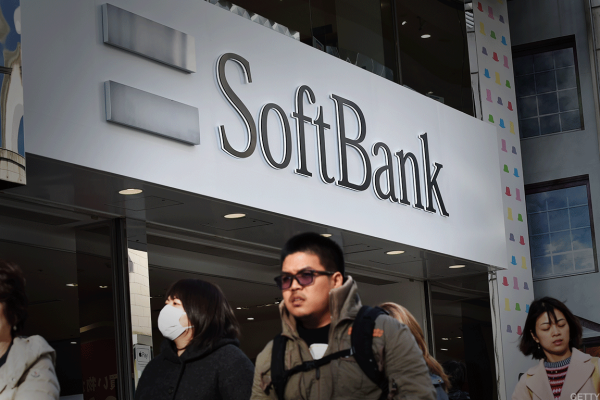
There’s a changing of the guard in Japan, where SoftBank Group (SFTBY) (T:9984) has replaced Toyota Motor (TM) (T:7203) as the largest company in the country, a shift that reflects the broader reshaping of the investment landscape in East Asia.
SoftBank, whose founder Masayoshi Son says he is “all in” on artificial intelligence (AI), has a market capitalization equivalent to $308 billion. What started as a prosaic software distributor has morphed into one of the world’s largest tech investors.
SoftBank shares have almost doubled this year, up 96.2% as of Tuesday’s Tokyo close at a record high of ¥8,632 per share. They are on Tuesday bucking the general downward move for Asian markets to end up 1.1% at yet another all-time closing high.
Toyota shares, on the other hand, are down 15.3% so far in 2026, leaving the company with a market cap of $234 billion. Their peak came in March 2024, just before U.S. President Donald Trump started his war on trade by imposing hefty U.S. import taxes on goods.
Tesla Sells 14% of Toyota Vehicle Count
Toyota remains the world’s second-largest carmaker by market size. It pales in comparison to Tesla (TSLA), however, given Tesla’s $1.6 trillion market cap, even though Toyota sold 11.5 million vehicles globally to the 1.64 million sold by Tesla.
It is a further indication of the changing nature of Asian markets that the Japanese chipmaker Kioxia Holdings (KXIAY) (T:285A) has also moved past Toyota at the same time as SoftBank. Kioxia has seen its shares shoot 643.1% higher in 2026, making it the second-biggest listing in Japan.
This is actually not the first time that SoftBank has stood atop the corporate pile of “Japan Inc.” It briefly eclipsed all other Japanese companies in February 2000, at the peak of the dot-com tech bubble, only for its shares to plummet some 98% by the end of that year. It has taken two and a half decades for it to regain that lost ground.
Toyota itself moved past the telecom firm NTT Docomo, which was subsequently taken private, to become the largest Japanese corporation in 2003.
SoftBank Seeking Spinoffs
There are better underpinnings for SoftBank’s rise this time around, while its shares remain at risk should the current spate of AI investment prove to be another bubble.
SoftBank got a jolt on Monday after the company pledged to invest up to €75 billion ($87 billion) to build out a network of data centers in France, the largest such commitment to AI infrastructure in Europe.
SoftBank also holds 87% of the shares in British chip designer Arm Holdings (ARM), which have almost quadrupled in 2026 with a 288.6% advance. Arm’s designs function in just about every smartphone on the planet, and the company is starting to make its own chips after licensing its tech to the likes of Nvidia (NVDA) and Apple (AAPL).
The Japanese tech investor would like to replicate the Arm success with further listings. It has reportedly hired investment banks to prep an initial public offering of Roze, an AI-infused robotics unit that it wants to spin out, as I outlined in a column early last month.
Data-Center Listing for SB Energy
SoftBank is already a partner of OpenAI and Oracle (ORCL) on the Stargate initiative. OpenAI and SoftBank are each investing $500 million into SoftBank subsidiary SB Energy, which is building a data center in Texas that’s one of five AI sites that Stargate intends to operate. SoftBank has already invested $30 billion directly into OpenAI and committed to another $30 billion stake.
SoftBank, Open AI and Oracle are also building out AI infrastructure in Abu Dhabi, alongside Cisco Systems (CSCO) and local cloud-computing and AI operator G42. It’s interesting to see SoftBank and Cisco mentioned in the same breath, since Cisco briefly became the world’s largest company by market cap in 2000, just as SoftBank ranked largest in Japan.
SoftBank is also looking to list SB Energy as a separate entity. Any cash SoftBank raises through SB Energy or Roze IPOs would help bolster a balance sheet that SoftBank has been leveraging to place extremely expensive bets on AI.
Korea, Japan, Taiwan at All-Time Highs
The gains in tech shares have seen markets in South Korea, Japan and Taiwan all set fresh all-time closing highs this week, driven in large part by gains in technology companies, in particular semiconductor stocks. Japan eased off its Monday record today, although Korea and Taiwan advanced yet again.
Korea’s Kospi benchmark is the top-performing index in the world this year, doubling with a 108.9% year-to-date gain.
The gains in South Korea are turbocharged by the stellar showing of Samsung Electronics (KR:005930) and rival SK Hynix (HXSCL) (KR:000660), both companies that make the High Bandwidth Memory chips that power the infrastructure behind AI systems.
The numbers are remarkable, with Samsung shares up 200.7% in 2026, and Hynix up 262.5%. Hynix shares are 10 times their value at the start of 2025.
Likewise, Taiwan Semiconductor Manufacturing Co. (TSM) (TW:2330) is up 53.5% this year and is triple the price it set in April 2025. The chip foundry market leader has propelled gains in the Taiwan market, where it accounts for around 43% of total market capitalization.
Members of the $1 Trillion Club
The gains have propelled TSMC, Samsung and Hynix past the $1 trillion mark. TSMC is now Asia’s most-valuable company, at $2.3 trillion in market cap, good for seventh-place worldwide. Samsung at $1.6 trillion just moved past Tesla and Meta Platforms (META) into ninth place, and Hynix is No. 13 worldwide in terms of market cap, at $1.1 trillion, just behind U.S. rival Micron Technology (MU).
While Samsung and Hynix account for exactly half the total market capitalization of the 818-company Kospi, they’ve got an assist from the likes of consumer-electronics specialist LG Electronics (KR:066570), which has spiked 178.6% since the end of April.
Nvidia CEO Jensen Huang is is currently in his native Taiwan for the Computex conference. He’s due to then travel to South Korea this week, with meetings scheduled with Hyundai Motor (HYMTF) (KR:005380), LG Electronics, Samsung and Hynix. He already met with Taiwanese companies including TSMC, Foxconn Technology (FXCOF) (TW:2317), Quanta Computer (QUCCF) (TW:2382) and Wistron (TW:3231), and held a “Korea Partner Night” in Taiwan.
The chatter suggests that Huang wants to meet LG Group chairman Koo Kwang-mo to discuss a partnership with LG Electronics around the creation of “physical AI,” leaning on the company’s device-manufacturing prowess to bring AI into the real world.
Shares in Naver (NHNCF) (KR:035420), operator of the largest Korean search engine, are up 41.1% since last Wednesday’s close, based on Huang’s scheduled meeting with its top executives on Friday.
The “Nvidia effect” has considerable spillover for Asian tech companies. Hyundai Motor shares are up 145.9% this year after it in March expanded a partnership with Nvidia to work on robotics, autonomous-driving systems, and a massive AI data center that the Hyundai Group has announced in Korea.
AloJapan.com