
![The "stagnation" of Umeda was purified, revealing the history of the land: MR experience event "Blooming Park" [On-site report]](https://www.alojapan.com/wp-content/uploads/2026/06/3f79e2a5a88e44e5d6448717c344f066-kix.9x3x6pfu14hf.webp "The “stagnation” of Umeda was purified, revealing the history of the land: MR experience event “Blooming Park” [On-site report]")
From May 15th to 17th, 2026, the MR (Mixed Reality) experience event “Blooming Park ~Exploring and Playing Through the Memories of the City~” was held at Grand Green Osaka Umeda Park. Admission was free, and devices were provided by staff, so you could participate empty-handed.
Having experienced all sections over two days, I will report on my experience.
■ Devices used and how the experience works
The device used was the Meta Quest 3S. This device is characterized by its ability to provide a so-called MR (Mixed Reality) experience, where real and virtual objects appear to merge. At this event, we were able to enjoy a variety of things, from content that allowed us to immerse ourselves in virtual space to effects that made the city scenery look more vibrant.
 ▲ Reception area with Meta Quest 3S units available for loan.
All operations are controlled by hand tracking—your hands themselves become the controller. You can operate it simply by moving your hands intuitively, so even beginners have no worries.
Furthermore, the design allows up to 30 people to participate simultaneously, enabling them to share the same experience in real time with those around them. This meant that friends and family could participate together and share the same emotional experience.
■ “The more you play, the cleaner the city becomes” – The concept of purifying stagnation
Before we delve into the details of each section, let me introduce the core concept behind this event.
According to the organizers, the overall theme of “Blooming Park” is the purification of the “stagnation” that has accumulated in Osaka’s Umeda district. The event’s theme perfectly aligns with the formation of the Yodo River, where three rivers merge and sediment continues to accumulate. The main focus of the experience is on resolving the “bugs” in the city through the game.
The area where Grand Green Osaka currently stands has undergone significant transformations over many years. Once the bottom of the sea, it eventually became a low-lying wetland, and during the Edo period, it was home to the Umeda Cemetery, one of Osaka’s seven major cemeteries. Since the Meiji era, it has served as a railway freight terminal, becoming a hub for logistics.
The game gradually resolves this accumulation of history—this “stagnation”—through gameplay. Defeating enemies, loading cargo onto trains and sending them off, transferring will-o’-the-wisps to lanterns, and bringing fish back to the ancient sea—the intention to relive the history of Umeda is incorporated into the game design of each section. The concept word is “The more you play, the clearer the town becomes.” Knowing this beforehand will allow you to enjoy the game in a completely different way.
■Learn about the history of Umeda while having fun
Now, let’s introduce the content we were able to experience in each section.
We were greeted by a fox and a torii gate.
 ▲ This fox will greet you when you put on the headset.
The first thing that catches your eye when you put on the headset is a red fox and a torii gate. The Japanese aesthetic, while virtual, is stylish and effectively builds anticipation for the experience that is about to begin.
Furthermore, the initial interactive content was a simple one where you manipulated blocks floating in space with your hands, serving as a warm-up to get a feel for hand tracking. I was impressed by the careful design that allowed users to experience the sensation of “being able to use their hands” right from the start.
That labyrinthine underground shopping area has been transformed into a dungeon! “Umeda Dungeon”

“Umeda Dungeon” is a game where you fight wielding swords in both hands. The name is said to originate from the fact that Umeda’s complex underground shopping area has long been described as a “labyrinth.” It truly recreates an RPG dungeon, and you fight monsters using swords. This section is based on the concept of defeating the symbols of “stagnation” that lurk in the dungeon.
I was able to experience this with someone I happened to meet at the venue, and this section was especially fun. The experience of picking up a sword, facing your opponent, and moving while reading the distance and timing gave me a strong sense of “fighting together,” and I think it best showcased the advantages of real-time multiplayer.
Rescue the captain trapped in the barrel.
 ▲ A section where you stab a sword into a giant barrel AR object to free the trapped captain.
A giant AR object resembling a barrel suddenly appears before you—this section involves stabbing a sword into the trapped captain to help him escape. It’s a game everyone’s familiar with. The moment I hit the right sword, the captain flew high into the air, and I couldn’t help but let out a cry. It’s a simple game, but the satisfying reaction was really well-crafted.
The ghosts dance in Umeda Cemetery
 ▲ When you light the lanterns, the ghosts begin to dance.
The current Umeda area is the site of Umeda Cemetery, one of the seven major cemeteries of Osaka during the Edo period. It functioned as a funeral area adjacent to an execution ground and is also the origin of the cultural custom of “visiting the seven cemeteries,” which continued until the Meiji era. I was genuinely surprised to learn that this was the kind of place it was, as I would never have imagined it just by walking around Umeda Kita Park.
When you try it out, you see tombstones and lanterns lined up, with will-o’-the-wisps floating around. When you grab one of the will-o’-the-wisps and hold it up to a lantern, the flame lights up, and the ghosts begin to dance around the tombs—that’s the effect. This section is a game that directly embodies the concept of purifying “stagnation” with light. The interaction felt rather simple, but in terms of matching the historical context with the experience, it was a scene that was very much in line with this event.
A crane game that evokes the image of Umeda when it was a cargo terminal.
 ▲ A crane loads a cargo container suspended in mid-air onto a train. In the background is the Umeda Kita Park, which is currently under construction.
Personally, this was the part of the event that got me most excited.
Operate a crane to load cargo containers onto a train and make it depart—the gameplay is simple, but the backdrop is the realistic scenery of Umeda Kita Park, where construction is still ongoing. ▲ The current state of Umeda Park as seen from the experience area. This was once a freight terminal.
It was only about 10 years ago that Umeda Kita was a railway freight terminal. I never actually saw it in person back then, but as I watched the containers being moved by crane against the backdrop of the actual park scenery, I was suddenly overwhelmed with the realization that “this really was that kind of place.” Other sections also use history as a motif, but this is the only place where the current scenery and memories of the past overlap so realistically. It was an experience that made me feel incredibly close to history.
The sky above Umeda is turning into the deep sea!?
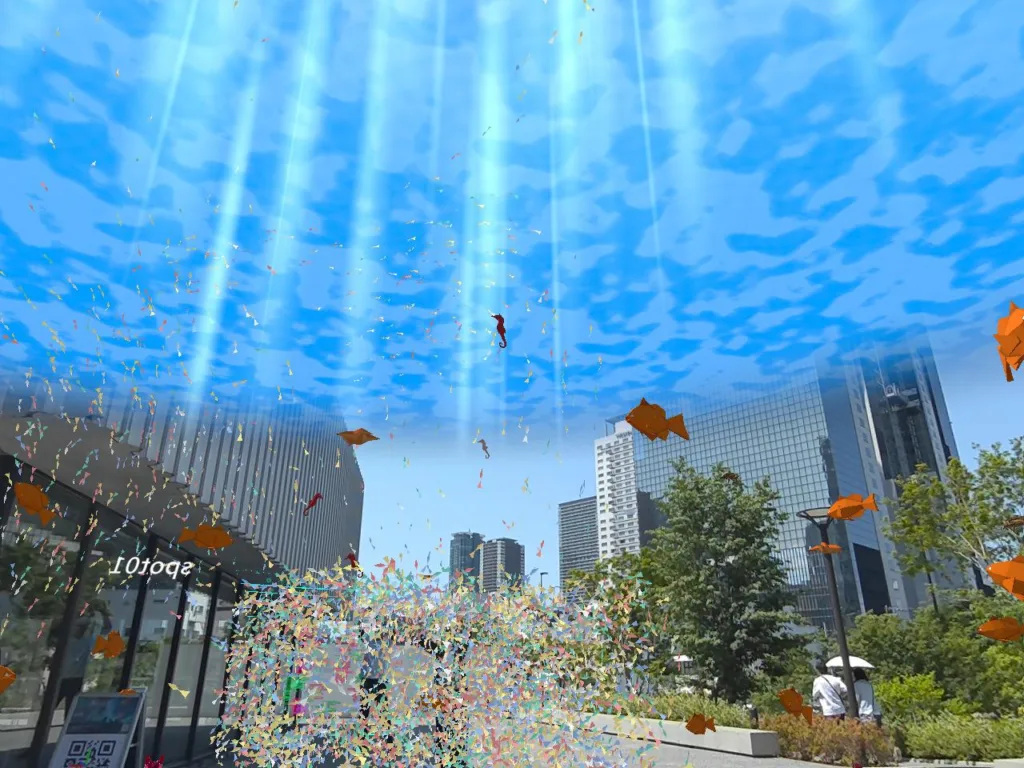 ▲ Looking upwards, the deep sea unfolds. Rays of light stream in, and marine life swims.
Looking up, you get the feeling of being at the bottom of the ocean in the deep-sea section. Your feet remain in the real world, but the sky becomes a virtual deep-sea—a hybrid design. The images of fish and marine life swimming in the light-filled water are very fantastical, and the experience makes you feel the story that Umeda was once at the bottom of the sea. This section involved “purification,” where you move the fish to restore the appearance of the ancient ocean.
Fireworks ending
 ▲ The fireworks display that capped off the event. It gave me a feeling of liberation, as if all my worries had been lifted.
After completing all sections, fireworks were launched as the finale. The spectacle of fireworks filling the sky was reminiscent of the Yodogawa Fireworks Festival, and it was a satisfying way to conclude the entire experience.
The context of Umeda revealed through MR
What I realized again after experiencing “Blooming Park” is how well the fun of the game and its historical context are intertwined.
Each section can be enjoyed as a standalone game, but understanding the concept of “purifying stagnation” changes the meaning of each experience. You can enjoy it without knowing the concept, but you can enjoy it even more deeply if you do. I felt that this kind of design was well done for an event aimed at a wide range of people.
Of all the sections, the cargo crane section stood out to me personally as an experience where real-world scenery and historical facts directly intersected. I felt like I saw one answer to the question of “using modern technology to let people experience history.”
With features like controller-free hand tracking and multi-user support for up to 30 people, there were many technical highlights. It had been a while since I’d experienced a device like this, but I was amazed at how much is possible with current MR technology. Being able to experience all of this for free was truly a great deal.
Since the Kansai Expo, we can expect to see an increasing number of hands-on events utilizing cutting-edge technology. I’m already looking forward to seeing what kind of experiences and locations we’ll encounter next.
Event Name
Park Blooming ~Exploring and playing amidst the town’s memories~
schedule
Saturday, May 16th and Sunday, May 17th, 2026
place
Grand Green Osaka North Building JAM BASE Multi-space
Organizer
Sakura Internet Inc., U.S. Co., Ltd.
Co-sponsored
JAM BASE
cooperation
Umeda MMO (General Incorporated Association)
URL
https://peatix.com/event/4976229
AloJapan.com