
image:
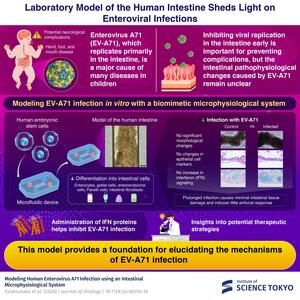
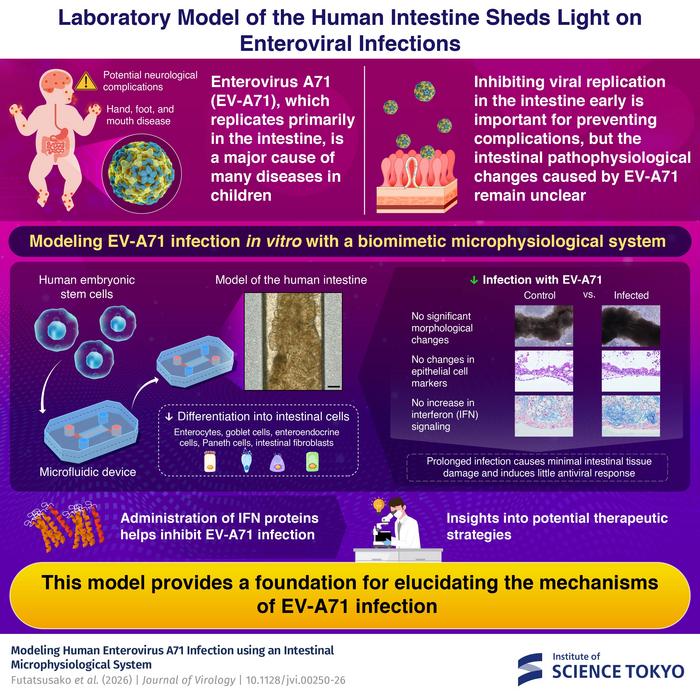
The proposed system will help researchers build a deeper understanding of the pathogenesis of enterovirus A71 infection, hopefully leading to effective treatments.
view more
Credit: Institute of Science Tokyo
A miniaturized, biomimetic model of the human intestine successfully reproduced long-term enterovirus A71 (EV-A71) infection, report researchers from Science Tokyo. Using this innovative platform, they shed light on how this virus grows in the intestine without triggering a strong immune response. Their findings could help develop effective treatments for EV-A71 infectious diseases.
Enterovirus A71 (EV-A71) is a widespread virus that primarily infects infants and young children, often causing conditions such as hand, foot, and mouth disease. Most children who get infected experience only mild symptoms, such as small sores and fever. However, in some cases, EV-A71 can affect the central nervous system and trigger serious neurological complications, such as life-threatening encephalitis and meningitis.
Despite decades of research, there are still no approved drugs to treat EV-A71 infection. One of the main reasons behind this is that scientists still do not fully understand how EV-A71 behaves inside the human intestine, where the virus first takes hold. Conventional laboratory models used to study the virus rely on cancer-derived or animal-derived cells that differ substantially from normal human tissue. Although more recent intestinal organoid models can better reproduce some of the gut’s functions, they still lack important cell types and the tissue organization found in the real organ.
To address these challenges, a research team led by Professor Kazuo Takayama, graduate student Hiroki Futatsusako, and Junior Associate Professor Sayaka Deguchi from the Department of Synthetic Human Body System, Medical Research Laboratory, Institute of Integrated Research, Institute of Science Tokyo (Science Tokyo), Japan, developed a more complete model of the human intestine to study EV-A71 infection. Their paper, made available online on April 21, 2026, and published in Volume 100, Issue 5 of the Journal of Virology on May 19, 2026, describes how they infected a microphysiological system (MPS) mimicking the intestine and monitored its condition over two weeks.
Their intestinal MPS is essentially a miniaturized model of the gut built from human embryonic stem cells cultured inside a microfluidic device, where fluids flow in a controlled way. Unlike simpler models, this chip-sized system contains multiple cell types, such as goblet cells, enterocytes, and fibroblasts, and closely resembles the real intestinal structure.
The researchers infected the MPS with EV-A71 and monitored viral replication, tissue integrity, and immune responses over time. Whereas conventional cell cultures are rapidly damaged by infection, the intestinal MPS sustained long-term viral replication while remaining structurally intact. After 14 days, the intestinal tissue showed little damage and maintained normal expression of key protein markers.
The team also found that EV-A71 triggered only a weak antiviral response in the intestinal MPS. In particular, the virus failed to significantly increase the secretion of interferons, which are proteins that normally help cells fight viral infections. This may help explain how EV-A71 persists in the intestine for extended periods without causing severe intestinal symptoms. However, when the researchers treated the infected tissue with recombinant interferons (which were artificially created and supplied), antiviral genes became strongly activated and viral RNA levels dropped significantly.
Overall, the MPS used in the study closely reproduced key features of EV-A71 intestinal infection and demonstrated its potential as a platform for testing antiviral therapies. “This model provides a foundation for elucidating the mechanisms of EV-A71 infection in the human intestine and for developing therapeutic strategies to prevent severe disease progression,” highlights Takayama.
Going forward, this work points toward broader applications for MPS technologies in infectious disease research. Further progress in this field could lead to a deeper understanding of EV-A71, as Takayama explains: “It may be possible to model viral dissemination from the intestine to the CNS by connecting our intestinal MPS, persistently infected with EV-A71, with brain organoids using a microfluidic device. We hope that our study will provide new insights into the pathogenesis of EV-A71 infectious disease.”
***
About Institute of Science Tokyo (Science Tokyo)
Institute of Science Tokyo (Science Tokyo) was established on October 1, 2024, following the merger between Tokyo Medical and Dental University (TMDU) and Tokyo Institute of Technology (Tokyo Tech), with the mission of “Advancing science and human wellbeing to create value for and with society.”
Journal
Journal of Virology
Method of Research
Experimental study
Subject of Research
Cells
Article Title
Modeling human enterovirus A71 infection using an intestinal microphysiological system
Article Publication Date
19-May-2026
COI Statement
Kazuo Takayama and Sayaka Deguchi are inventors on JP patent application no. 2023-132372 “Intestinal microphysiological system.” Kazuo Takayama receives research funds for developing intestinal microphysiological systems under a contract with Fujifilm Corporation and Kanto Chemical Co., Inc. The other authors declare no competing financial interests.
Disclaimer: AAAS and EurekAlert! are not responsible for the accuracy of news releases posted to EurekAlert! by contributing institutions or for the use of any information through the EurekAlert system.
AloJapan.com