

Photography by Fifou. Image Courtesy of Kevin Germanier.
“I’m here to play tennis, not to put on a fashion show.” Now guess who said it. A woman? A man? A judge? Someone else? In a way, it doesn’t matter. It could have come from anyone active in professional sports. Because fashion in this space still burns like wildfire in a dry forest. For many different reasons. Or maybe for just one, but we’ll get to that later. In this case, the statement came from German tennis player Laura Siegemund, after her match against Naomi Osaka on the third day of the 2026 French Open.
What Siegemund is referring to is Osaka’s rather extravagant three-part outfit by Swiss couturier Kevin Germanier, which she wore onto the court at Stade Roland Garros in Paris last week. You’ve probably seen it already, but let’s describe it once more: a voluminous black tulle skirt, gently grazing the red clay of the court. A tight, caramel-brown top embroidered with shimmering sequins, featuring a high collar, no sleeves and two rows of ruffles at the hem. But that’s not all. Before the match began, Osaka walked to the corner of the court and took the long skirt off, revealing the short, matching caramel-brown outfit underneath.
Siegemund’s critique: that Osaka was treated differently, having been allowed extra time in a sport where every second is accounted for. It’s not the first time Osaka has shown up with theatrical outfit choices that go well beyond “expressive style”. Earlier this year, she entered the court for her Women’s singles first-round match of the Australian Open against Antonia Ruzic wearing a white hat with a long, flowy veil and carrying a wide umbrella, designed by Robert Wun. Opinions, as expected, are divided: unprofessional, unnecessary, a distracting media spectacle. Or a bold empowerment move?
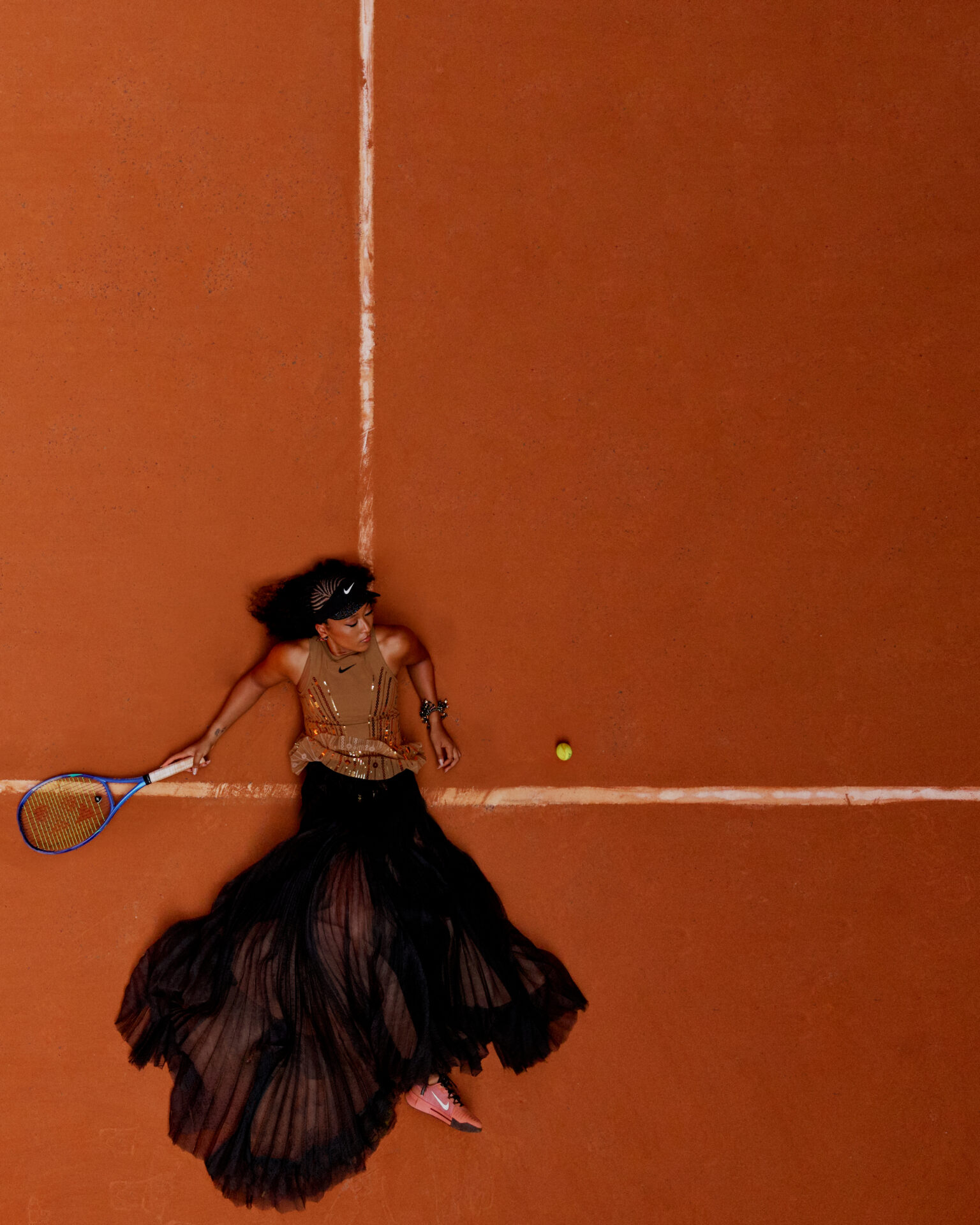
Photography by Fifou. Image Courtesy of Kevin Germanier.
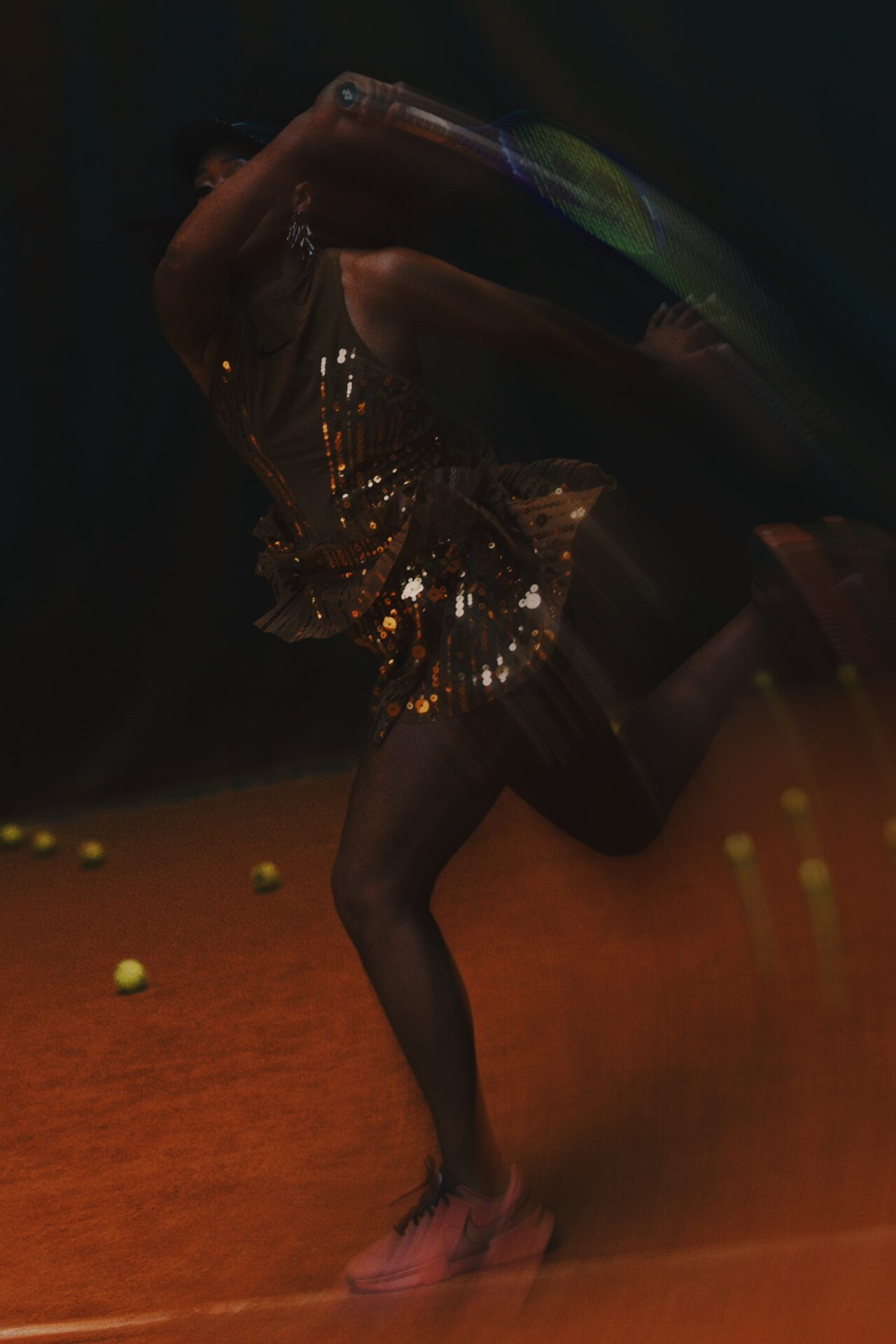
Photography by Fifou. Image Courtesy of Kevin Germanier.
Siegemund is, of course, entitled to her opinion. But with the interview she gave after the match, she seems to overlook two incredibly important things. First, Osaka’s performance is not meant as an affront against her. Not a form of cheating. It actually carries a very real meaning. And second, extravagant fashion has a long, provocative, pop-cultural legacy in sports. One that stretches far beyond tennis, and far beyond women.
Now, think about what a woman in sport is supposed to look like according to the rules. You may remember how, at the 2024 Paris Olympics, the uniforms of the US and Canadian women’s beach volleyball teams sparked a worldwide debate. Responding to windy, wet weather, the players chose to wear long pants instead of traditional bikini uniforms. The internet’s reaction: backlash and disappointment. “Disappointment?” you’re maybe wondering right now. But again, no surprise. While men are allowed to simply do sports, women have to constantly worry that something might slip while photographers are waiting to get a good shot.
And it’s not just beach volleyball. Across sports, women’s jerseys tend to be more “femininely” tailored, with accentuated waists and tighter cuts. Even in football. The message, intended or not, has always been the same: a woman in sport should look a certain way. Osaka’s outfit challenges that directly.
To understand how we got here, how we got to the Olympics and the French Open, it helps to look back. Osaka didn’t arrive in a vacuum. Multiple generations of athletes carved out the space she now occupies: Venus Williams. Florence Griffith Joyner. Sha’Carri Richardson. Serena Williams, to look at one example, has been challenging conventions and sparking debates since the early ’90s, at one point even forcing rule changes in tennis: At the French Open in 2004, she wore vibrant pink hoops. At the 2018 US Open, a Nike x Off-White tutu in lavender. At the 2004 US Open, tight shiny boots with a fierce retro Prada meets futuristic biker energy. Maybe you also remember the black catsuit she wore in 2018, paired with diamond-encrusted accessories. The story behind it: after the birth of her daughter, Williams dedicated the outfit to new mothers. Tight all-in-ones had helped her manage the blood clots that had nearly cost her life during childbirth. The French Open’s response? Well, they banned catsuits after that.
But even if the debate often focuses on the female side, fashion statements are not exclusive to women’s sport. Especially this month, with the World Championship about to “kick off”, the connection should come to mind quickly. Honestly, just think about Neymar Jr. Antoine Griezmann. Abel Xavier. Giovanni Simeone. Ronaldinho. Think about bright pink buzz cuts, lines carved into hair, extreme mullets and even animal prints. Expressive hairstyles have been a fixture in men’s football for decades. They let players express personal identity, draw attention and, practically speaking, make it easier to spot someone on the pitch from the couch. Just like Osaka, male players have faced heavy criticism for these choices in the past. For example, Günter Netzer, the German player of the ’70s, was famously mocked for his “feminine” long hair. But by the 2000s, when David Beckham proved that earrings, diamonds and a good fringe can be incredibly masculine, the debate was largely over. For men, at least.

Photography by Fifou. Image Courtesy of Kevin Germanier.
Basically, to come back to our main point, what Osaka is doing is not so different. She’s generating enormous media attention for herself, attention that boosts her career and sponsorship deals. And why not? She’s a hustler. A hustler with a serve that can reach up to 201 kilometres per hour, by the way. But more media attention for Osaka ultimately means more media attention for women’s sport in general. Higher airtimes. More brand collaborations. A small but meaningful step toward closing the enormous gender pay gap. Back in 2022, according to UN Women Germany, despite 70 percent of people enjoying watching women’s sport, only 16 percent of sports media coverage was dedicated to it. Time to change that.
Looking at the bigger picture, Osaka’s gown-like outfit is powerful precisely because it raises the right questions. What is feminine? What is sexist? What is functional? Can fashion be a statement in its own right? Because fashion in sports has never really been about gossip, headlines, or clicks. It is not a distraction from athletic performance, nor does it diminish the seriousness of the game. Women like Naomi Osaka, Serena and Venus Williams, Florence Griffith Joyner, and many others have long demonstrated that fashion can be a form of empowerment and that taking up space is not a problem. In fact, it is necessary.
So, what their choices reveal instead is a deeper discomfort that still exists within sport: a largely male-dominated arena where women are expected to conform to narrow ideas of how female athletes should look, behave, and present themselves. The moment they step outside those expectations, whether by dressing differently, covering up, standing out, or refusing to cater to the male gaze, they become a topic of discussion.
And so perhaps there aren’t so many different reasons why fashion in sports continues to spark debate. Perhaps there is only one. It has nothing to do with fashion. It has to do with who is allowed to take up space and on whose terms.
AloJapan.com