
HEAVY WEATHER:
Typhoon Jangmi is due to crash straight into the Ryukyus as airlines look to shift flights to larger aircraft or cancel flights to Okinawa entirely
By Shelley Shan
/ Staff Reporter
Taiwan’s international air carriers announced flight adjustments over the weekend as Typhoon Jangmi is forecast to hit the Ryukyu Islands today and tomorrow.
The Central Weather Administration (CWA) upgraded Jangmi from a tropical storm to a typhoon at 8am yesterday, with the eye located 580km south of Naha city. It was moving north at 19kph.
Today, China Airlines’ CI-120, CI-121, CI-122 and CI-123 flights between Taoyuan and Naha, Okinawa, have been canceled as well as CI-132 and CI-133 between Kaohsiung and Naha. EVA Air’s BR-112, BR-113, BR-186 and BR-185 flights between Taoyuan and Naha are also canceled.
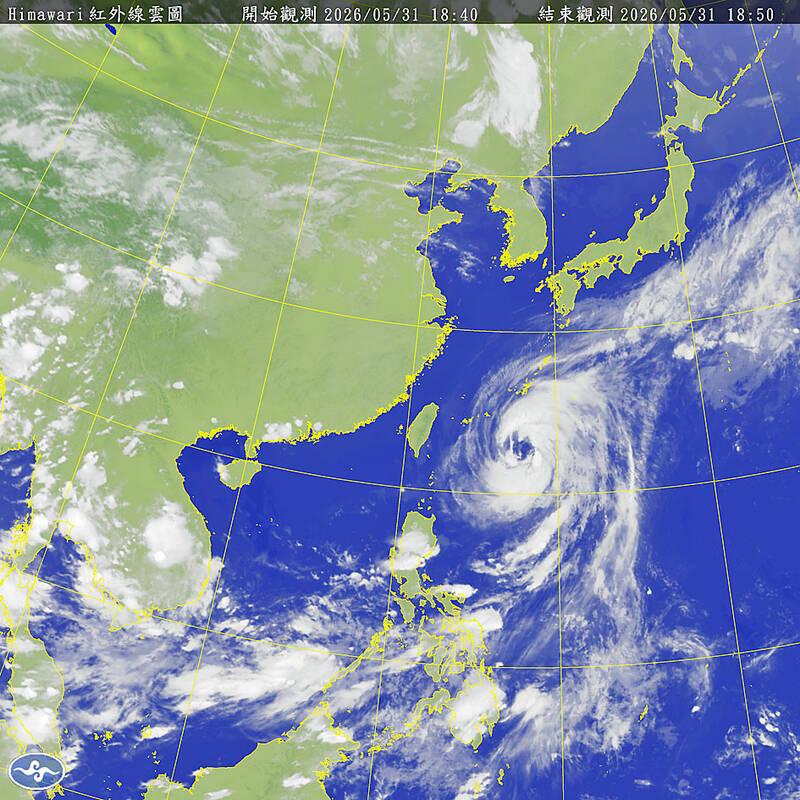
Photo: Central Weather Administration
Low-cost carrier Tigerair Taiwan canceled IT-230, IT-231, IT-232 and IT-233 operating between Taoyuan and Naha today, as well as IT-792 flight to Naha from Taichung and IT-288, IT-289 and IT-729 flights between Kaohsiung and Naha.
Tomorrow, China Airlines would use larger aircraft to transport passengers between Taoyuan and Naha, it said.
All three airlines advised passengers to closely monitor the status of their flights on the airlines’ official Web sites and apps, adding that arrival and departure times of flights are subject to change due to the weather.
Jangmi is forecast to strike the Ryukyus, Kyushu and Shikoku Islands, as well as southern Honshu, tomorrow and Wednesday, adding that meteorologists in Europe offered similar projections.
People planning to travel to any of these areas are advised to closely monitor for flight changes.
Former CWA weather forecast center Daniel Wu (吳德榮) wrote in his online column that Taiwan is expected to be out of the influence from Jangmi on Wednesday and Thursday. Hot, sunny days are forecast nationwide, with high chances of showers after noon, Wu said.
From Friday to Tuesday next week, the interaction of the fifth rain front in this year’s plum rains and a southwesterly monsoon would create highly unstable atmospheric conditions, Wu said.
“Such a pattern is conducive to the formation of mesoscale convective systems, which could bring more intense rainfall that is not confined to the afternoon, marking the onset of the plum rain season’s most active period,” he added.
AloJapan.com