


Michiko Yagi, left, recounts her experience of the atomic bombing at a movie theater in the Morimachi district of Nagasaki, on May 12, 2026. (Mainichi/Arina Ogata)
NAGASAKI — This southwest Japan city is seeing a surge in school trips from the Tokyo metropolitan area as schools seek to avoid overcrowded Kyoto and curb the impact of rising prices. This recent trend has created a new challenge: how to secure venues for speeches by atomic bombing survivors for visiting students, prompting the use of unconventional spaces.
“When you return to Yokohama, tell many people what peace is about and pass the baton. Peace will never spread if we stay silent,” said A-bomb survivor Michiko Yagi, 87, of Nagasaki on the evening of May 12 in front of a screen at a cinema inside the major shopping complex Mirai Nagasaki Cocowalk in the city. Her audience was 136 second-year students from Yokohama Hayato Senior High School in Kanagawa Prefecture visiting Nagasaki on a class trip.
Images of the late Sumiteru Taniguchi, who suffered severe burns all over his back due to the Aug. 9, 1945, U.S. atomic bombing, and a boy burned black by the blast were projected onto the screen that usually shows films. Pointing to the images, Yagi recounted her own experience of being exposed to the bomb at age 6.

Michiko Yagi shows a photo of Sumiteru Taniguchi, who suffered severe burns on his back, during her atomic bombing testimony in the Morimachi district of Nagasaki, on May 12, 2026. (Mainichi/Arina Ogata)
According to the Nagasaki Foundation for the Promotion of Peace, which arranges survivor talks at the request of schools and travel agencies, this was the first time such a talk was held in a movie theater. The event was planned and coordinated by Nagasaki Bus Kanko, a local company that organizes charter bus tours for school trips.
Until recently, the company had received almost no bookings from schools in eastern Japan’s Kanto region that includes Tokyo. For fiscal 2026, however, it already has around 70 to 80 reservations, and twice that number for fiscal 2027.
The Nagasaki Prefecture Tourism Association said many of these schools previously went to Kyoto but cited heavy crowds of general tourists disrupting study schedules and higher accommodation costs due to inflation as reasons for switching destinations.

Students on a school trip pose for a photo with Togetsu-kyo Bridge in Arashiyama in the background, in Kyoto on May 18, 2024. (Mainichi/Kenjiro Sato)
Hotel use and booking data also reflect this trend. A local hotel association’s survey found that 23 junior high schools from Tokyo, with a combined total of 3,270 students, visited Nagasaki in fiscal 2025. For fiscal 2026, reservations have already reached 64 schools with 8,414 students, roughly triple the previous figure. Many of these schools changed their trip destinations from Kyoto to Nagasaki.
Most schools traveling to Nagasaki focus on peace studies, with A-bomb survivors’ talks at the core. However, only a limited number of venues can accommodate large groups. Although survivors sometimes visit hotels to speak, such arrangements often require them to go out at night during students’ dinner hours, posing a burden on elderly speakers.
While using a cinema costs students a modest fee, the space is ready to use with air-conditioning, microphones and screens already in place. For the theater, allowing use during daytime off-peak hours on weekdays is also advantageous.
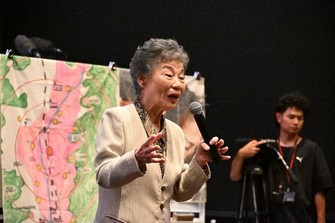
Michiko Yagi speaks about her experience of the atomic bombing while standing in front of a movie screen, in the Morimachi area of Nagasaki on May 12, 2026. (Mainichi/Arina Ogata)
“I could clearly see each student’s face,” Yagi said after her talk. Ameri Horii, 16, a student who attended the session, said, “The sound of the air raid siren (at the beginning of the speech) felt three-dimensional. It was a peace lecture that felt as if I was experiencing it.” The theater’s advanced equipment appeared to have helped students better understand the content of Yagi’s speech. Nagasaki Bus Kanko plans to continue using cinemas as one of the venues for lecture programs for students on school trips.
As the number of aging survivors still able to give talks declines, organizations such as the Nagasaki Atomic Bomb Survivors Council are scrambling to encourage younger generations without firsthand experience of the bombing to carry on these efforts by offering them training programs, among other initiatives.
(Japanese original by Arina Ogata, Nagasaki Bureau)
AloJapan.com