

このページを
日本語
で読む
JAPAN Forward launched its “Ignite” series of essays in English to directly share Japanese students’ voices with their global peers. N High School student Haruhi Okudaira is one. As part of the US-Japan Council’s TOMODACHI Initiative, Okudaira and other participants traveled to the region devastated by the 2024 Noto Peninsula earthquake on March 14-15, 2026. From that experience, she reconsidered how outsiders can use social problem-solving for better results in disaster recovery efforts and beyond.
The TOMODACHI Initiative is a private-public partnership between the US Embassy Tokyo and the US-Japan Council. Launched in the wake of the 2011 Great East Japan Earthquake, it focuses on developing next-generation leaders in Japan and the United States. This particular Noto Peninsula project was organized by the TOMODACHI Regional Representative of the Chubu-Hokuriku Region, Shiori Sata. Funding was provided by Prudential and Amazon.
Okudaira’s essay is the fourth submission among participants in the 2026 Noto Peninsula project. She brings her experience as a participant in an earlier MUFG TOMODACHI Initiative project that took her to San Francisco. Building on that experience, Okudaira explores the significance of listening carefully to the community. She considers how this disaster recovery process can also apply to her future work on gender and diversity. Her perspective is unique, so let’s learn more.
Forty-third in the Series, ‘Ignite’
 Haruhi Okudaira (provided by the author)
By Haruhi Okudaira
Essay on the TOMODACHI Initiative Noto Peninsula Project
My journey as a TOMODACHI alumna began when I joined the MUFG Sustainable Entrepreneurship Program in high school. At the time, I was simply curious about leadership and entrepreneurship, without fully knowing what I wanted to do in the future. After three months of preparation, I spent 10 days in San Francisco, and that experience ended up changing the way I think about my role in society.
During the program, I was exposed to many new perspectives. I attended a psychology lecture at Stanford University, listened to talks from people working in MUFG’s innovation department, and visited a company developing electric vehicle chargers. Each experience was interesting, but what stayed with me most was not just the content itself, but the way people shared ideas so openly. I also had the chance to hear from one of the first same-sex married couples. Until then, I hadn’t really thought deeply about how differently people can live their lives, and it made me realize how narrow my own perspective had been.
At the end of the program, we presented our ideas at MUFG headquarters. I remember feeling nervous, but also excited to share something we had worked on seriously. Looking back, that moment made me realize that I don’t want to just think about problems ー I want to actually do something about them, even in small ways.
Another thing that left a strong impression on me was the atmosphere among the participants. People didn’t dismiss each other’s ideas. Even when opinions were different, they tried to understand first. Because of that, I felt more comfortable speaking up than I usually do. It made me realize how much the environment around us can influence whether we take action or stay silent.
Joining the Noto Peninsula Recovery Project
After the program, I got busy with part-time work and gradually lost touch with TOMODACHI activities. But when I later saw a newsletter about the Noto Peninsula project, I felt a strong pull to join. I had been interested in the region since working at the Osaka Expo, where I learned about its culture, including Wajima lacquerware, so it felt like a chance I shouldn’t miss.
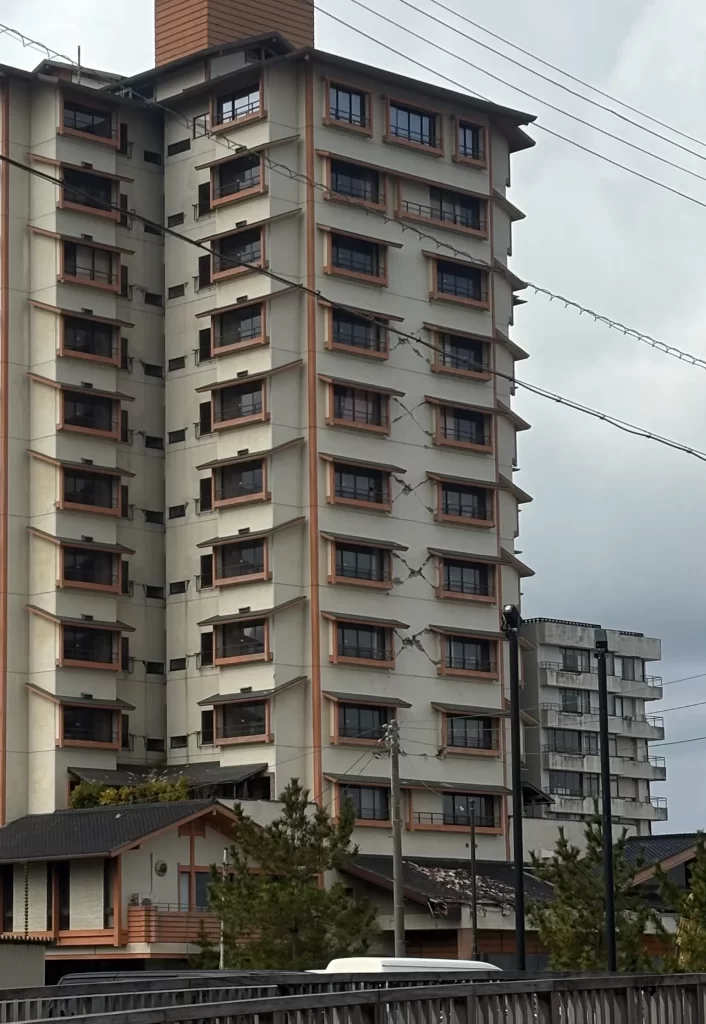 The exterior wall of the historic Kagaya Inn at Wakura Onsen. Visible between the windows, the building was cracked in the shape of “Xs” in the earthquake. (©Haruhi Okudaira)
Visiting Noto was a very different kind of experience from what I had imagined. Before going, I had mostly seen information on social media saying that reconstruction wasn’t progressing and questioning the government’s response. I had accepted that view without thinking too deeply about it. However, once I was there and spoke directly with local people, I realized that the situation is far more complicated than it appears from the outside.
A Process of Memories, Relationships, and History
On the first day, I heard something that really challenged my assumptions. Instead of relying on heavy machinery to rebuild as quickly as possible, some people chose to rebuild slowly by hand. They talked about recovery not as simply restoring what was lost, but as a process of carrying forward memories, relationships, and history. Until then, I had thought “recovery” meant speed and efficiency. Hearing this made me reconsider what rebuilding actually means.
The next day, I visited Wakura Onsen. Seeing the coastline lined with damaged hotels and inns was honestly shocking. At first glance, it made me wonder why things hadn’t changed more. But as I learned about issues like land ownership and the long histories tied to each place, I began to understand why recovery cannot be simple or quick.
At that point, I started thinking about what someone like me, who is not from the area, can realistically do. I don’t have the power to rebuild towns, but I realized that simply going there, seeing the situation firsthand, and sharing what I learned with others is still meaningful. It may be a small contribution, but it feels more honest than forming opinions from a distance.
Finding New Meaning in What Remains
During my stay, I also experienced the warmth of the community. I remember trying Noto ice cream, especially the roasted stem tea (bocha) flavor. I initially just thought it was good, but later learned that it is made from parts of tea that would normally be discarded. That idea of creating value from something overlooked stayed with me. In a way, it felt connected to how the region is trying to rebuild not by returning to exactly what it was, but by finding new meaning in what remains.
 Ice cream made with Noto milk and roasted green tea. It was full of the wisdom of the people of Noto. (©Haruhi Okudaira)
This experience also made me reflect on the LGBTQ+ issues I care about. As someone who is part of the community, I have sometimes struggled with feeling unable to fully be myself. In the past, I often focused on how society should change, but my time in Noto reminded me of something more basic: the importance of listening. Just as I misunderstood the situation in Noto by only looking from the outside, I realized that people’s lives and challenges cannot be understood without hearing their individual stories.
What I learned there, actually going to a place, meeting people, and listening carefully, is something I want to apply to everything I do, including my future work related to gender and diversity.
Understanding Diversity and Society
Starting in May, I will go abroad on a working holiday. I’m both excited and a little unsure about what I will find, but I hope to experience different cultures and ways of thinking firsthand. By stepping outside Japan, I want to deepen my understanding of diversity and eventually bring those perspectives back with me.
Looking back, the Noto project was more than just a visit. It gave me time to think more honestly about how I want to live and what kind of society I want to be part of. I still don’t have clear answers, but I feel more willing to keep asking questions, listening to others, and taking small steps forward.
 Haruhi Okudaira (provided by the author)
About the Author:
Haruhi Okudaira is an alumnus of two TOMODACHI Initiative projects. She was a high school senior at N High School group in Osaka, when she visited the Noto Peninsula as part of the TOMODACHI Initiative and wrote this essay. N High School is an open-campus style school based in Ikeda, Osaka. A native of Takatsuki, Osaka Prefecture, she is currently on a working holiday in Australia.

RELATED:
Author: Haruhi Okudaira
TOMODACHI Initiative Alumnus
このページを
日本語
で読む
Continue Reading
AloJapan.com