
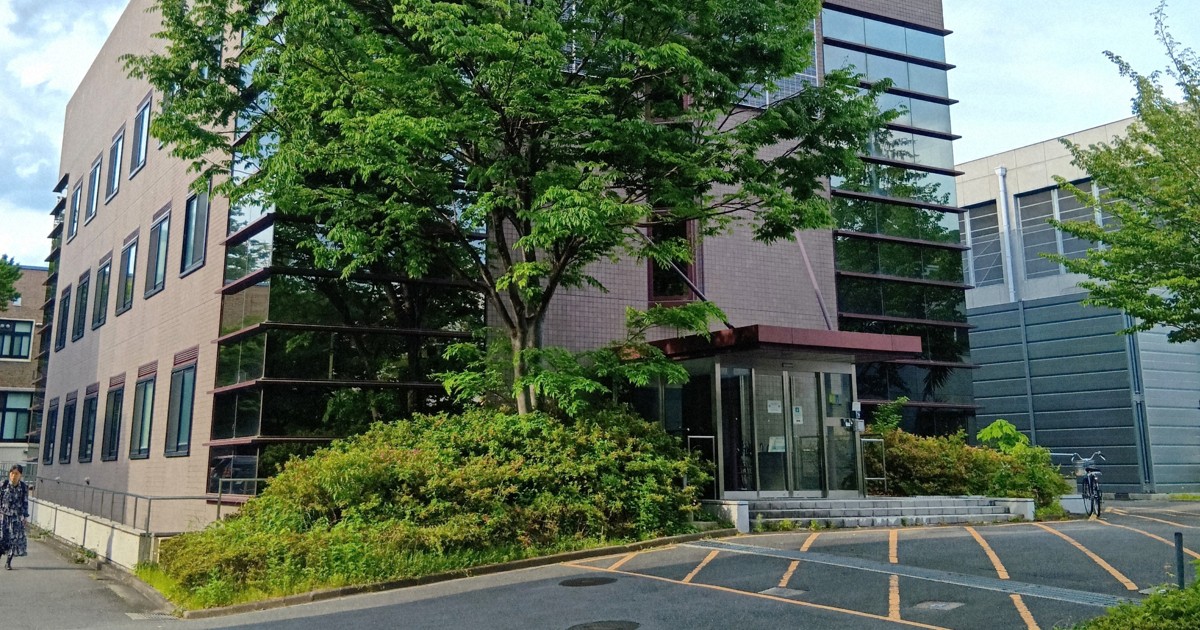

The academic research support building of Kyoto University Office of Research Acceleration is seen in Kyoto’s Sakyo Ward, on May 12, 2026. (Mainichi/Hiroyuki Ota)
KYOTO — In an effort to address the heavy burden of writing and publishing research papers in English — which about 80% of university faculty members say leaves them with insufficient time for research — the Kyoto University Office of Research Acceleration (KURA) has launched an English paper preparation and submission support ecosystem.
The program, called “Kagayaku,” has been available since May to about 5,000 faculty and staff members at the university and aims to reduce individual workloads and enhance the global reach of their research.
One of the pillars of the system is “Editage Plus,” a package of artificial intelligence-powered tools developed by Cactus Communications K.K., a company with a track record in academic writing support. It includes three tools designed to assist with English paper writing, scientific illustrations, and academic paper search and comprehension, along with on-demand learning materials for academic writing. While some faculty members had used it individually before, KURA’s new partnership agreement with Cactus Communications allows any interested faculty member to access the system.
In addition, a selective program is offered that includes a “research paper elite training course,” one-on-one mentoring and subsidies for English proofreading tools. Together, the ecosystem provides comprehensive support through the entire process of writing, submitting and publishing English papers, improving both efficiency and skills.
The development of Kagayaku has been supported by financial contributions, including those from Daiichi Sankyo Co.’s fiscal 2025 “Habataku” Support Program for the Next Generation of Researchers. Combining institutional infrastructure with specialized professional assistance, the university describes this campus-wide support framework as a pioneering model among Japanese universities.
Kyoto University had already introduced “Paperpal,” an AI writing support tool included in “Editage Plus,” at its medical school-affiliated hospital starting in fiscal 2024, coinciding with work-style reforms to reduce physicians’ hours. In KURA’s fiscal 2025 pilot of “Editage Plus,” more than 70% of users reported that the system contributed to improved efficiency and said they wished to continue using it, confirming its effectiveness and cross-disciplinary demand.
The new system is also part of Kyoto University’s broader effort to strengthen its research support functions as it seeks designation as one of the Japanese government’s “Universities for International Research Excellence” programs.
Noriyuki Naya of the KURA Research Promotion Division, who has a doctorate in health science and was responsible for developing the system, stated, “We hope to contribute to strengthening research capabilities and returning research outcomes to society by securing more time for research and improving the international dissemination of our findings.”
(Japanese original by Hiroyuki Ota, Kyoto Bureau)
AloJapan.com