


As Sapporo’s spring brown bear management capture begins, hunters head into the mountain forest in the city’s Toyohira Ward, March 11, 2026. (Mainichi/Toshiki Miyama)
SAPPORO — In Hokkaido, brown bears are increasingly appearing in urban areas with little fear of humans. Since 2023, authorities have battled that trend with an initiative to capture bears just after they emerge from hibernation, around February to May, before they come down from the mountains. The idea is to get ahead of them before they become fully active. But in 2026, such efforts have not produced the hoped-for results. Looking into why brings into focus both the history and one particular ability brown bears possess.
On March 11, at Mount Shirahata in Sapporo, eight hunters climbed a slope where the snow had only just begun to melt. Along with hunting rifles, they carried a small drone equipped with a thermal sensor, scanning carefully for signs of bears. When there is still snow on the ground, bear tracks are easier to spot, and with no leaves on the trees, visibility is also better. Spring management capture, aimed at keeping bears from venturing into populated areas, is a sensible strategy.
Yet, during eight days of this operation in Sapporo in March, not a single bear trace was found. According to the Hokkaido Prefectural Government, only one bear was captured through such operations in 55 municipalities across the northernmost Japanese prefecture by the end of March. Even by the end of April, after 66 municipalities had carried out the initiative, the total had reached only 12. Considering that by the end of April 2025, 47 municipalities had conducted the operation and captured 19 bears, the efficiency has worsened. Why?

A footprint of a bear found by Yasuo Tamaki, chief of the brown bear control squad at the Sapporo branch of the Hokkaido hunting association, is seen in this photo provided by the individual.
Atsushi Horie, chairperson of the Hokkaido hunting association, points to the fundamental difficulty of the spring management capture program itself, saying, “It is not easy to track a bear and capture it.” In Hokkaido, from 1966, authorities carried out “spring bear culls” targeting bears in hibernation or those that had recently woken up. But because bear numbers declined in some areas and the species faced the risk of extinction, the program was abolished in 1990. After that, while the human population fell, the number of brown bears is estimated to have doubled. Moreover, some bears also apparently became unafraid of people.
In 2023, the spring management capture program resumed after a 33-year hiatus, but that long gap became a problem. Horie said, “Hardly any members (of the current hunting association) experienced the spring bear culls. They do not have a grasp of things like where dens are in the mountains.” It is also possible that because many bears have been captured around populated areas in recent years, the overall number of bears itself has declined.
At the same time, some point to a shift in the timing of brown bear activity.
In a typical year, brown bears emerge from hibernation around the middle of March and feed on dug-up acorns and butterbur sprouts. Because bears move sluggishly right after emerging, this period was supposed to be the ideal time to target them for capture. Yasuo Tamaki, 64, chief of the brown bear control squad at the Sapporo branch of the Hokkaido hunting association, speculates that bears may have adapted to the poor food harvest in 2025, shifting their internal clocks to avoid becoming weaker while searching for food. It is possible, therefore, that snow melted before the bears really began their activity. This suggests just how formidable bears’ learning ability may be. But if that is indeed what is happening, it creates a new risk: Bears emerging later from hibernation could end up encountering people during the peak April-to-June season for gathering wild mountain vegetables.
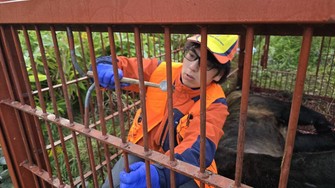
Rito Takasaki, head of the Mikasa branch of the Hokkaido hunting association, repairs a trap that caught a bear, in this photo provided by the individual.
The prefectural government is not simply sitting on its hands in the face of this situation. Rather than judging the results of the spring management capture initiative solely by the number of bears seized, it is focusing on training new people to carry on the work, with an eye on the decline in veteran hunters, to instill caution in bears. Hunter training, in particular, is expanding in new ways. Since 2025, a training system has allowed hunters from municipalities that do not carry out spring captures to take part in operations in other municipalities.
Yoshikazu Sato, a professor of wildlife ecology at Rakuno Gakuen University, values such grassroots efforts but stresses that “we need to avoid getting carried away by capture numbers alone and instead take a long-term view while monitoring bear sightings and sorting out the problems.”
Taisuke Miyauchi, a professor of environmental sociology at Hokkaido University, also points out, “There are cases where the mountains where brown bears inhabit are far from the areas in which they appear, or where their appearances span multiple municipalities.” He continued, “Ideally, (spring management capture) efforts should be carried out thoroughly across Hokkaido, applying collective pressure to drive them toward the deep mountains from the edges of populated areas.”
With spring management captures at the center, trial-and-error efforts to prevent harm are continuing.
(Japanese original by Ayako Morihara, Hokkaido News Department)
AloJapan.com