
 Save
Save
You have reached your maximum number of saved items.
Remove items from your saved list to add more.
AAA
Our Japanese cruise brings me to Kanazawa on a perfectly sunny spring day.
I decide to skip the excursion and instead wander this elegant city on Honshu’s central north-west coast, still something of an under-the-radar destination for international visitors.
I take a taxi from the port to the station and walk towards the centre of town beside a multi-lane road. Along its median strip blowsy azaleas bloom, but something else catches my eye, something ordinary in Japan, perhaps, but extraordinary to me.
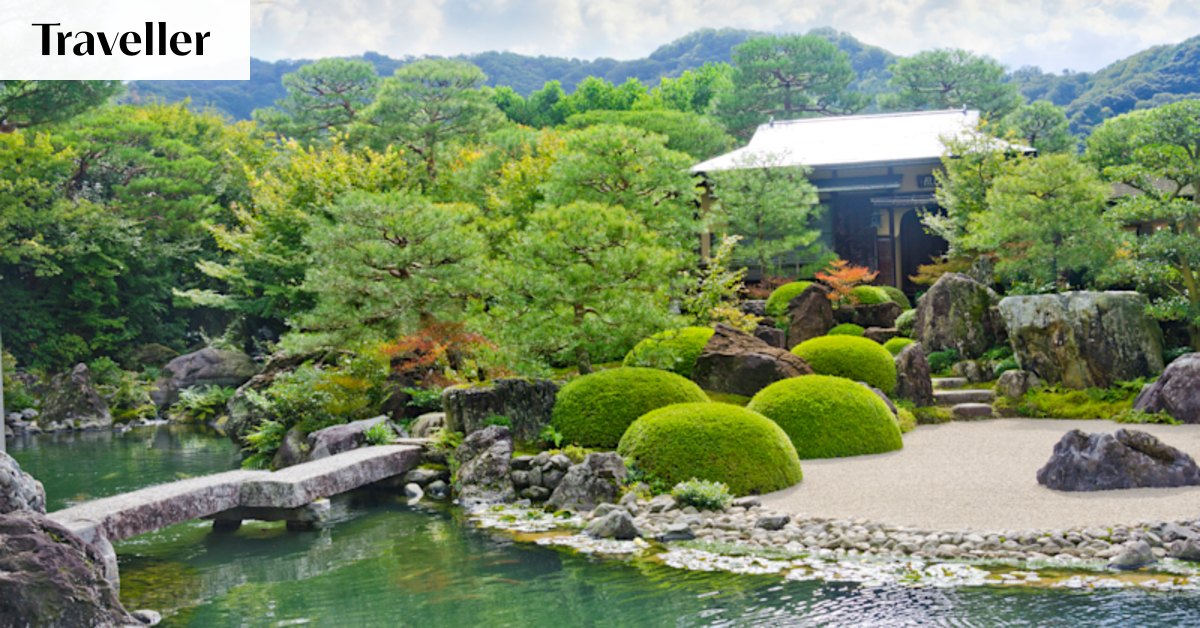
 The Adachi Museum of Art in Yasugi, Shimane Prefecture, was founded by businessman Adachi Zenko in 1970.
I stop to admire and photograph a narrow garden that wraps around the corner of an otherwise unremarkable building. I see structure, restraint and harmony. Every stone and clipped shrub feels considered; trees are placed and pruned just so; different hues of green complement each other in a perfectly layered palette.
Suddenly, I’m mentally redesigning the dingy breezeway at home.
Sign up for the Traveller Deals newsletter
Get exclusive travel deals delivered straight to your inbox. Sign up now.
Two weeks earlier I might have walked straight past this little patch. At most, I may have registered it as pleasant. But after 10 days aboard Botanica World Discoveries’ Island Sky, I’m seeing Japanese gardens in an entirely different light.
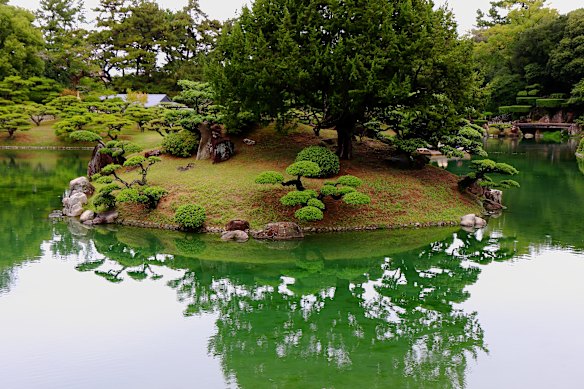 Ritsurin Garden, the largest Cultural Property Garden in Japan.iStock
Back on Island Sky, I show my photos to our guide, Simon Rickard. “I know exactly where that is,” he says. “I’ve put it on my Instagram.” I feel absurdly pleased. Botanica may yet turn me into a proper gardener.
It’s not as though I arrived as a non-gardener, but on this small-ship cruise I’m surrounded by 100-odd fellow passengers whose horticultural passions border on Chelsea Flower Show entrant level. Their obsessions range from pine trees to peonies, blossom to bonsai, maples to moss.
Then there are the true plant polymaths, people like Maureen, who seems to know everything about everything you could possibly do in a home garden, and whom everyone wants on their team come the botanically themed trivia night.
Botanica World Discoveries is an Australian company that runs garden-themed small-group tours. I’m on its 12-Day Spring Gardens, Culture and History of Japan and South Korea by Small Ship itinerary.
 Ponds in Ritsurin garden.iStock
It’s an unwieldy title for a refined and precisely tuned trip. With its green-tinged light on the places we visit, the company of my enthusiastic tour mates, it’s hard not to become infused with a passion for plants on this journey.
I realise this on just the second day of our 12-day exploration, when our ship stops in Takamatsu in Kagawa Prefecture on Shikoku, the smallest of Japan’s four main islands.
I’ve been to Takamatsu before and visited Ritsurin Garden, the largest Cultural Property Garden in a nation that takes both Cultural Property and gardens very seriously.
That time – admittedly during hot, steamy August – I found the garden pretty but was unmoved by it, despite its illustrious history as a private strolling garden and villa for the Matsudaira clan, feudal lords of the Takamatsu domain, who developed it over 200 years beginning in 1642.
 Korakuen, a traditional Japanese landscape garden in Okayama.iStock
This time, wandering through the meticulously cultivated landscape, Rickard coaxes stories out of seemingly innocuous details – a rock here, a shrub there – and I begin to understand what I missed the first time.
He points out the Neagari Goyomatsu, an eight-metre-tall white pine originally presented as a bonsai to Yorihiro Matsudaira, the ninth lord of the Takamatsu domain, by the 11th Tokugawa Shogun in 1833. “You can see that the roots are exposed above the surface, which is quite a common way to plant pine trees in Japan, because it suggests nobility in adversity,” he says.
“Imagine a tree in a river floodplain, and the river floods the soil around the roots, yet the tree holds fast and raises its head high, proud and majestic. Nobility in times of adversity is something this tree needs to have.
“It has been very sick in recent years, and they’ve cut a lot of dead material off the top. I’ve never seen it looking so thin. So let’s all cross our fingers that it makes it.”
Later, Rickard, a specialist in Japanese gardens and a longtime Botanica guide, directs our attention to a cluster of trees in the distance. “See that grove of Japanese maples?” he says.
He explains that in Japan, certain trees are watched closely as markers of the changing seasons, and that the turning of the maples in gardens such as Ritsurin can signal autumn’s arrival, while a single cherry may herald the beginning of blossom season. “That’s a big job for one tree,” he says.
In gardens like these, little, if anything, is by accident. For instance, at Okayama Korakuen, Rickard explains that there, in “one of the three great gardens of Japan”, a path is never just a path.
“They’re actually a narrative and tell a story as you move around the space. Every time you turn a corner, there’s some scene more delightful than the last. Or perhaps you enter a shady forest grove, or perhaps you’re out in the sun, or perhaps you see a particularly beautiful, ancient tree, or a view to the castle.”
Even a patch of grass is freighted with meaning. “In Anglo culture lawn is the most obvious thing in the world,” he says. “But in the late-17th century, having a lawn in a Japanese garden was unique – it was weird. And it was a display of soft power, because if you had enough space to give over to one completely useless plant, and you had enough flunkies to manicure it and keep it looking nice, that meant you were rich and powerful.
“Visiting warlords would have come here and thought, ‘wow, check out this guy’s lawn. He must be doing OK. I couldn’t afford to give this amount of space to a stupid green plant.’”
 Yuishinzan Hill in Korakuen gardens, Okayama.iStock
In the wooded hills south of Kitakyushu on the island of Kyushu, I begin to understand how those warlords might have viewed all that “weird” grass. Here, though, the planting that is impressive to me is wisteria. Not the plant itself, but the volume of it. I am spellbound by Kawachi Wisteria Garden, a famously fragrant patchwork of purple, pink and white Japanese wisteria grown over tunnels, domes and sweeping canopies.
The scent hangs in the air. Bees hum lazily between blooms. I fall quiet beneath cascades of colour. We all do. The story is not one of power, but beauty. Yet even a garden so singularly devoted to floral spectacle speaks to Japan’s deep reverence for the botanical world.
Kawachi began as the private garden of Masao Higuchi, who in 1968, alongside his eldest son, started clearing the wooded hillside and constructing what would become one of Japan’s most celebrated floral displays.
 Wisteria tunnel at Kawachi Wisteria Garden on the island of Kyushu.
Inspired by a children’s book, the garden officially opened in 1977, though it was not until CNN named it one of the “31 Most Beautiful Places in Japan” in 2015 that it entered the consciousness of tourists.
Our visit comes early in the season – the blooms are only about 30 per cent developed – which proves a blessing. The tunnels are uncrowded and our wanderings blissfully unhurried.
That describes our time at sea, too. Japan is a country known for vibrant cities. But it is also an island nation, with four main islands and hundreds of inhabited smaller ones and thousands more beyond them.
From Island Sky, which is small enough to navigate channels and ports many larger ships can’t, the coastal scenery is as much part of the Botanica experience as our visits. I see a quiet, serene and completely enchanting side of Japan you only get from the water.
 Jeju Island, South Korea.
Island Sky’s size and age also mean some tough going in rough conditions, but it’s a small price to pay as we make our way into Uwajima, Matsue, Hiroshima, Miyajima and South Korea’s Jeju Island and city of Ulsan.
On Shikoku, we visit the Kinashi Bonsai Village, where white pine bonsai worth hundreds of thousands of dollars underline Japanese gardening’s relationship to China.
In Nagasaki, we visit the Atomic Bomb Museum and Peace Park, then spend the afternoon in Glover Garden, its European influence in striking contrast to the other manicured spreads we have visited. An open-air museum of Western-style houses with Victorian plantings, it is undeniably pretty, but I find I miss the order and meaning we’ve encountered elsewhere.
Related Article
Soon, though, we visit the Adachi Museum of Art, where one man’s personal passion for the principles of Japanese gardens are realised with astonishing precision.
Created by businessman and art collector Zenko Adachi, vistas are framed by windows and outdoor viewing points which function as works of art themselves. With not a leaf nor pebble out of place, it feels close to perfect.
Later, in Kanazawa, my wanderings take me past that little garden which so inspired me and I come across Ootomorou Ryotei, a restaurant that encases a 250-year-old teahouse. I peer behind the noren and see a warren of guest spaces facing into a traditional garden.
I turn to leave and run into an ancient cherry tree jutting out of a exterior wall. It is propped up with timber stakes and beams – passers-by and the building’s structural integrity seem less important than keeping the tree alive.
I walk away awestruck by the specialness of that tree, and how the inconvenient nature of its care is outweighed by how essential it is to Ootomorou Ryotei’s identity.
Two weeks earlier, I might never have noticed it at all.
THE DETAILS
TOUR
Botanica World Discoveries will run a version of this tour in 2027, timed for cherry blossom. Coastal Cruise of Japan & South Korea – Cherry Blossoms and Celebrated Gardens is a 10-night private-charter cruise aboard Island Sky. It departs Osaka April 2, 2027. From $17,995 a person, twin share. See botanicatours.com
FLY
Singapore Airlines flies to Osaka via Singapore. Jetstar and Qantas also operate flights to Osaka. See singaporeair.com ; qantas.com; jetstar.com
The writer travelled as a guest of Botanica World Discoveries.
Save
You have reached your maximum number of saved items.
Remove items from your saved list to add more.
 Julietta Jameson is a freelance travel writer who would rather be in Rome, but her hometown Melbourne is a happy compromise.Connect via email.From our partners
AloJapan.com