
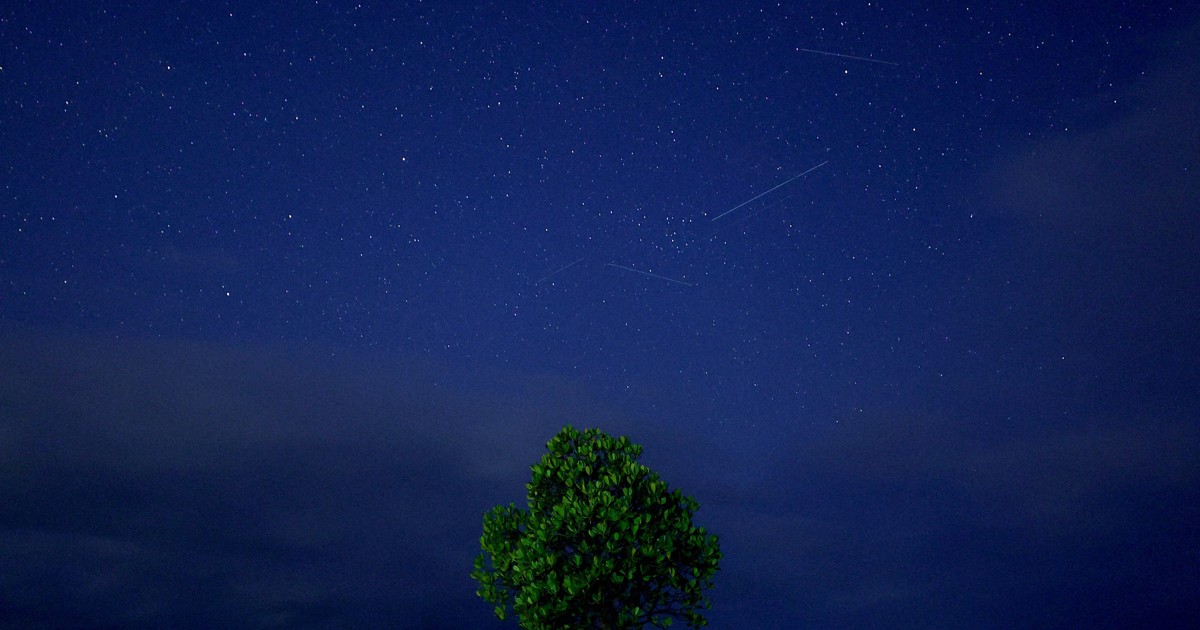

A “lone mangrove” stands beneath a sky full of stars in the city of Ishigaki, Okinawa Prefecture, March 21, 2026. (Mainichi/Shinnosuke Kyan)
The greatest number of constellations in Japan can be seen on the Yaeyama Islands in Okinawa, such as Ishigaki Island. Of the 88 constellations covering the entire sky, 84 can be observed here, including the Southern Cross, which cannot be seen from the mainland of Japan or Kyushu region.
Artificial light pollution is also minimal. The Iriomote-Ishigaki National Park was designated as Japan’s first “International Dark Sky Place” eight years ago. Stars have been guiding sailors since ancient times. It is natural that legends about stars remain on the islands.
“Murikabushi Yunta” is an old folk song about the Pleiades cluster, commonly known in Japan as Subaru, which even Sei Shonagon, a famous poet and author during the Heian period (794-1185), cited as the foremost among stars. Murika is said to mean “to gather,” aptly describing the six-star cluster also known as Mutsuraboshi.
On Okinawa’s main island, the period combining “Shoman” and “Boshu” from the 24 solar terms is called “Sumanbosu,” a synonym for the rainy season. In contrast, people on the Yaeyama Islands call it “Yudun,” a word meaning “to stagnate” or “to rest,” referring to the time when Subaru disappears from the sky.
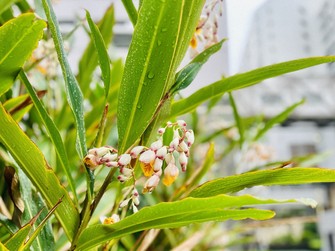
Shell ginger flowers are wet with rain in the city of Naha, May 22, 2025. (Mainichi/Hiroshi Higa)
Subaru vanishes around May 10 on the western horizon and reappears around June 20 from the east, exactly matching Okinawa’s average rainy season. The wisdom of those who linked such regular celestial phenomena with weather patterns crucial to farming and fishing is admirable.
May 21 is Shoman, a time when plants and trees are considered to begin flourishing on Earth. In China, where the term originated, the traditional Okinawan vegetable Nigana is said to thrive now. The Okinawa region, including Yaeyama, entered the rainy season earlier than usual, at the beginning of this month. From northern Japan’s Tohoku region to Kyushu to the south, unseasonal heat has persisted this year. These areas may also enter an early rainy season. It seems that the cloudless night skies will vanish for a while.
(“Yoroku” is a front-page column in the Mainichi Shimbun.)
AloJapan.com