
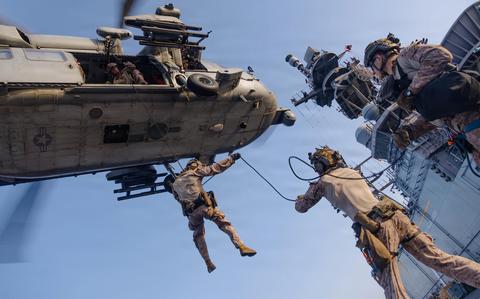

Members of the Okinawa-based 31st Marine Expeditionary Unit rappel out of an MH-60S Seahawk during training aboard the amphibious assault ship USS Tripoli on May 8, 2026, in U.S. Central Command’s area of responsibility. (U.S. Marine Corps)
The Marine Corps has left a gap “unfilled” in the Indo-Pacific by moving an expeditionary unit from Okinawa to the Middle East to support operations against Iran, the service’s top leader told lawmakers.
Marine Corps Commandant Gen. Eric Smith testified before the House Armed Services Committee during a Thursday hearing about the U.S. Navy’s proposed 2027 budget.
Smith replied to a question from Rep. Derek Tran, D-Calif., who asked how the Corps is filling gaps in its ability to deter adversaries in the Indo-Pacific while 2,500 Marines and three warships are deployed from the region to the Middle East.
Members of the 31st Marine Expeditionary Unit are aboard the amphibious assault ship USS Tripoli in support of Operation Epic Fury, according to U.S. Central Command.
“Well, frankly, the gap is unfilled,” Smith said, according to video of the hearing. “When you move … an [amphibious ready group/Marine expeditionary unit], you simply don’t replace it. When you move one force from one combatant command theater to another, you don’t replace it.”
He added that “the beauty” of the unit is its ability to return to the Indo-Pacific under its own power.

Marine Corps Commandant Gen. Eric Smith speaks during the 8th and I Evening Parade reception at Marine Barracks Washington, D.C., May 1, 2026. (Juaquin Greaves/U.S. Marine Corps)
“That is the value of the ARG/MEU … much like a carrier strike group, it is globally deployable,” he said. “It can be passed from one combatant commander to another.”
The 31st MEU has helped enforce a blockade of Iranian ports since April 13. Marines with the unit rappelled from helicopters on April 20 onto the Iranian-flagged Touska, according to CENTCOM video.
The unit is one of seven Marine expeditionary units and the only one permanently deployed in the Indo-Pacific. It features a combination of air, ground and support elements designed to quickly respond to combat and noncombat situations, including humanitarian assistance and evacuations.
The III Marine Expeditionary Force on Okinawa “remains postured, lethal, and ready to fight tonight,” spokesman Maj. Jordan Fox said by email Friday.
“Our readiness is generated by an integrated, combined arms team and sustained by the daily efforts of thousands of Marines and sailors across our major subordinate commands,” he wrote. “The Marines and sailors of III MEF stand shoulder-to-shoulder with our allies, partners, and the Joint Force, ready to respond to crisis and contingency.”
The Marine Corps has used other expeditionary units and elements of I Marine Expeditionary Force and III MEF to “provide that combat capability” in the Indo-Pacific, Adm. Samuel Paparo, head of U.S. Indo-Pacific Command, testified before the Senate Armed Services Committee on April 21.
The USS Boxer Amphibious Ready Group, homeported in San Diego, and the 11th Marine Expeditionary Unit from Camp Pendleton, Calif., are drilling in 7th Fleet’s area of responsibility, according to photos uploaded Saturday to the Defense Visual Information Distribution Service.
The group and unit “rapidly deployed ahead of schedule to meet the demands [of] our Nation proving the insatiable need for ARG/MEUs from our combatant commanders,” Headquarters Marine Corps spokesman Capt. Steven Keenan said by email Friday.
AloJapan.com