
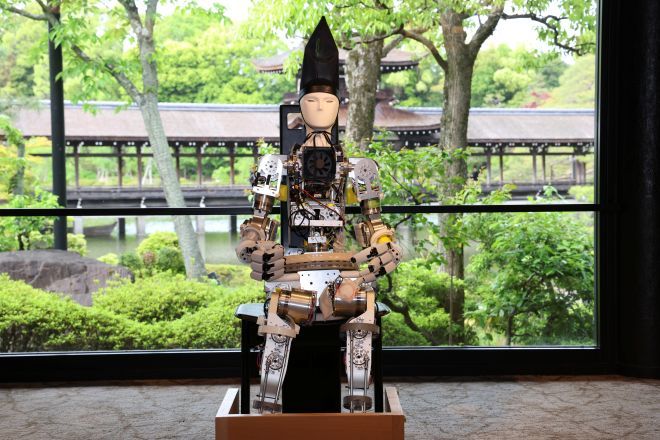
KYOTO—A made-in-Japan humanoid that’s part of a project to help the country make up for lost ground in android development got off to a shaky start.
A prototype of the robot, developed by Japanese companies and universities as members of the Kyoto Humanoid Association (KyoHA), a general incorporated association, was unveiled in Kyoto on April 28.
Designed for use in rescue efforts during natural disasters and other emergencies, the prototype is 140 centimeters tall and weighs 49 kilograms.
It is named Seimei, a play on the Japanese word meaning “life.”
But on the day of its public presentation, Seimei struggled to show signs of life. It was unable to walk or move its arms.
Apparently, a leg component had been severely damaged during a test just before the demonstration.
KyoHA intends to identify challenges involving parts and control systems through prototypes and complete a mass-produced model by the end of March 2029.
The association plans to release another prototype by year-end that can generate far greater force at construction sites and in nursing care.
Although the world’s first full-scale humanoid was born in Japan, the nation trails other countries, such as the United States and China, in the robotics field.
KyoHA aims to reverse the trend by pitching a domestically produced humanoid built with components from Japanese manufacturers.
“We must, first and foremost, acknowledge that humanoid robots from the United States and China are extremely advanced,” said Kenji Hashimoto, a robotics professor at Waseda University and a director at KyoHA. “Despite this, we are determined to go all out toward making the most of Japanese-made parts in our robots and thereby putting in place a domestic supply chain.”
Seimei appeared in traditional Japanese attire in the image of Abe no Seimei (921-1005), a yin-yang practitioner from the Heian Period (794-1185).
All components of the robot’s body, such as motors and sensors, are supplied by Japanese makers.
However, its graphics processing unit (GPU), the core of the android-mounted computer responsible for controlling the mechanical limbs, is provided by Nvidia in the United States.
The project to expedite the practical application of a Japanese-made humanoid started last June, primarily by Waseda University, electronics part giant Murata Manufacturing Co. and robot maker Tmsuk Co.
KyoHA is looking to collaborate with domestic manufacturers across a range of industries to eventually establish a dedicated supply chain for robotic parts.
So far, two universities and 14 companies have joined.
AloJapan.com