
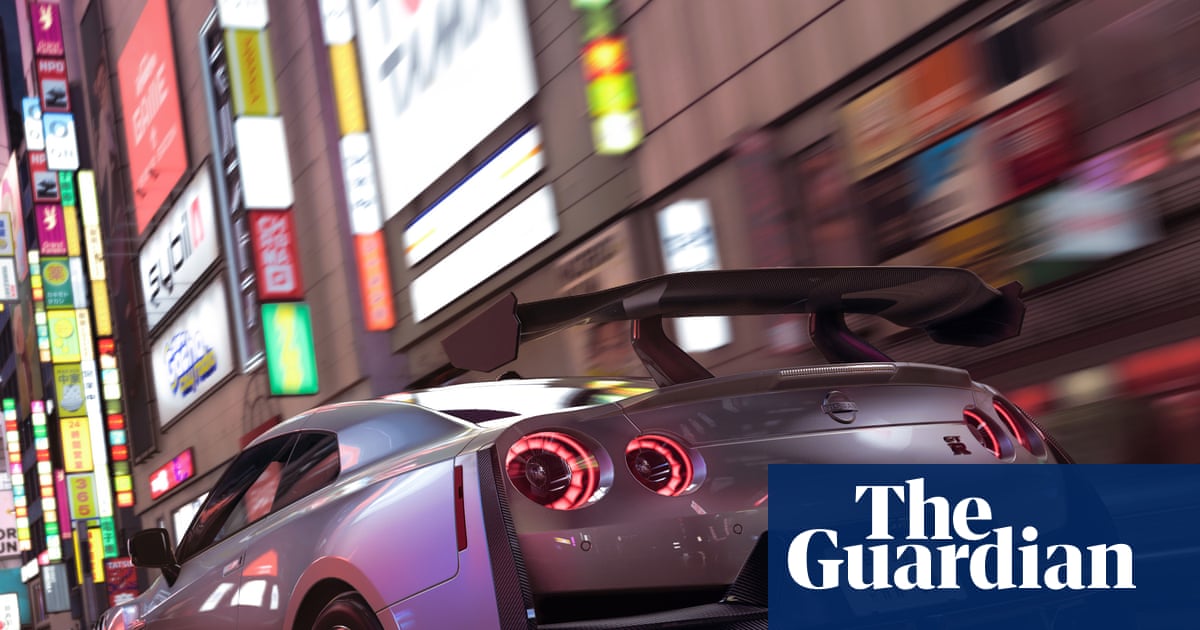
Since the arrival of the original Forza Horizon in 2012, a game that revolutionised open world driving sims by setting players loose in a virtual Colorado, British developer Playground Games has promised authenticity with its settings. For each instalment, design teams are sent out on location to take thousands of photos, hours of video, even detailed captures of the sky, before construction of a virtual copy begins. It’s a huge undertaking. But it seems that for much of the past decade, one country remained slightly out of reach – an intimidating prospect. “Japan has been on our shortlist for several games now,” says design director, Torben Ellert. “But we just didn’t feel like we were ready to take on the challenge of building it.”
It’s not just about the sheer variety of the country’s landscape. There’s something else going on. Most video game players hold an image of what it is like to explore Japan. It may be inspired by the fictitious rural town of Inaba in Persona 4, or the busy docks of Yokosuka in Shenmue, or perhaps the neon-drenched Kabukichō district of Tokyo, which forms a regular backdrop in the Yakuza series. For decades, gamers around the world have been bombarded with images of the country that are often highly stylised and fragmented, but nonetheless potent and persuasive. As art director Don Arceta puts it, “with Japan there’s such an expectation [of] what gamers want – it’s a certain version of Japan that they picture.”
New route …a moment in Forza Horizon 6. Photograph: Microsoft
Playground’s answer was to get away from the Japan depicted in other games, as well as legendary street-racing manga such as Initial D and Wangan Midnight. Instead, it hired cultural consultant and one time Porsche ambassador Kyoko Yamashita, who worked with the team for three years advising on their depiction of the country and racing scene. According to Xbox Wire, she was able to point out tiny details, such as the traditional colours of store signs and what they symbolise. The dev team also worked with famed Kyoto-based bodyshop Rocket Bunny and car culture photographer Larry Chen, who appears in the game and fronted a series of YouTube documentaries named Art of Driving, looking at the cars and locations in Forza Horizon 6. “Because it’s a culture we see a lot, there’s a temptation to think you know it better than you do,” says Ellert. “Which is why we tried really hard to get people to course correct us if we were drifting.”
On the subject of drifting, Playground has sought to replicate the major elements of the Japanese street-racing scene. Seminal drift and wangan cars such as the Nissan Skyline, Toyota Supra and Mazda RX-7 are in there, and so are the narrow, winding mountain roads of the illicit touge racing scene which emerged in the 1960s and hit peak popularity in the late 1990s. “We knew we wanted to do a touge experience, but we also knew that if you get 50 people in a room and ask them to define a touge experience you’d get 50 different descriptions,” says Ellert. “We’re imposing some class restrictions, delivering interesting liveried vehicles and putting players on to super iconic roads such as Hakone Nanamagari or Mount Haruna. Someone will go, ‘Oh, that’s not what I thought Initial D would look like in Horizon’ – and it’s like, well, yes, this is our take on that experience.”
Peak touge experience … Forza Horizon 6. Photograph: Microsoft
As with the countries featured in previous instalments, the Forza Horizon 6 map (the largest so far) is a sort of curated amalgam of scenic types. “We looked at iconic roads, landmarks, car culture, interesting biomes,” explains Arceta. “There was a lot of reference photography, a lot of scans, trips out there to capture the vibe and all the nuances that make Japan so special. [In previous games] we’d drive out with a Go-Pro on the dashboard, but this time we did the reference photography with 360-degree cameras which allowed us to capture the whole environment in both 2D and 3D – it was like our own version of Google maps. That helped us generate how we set dressed the world, but we also had proper scale and dimension – it really gave a sense of the space.”
You can zoom through bamboo forests and rice fields, you can run close to the railway tracks and watch a bullet train rocket past. The landscape is filled with little details – the little roadside temples, the pristine vending machines in rural lay-bys. “It’s the car-culture-adjacent elements,” says Arceta, when asked about his favourite elements. “The petrol stations, garages, the grassroots time attack circuits, just capturing that vibe … Those were the things that were exciting to work on.”
In the south of the map is a condensed yet still sprawling version of Tokyo. It takes in the bustle of Shibuya, the densely stacked electrical stores of Akihabara and the quaint suburban outskirts. Ellert seems particularly proud of the city: “When the preview version of the game was released I followed content produced by Japanese streamers, and one called out our representation of Tokyo railway station saying, I worked there and this looks really good. Honestly, for us to make a place with all the research, consultancy and support we can get and then for someone who lives there to say, ‘I recognise this place’ – that suggests we went in the right direction.”
Arceta concurs. “[Tokyo] is probably one of my favourite area, specifically Daikoku, because that’s basically a church – a church for cars. It’s so sacred. So us getting that right and capturing that type of car meet – it was really important.”
Those of us who have been playing Forza Horizon from the beginning have had many moments where we’ve spotted places we recognise. A little pub in a Cotswold village, the sun setting over the port town of Castelletto, a storm over the Maroondah rainforest. It will be fascinating to see how Japan comes together as a racing location, and if the game can give us elements of the country we have not experienced in games, cinema and anime, or even as tourists. We’re no longer in the era of open world racers – The Crew, Test Drive Unlimited, Midnight Club, Burnout Paradise have all come and mostly passed by. Horizon is still here. Its biggest test awaits.
Forza Horizon 6 is released on 19 May
AloJapan.com