
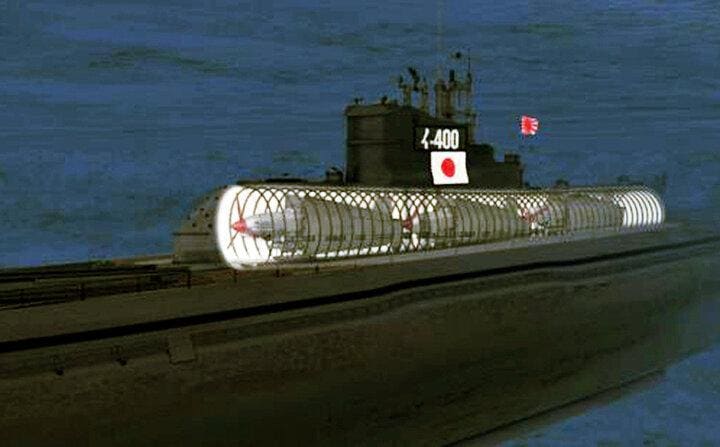
When people talk about the strangest projects of the Second World War, they usually remember jet fighters, rockets, or super-heavy tanks. But Japan had its own truly unusual idea: hide a strike aircraft inside a giant submarine, approach the target in secret, surface quickly, launch the planes, and then disappear underwater again. That was exactly why the Aichi M6A1 Seiran was created — a rare case in which an aircraft was designed from the very beginning not for an airfield and not even for an aircraft carrier, but for service inside a submarine.
The name Seiran is usually translated from Japanese as “storm in a clear sky” or “mist over the mountains.” It sounds poetic, but behind that beauty stood a very practical and very audacious military idea.
 Why Japan needed such an aircraft
The idea was simple and extremely ambitious. An ordinary aircraft carrier is visible, vulnerable, and requires a large naval formation. A submarine, by contrast, can move in secret. Japanese planners hoped to combine those two qualities: the stealth of a submarine and the surprise of an air strike. For that purpose they built the I-400-class boats, also known as the Sentoku class. These submarines were supposed to approach a distant target, launch their aircraft, and then vanish before the enemy even understood where the attack had come from.
The Panama Canal was initially considered the main target — a strategic artery linking the Atlantic and Pacific Oceans. If the Japanese had managed to destroy its locks, the movement of American warships from one ocean to the other would have taken months instead of days. Other targets were later considered as well: the naval base at Ulithi Atoll in the Caroline Islands, where the Americans kept a huge concentration of ships, and even bombing raids against New York or Washington.
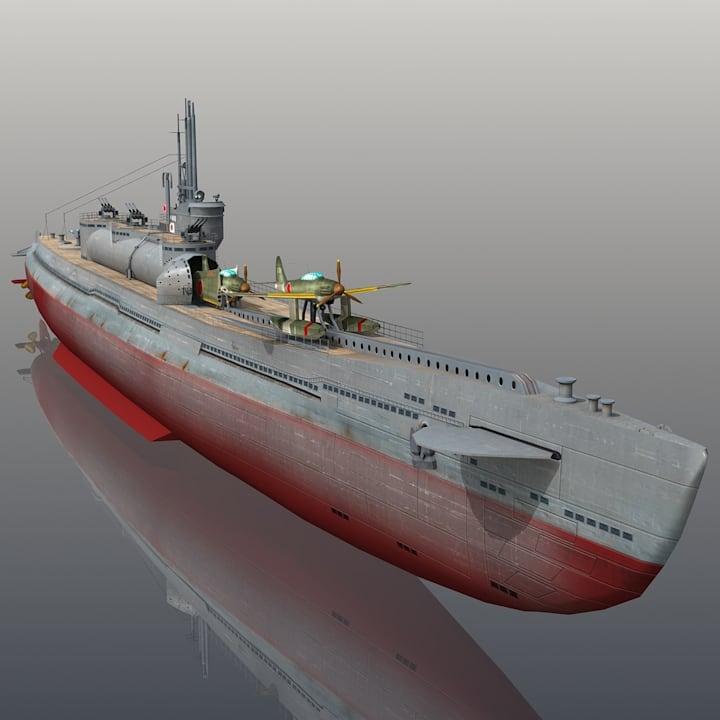
The I-400-class boats were not ordinary submarines, but true underwater aircraft carriers. Each one could carry three Seiran aircraft inside a watertight hangar and launch them from a catapult on deck. By the standards of the Second World War, these were enormous submarines: about 122 meters long, with a surfaced displacement of around 3,530 tons and a submerged displacement of up to 6,560 tons. Their record as the largest non-nuclear submarines in the world lasted until the appearance of nuclear missile submarines in the 1960s.
For comparison, the German Type XXI submarine, which was considered very large, was only 76.7 meters long. The I-400 was almost one and a half times longer.
 Why the Seiran was special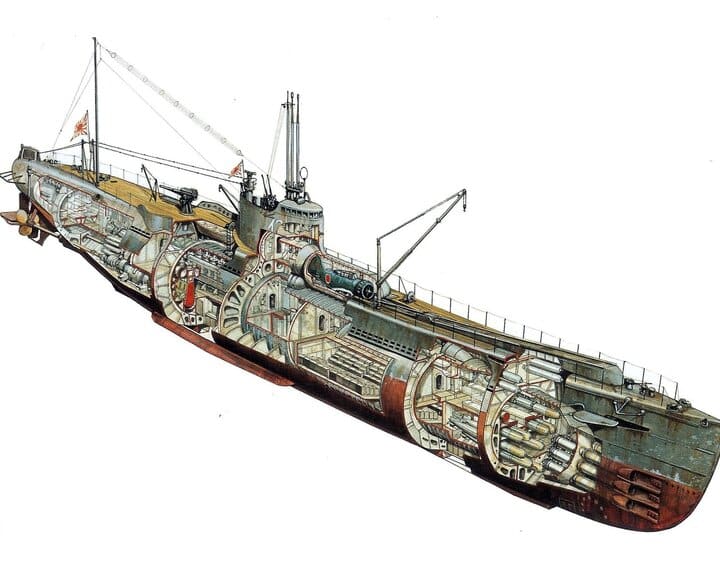
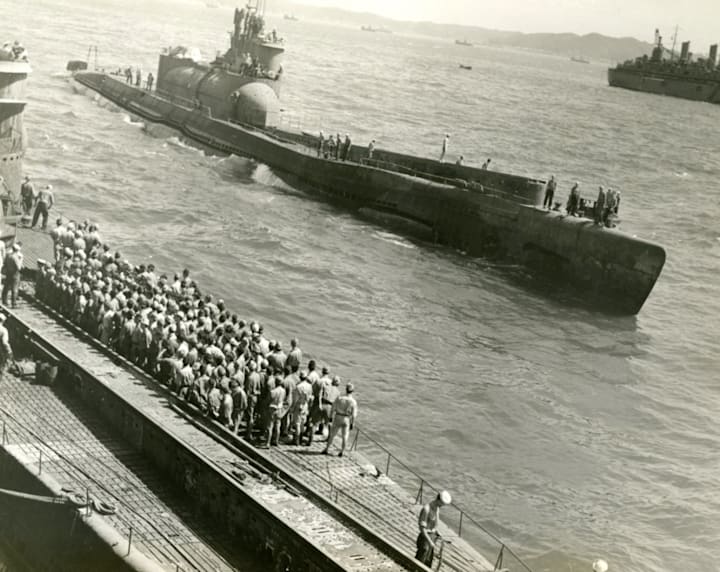
The Aichi M6A1 Seiran was designed for an extremely rigid mission. The aircraft had to be a strike machine, carry a bomb or a torpedo, be assembled quickly before launch, and at the same time fit into the cramped cylindrical hangar of a submarine. The hangar’s diameter was only about 3.5 meters, and its length roughly 34 meters.
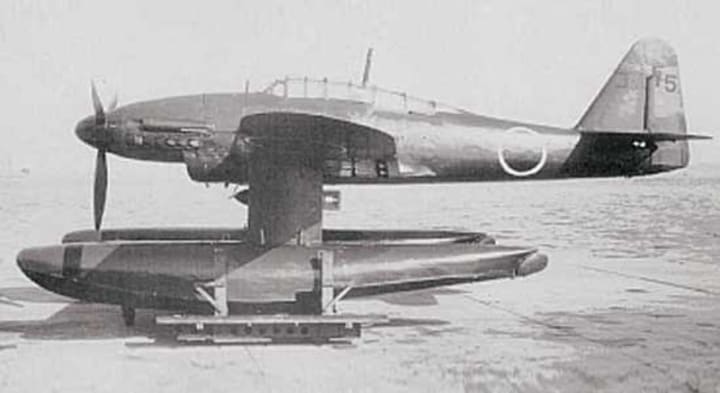
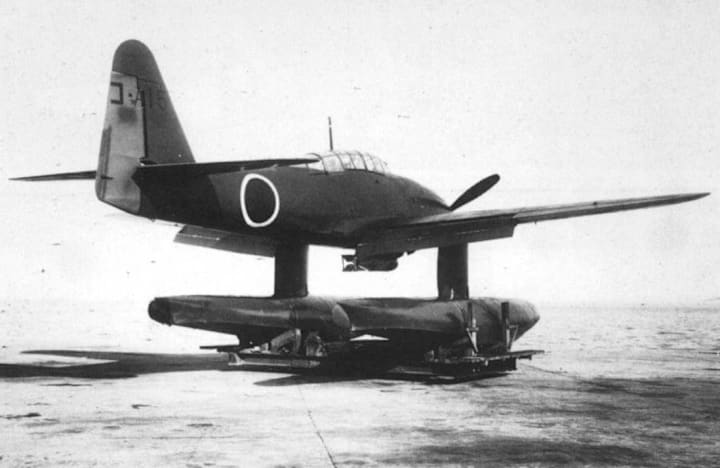
That is why the design was made foldable from the start. On the Seiran: its wings folded backward, rotating 90 degrees and lying tight against the fuselage; the tail surfaces folded down; the floats, because it was a seaplane, were stored separately in two waterproof cylinders next to the catapult.
As a result, the aircraft could be stowed inside the submarine’s structure and then quickly brought into flying condition before launch. A team of four men could prepare one Seiran for takeoff in about 7 to 10 minutes. All three aircraft from the hangar could be readied in roughly 30 to 45 minutes.
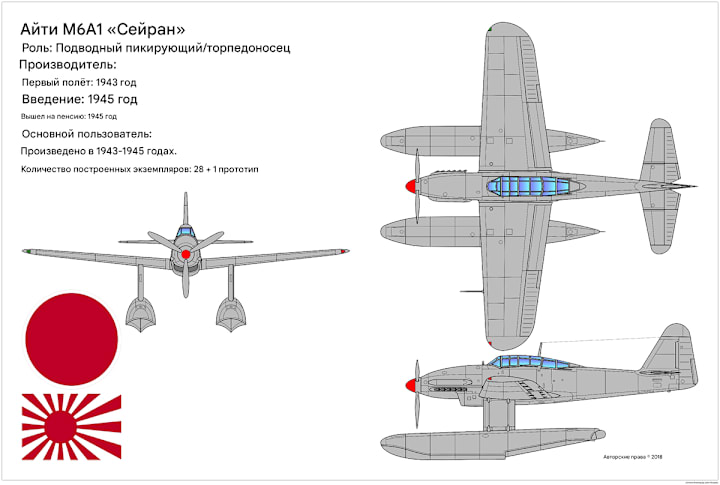
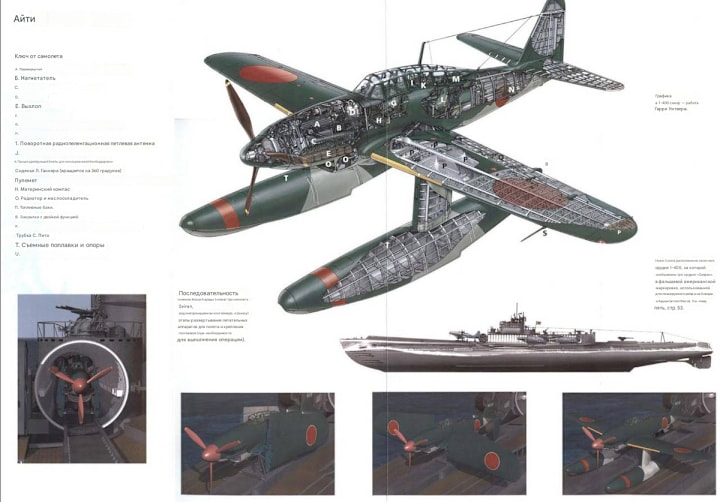
The technical characteristics of the Seiran vary slightly across sources, but in general they are given as follows: Length — about 10.8 meters, or about 9.5 meters when folded. Wingspan — 12.3 meters, reduced to about 2.5 meters in folded form. Height — around 4.6 meters. Engine — an Aichi Atsuta Type 32, a licensed version of the German Daimler-Benz DB 601, liquid-cooled, with about 1,400 horsepower. Maximum speed — about 475 km/h at an altitude of 5,200 meters. Range — up to 1,200 kilometers with a bomb load. Combat load — up to 800 kilograms: either one 800-kg bomb, two 250-kg bombs, or one torpedo.
For comparison, the American carrier-based Douglas SBD Dauntless had a top speed of about 410 km/h and carried up to 600 kilograms of bombs. The Seiran was faster and, at the same time, capable of landing on water.
The main difference between the Seiran and other “submarine aircraft,” such as the German Arado Ar 231, which was also built for submarines but was far weaker and slower, is that the Seiran was conceived as a full strike aircraft capable of destroying major targets. The Germans built small reconnaissance spotters. The Japanese built a weapon for strategic attack.
How the aircraft was hidden inside the submarine
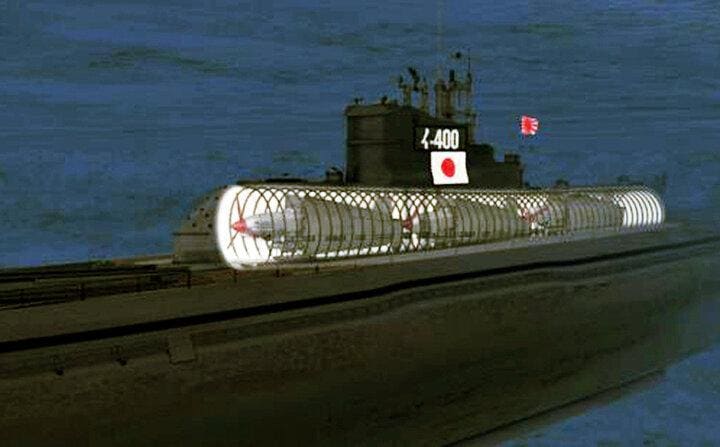
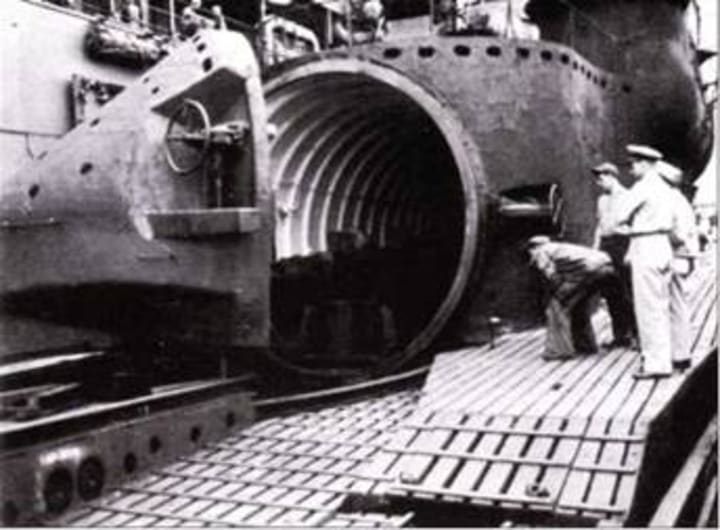
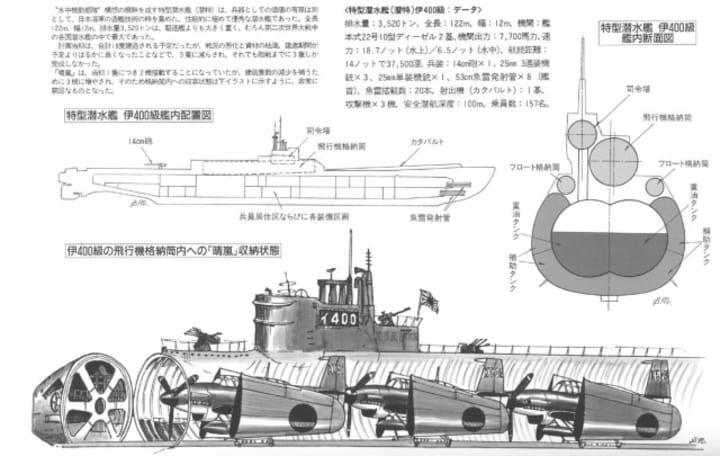
The most striking part of the story is the launch mechanism itself. On an I-400-class submarine there was a long watertight hangar, 3.5 meters in diameter and 34 meters in length. The hangar was not inside the pressure hull, but mounted above it as a separate structure. That made the submarine very tall on the surface, but gave enough room for three aircraft.
Before launch, the submarine surfaced and the watertight hangar doors at front and rear were opened. The aircraft were rolled out along rails onto the deck. There, the wings were unfolded and locked, the tail surfaces were put in place, the floats were taken from their containers and attached to the aircraft. After that, the Seiran was moved onto a pneumatic catapult about 30 meters long, mounted on the bow of the submarine. The catapult accelerated the aircraft to takeoff speed in about half a second.
One interesting detail is that, to save space and time, the Seiran could also be launched without floats. In that case, the aircraft was effectively disposable. After completing the mission, the pilot would have had to bail out, land at the nearest airfield if one could be found, or otherwise not expect a normal recovery. In theory, the crew was supposed to try to return to the submarine by landing on the water beside it, but the odds were poor.
This is where it becomes obvious how risky the entire concept was. The submarine had to surface, remain on the surface for 30 to 45 minutes, open the hangar, assemble the aircraft, and only then launch them. During all that time, it was vulnerable to aircraft, radar, and destroyers. The huge size of the I-400 also worked against concealment: on the surface it was more visible than an ordinary submarine and submerged more slowly, in about 1 to 2 minutes, whereas many submarines of the period could dive in 30 to 60 seconds.
 Development: long, expensive, and too late
The Seiran project began in 1942, when Japanese planners were still formulating the requirements for an underwater aircraft carrier. The company Aichi Kokuki KK, one of Japan’s major aircraft manufacturers, was chosen as the prime contractor. The lead designer was Tokichiro Goke, who had previously worked on the D3A Val dive bomber, the same type used in the attack on Pearl Harbor.
The first flight of the M6A1 prototype took place in October 1943. Tests showed that the aircraft was successful: good handling, respectable speed for a floatplane, and a reliable engine. But serial production began only in late 1944. By then, Japan was already losing control of the air, and American B-29 Superfortress bombers were regularly attacking Japanese factories.
Only 28 Seiran aircraft were completed, though some sources give figures as high as 36 depending on how unfinished airframes are counted. Of these, 18 were fully completed, while the rest were at different stages of assembly. There was also a training version, the M6A1-K Nanzan, without floats and with retractable landing gear for use from airfields, but only about 2 to 4 were built.
Why the I-400 and Seiran never fought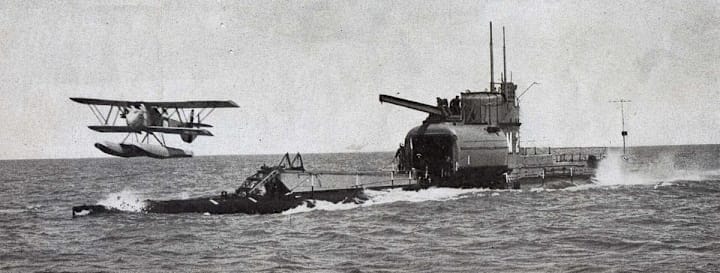
By the time the I-400 and the Seiran were ready to become real weapons, the war had already changed. Japan was losing the initiative, American naval and air superiority was growing, and the window for such complex operations was rapidly closing.
The plan to attack the Panama Canal was studied in detail for a long time. Japanese officers even sent reconnaissance agents to Panama. But by mid-1945 it had become clear that crossing the Pacific, slipping past American bases, and arriving undetected was nearly impossible. The Panama plan was abandoned.
Instead, the mission shifted to Ulithi Atoll in the Caroline Islands, where hundreds of American ships were anchored in the lagoon — battleships, aircraft carriers, and transports. The operation was called Arigō. Five submarines, both I-400-class boats and older I-13 and I-14 types, were supposed to launch ten Seiran aircraft simultaneously.
The submarines sailed at the end of July 1945. But on the way, one of them, I-13, was sunk by an American carrier aircraft on July 16. The others continued. On August 15, 1945, Japan announced its surrender. The commander received orders to return and surrender. He ordered the bombs, torpedoes, and then the aircraft themselves to be thrown overboard so that they would not fall into American hands. The Seirans were pushed into the sea with their wings extended and slowly sank. That was the inglorious end of Japan’s final offensive air operation.
What remained of the project
Of the 28 Seirans built, not one was ever used in combat. Several were destroyed in factory bombings, some were scuttled by the Japanese in August 1945, and several were captured by the Americans at the end of the war.
The only fully preserved Seiran today is in the Smithsonian National Air and Space Museum in Washington, D.C. It was the last completed example, which the Japanese did not manage to send to an operational base. After the war it was taken to the United States, restored over many years, and is now displayed at the Udvar-Hazy Center near Dulles Airport.
One of the old I-400 submarines was found off Hawaii in 2013 at a depth of about 800 meters, and another, I-401, in 2005. The Americans had sunk them after examination so that the technology would not fall into Soviet hands. Today, the wrecks are underwater museums.
One more detail: in 2019, the Japanese company Fuji built a full-size non-flying replica of the Seiran for a museum on Etorofu Island, now known as Iturup. That showed that interest in the project has not disappeared even after 75 years.
Why the Seiran and the I-400 are considered unique
Although no Seiran ever dropped a bomb in battle, the project remains historically unique for several reasons.
First, it was the most fully developed and advanced submarine-borne aircraft of the Second World War. Earlier attempts — the German Ar 231, the Japanese E14Y1 Glen, and American Kingfisher floatplanes on submarines — were reconnaissance machines or weak bombers. The Seiran was a real strike floatplane.
Second, the I-400-class boats remain the largest non-nuclear submarines in history. That record still stands.
Third, this was the most complex integration of aviation and submarine warfare ever attempted. Normally, aircraft were based on carriers. Here, the submarine itself became the carrier. The United States and Britain looked at similar concepts in the 1950s, but abandoned them quickly because missiles and helicopters proved more practical.
Fourth, despite all its technical boldness, the project failed strategically. The main problem was timing. The Seiran and the I-400 were developed from 1942 onward, but they became ready only in 1945. By then, Japan no longer had enough fuel for such boats, no reserve of trained pilots, and no freedom of movement in the ocean. Good technology, put into production too late and in too few numbers, cannot reverse the course of a war. It is a classic example of a “wonder weapon” that arrived two years too late.
Interesting details
The I-400 submarines carried a special optical device to help direct the aircraft and coordinate launch preparations. The waterproof float containers also served as auxiliary fuel storage. The Seiran was fitted with lights for night takeoffs from the submarine deck. After Japan’s surrender, the Americans found on I-400 a fully illustrated assembly manual for the Seiran. It is now in U.S. archives. The Aichi company that built the Seiran ceased to exist after the war, and its factories were converted to automobile and auto-parts production. Some facilities were later acquired by Toyota.
The main point
The Aichi Seiran and the I-400 submarines are an example of technical brilliance that found expression, but chose the wrong moment. The designers solved an almost impossible problem: fit a strike aircraft inside a submarine and make it combat-capable. The aircraft flew well, the submarines were built, and the crews were trained.
But wars are not won by engineers alone. They are won by those who arrive in time. The Japanese command spent three years developing the concept, and by the time it was ready, the outcome of the war was already decided. That is why the Seiran remained not the scourge of the Panama Canal, but a beautiful and somewhat melancholy legend on the floor of the Pacific and in the halls of a museum in Washington.
AloJapan.com