

Thank you for making the time to speak with us today. Before we begin, I’d like to share this topic with you building on what I mentioned earlier that we’re particularly interested in your recent initiatives around albums and commemorative albums: how you are responding to production needs, shorter lead time, and efficiency pressure; how customer experience and demand are evolving; and what you are seeing in terms of market expectations and production as you develop “hybrid” solutions across bridge traditional albums and commemorative products. From your perspective, how are market conditions and production realities changing?
There are certainly many factors: labor constraints, rising material costs, and other pressures. But the biggest issue in my business, without question, is the population decline of children in Japan. The falling birthrate defines structural challenge. And our company is certainly on the front line of that change.
If you look at Daicolo’s history, there have been periods of growth and periods of decline. For roughly the first 30 years from our founding, it was essentially all “uphill.” That was the era when Japan’s population was growing. In very blunt terms, it was a phase: even if you didn’t do much, performance still improved because the underlying market was expanding.
The “downhill” phase is different. When the population is shrinking, the market shrinks even if you keep the same number of client schools. You may still serve the same schools, but the number of children in those schools declines year by year. So even if the surface looks stable, the substance gets smaller.
To share a particularly revealing data point: if we take elementary and junior high schools in Japan as a base model; and what percentage of that have graduating classes of 50 students or fewer in your guess?
I imagine it’s quite high. Over 50%?
Exactly. In 2023, it crossed the 52% mark. That means more than half of the elementary and junior high schools in Japan now graduate 50 students or fewer.
What that tells us is very clear: the way we used to make these albums our traditional production approach (built for classes of 100 or 200 students) works simply no longer at scale. In the past, when each school had far more graduates, even analog production methods were sufficient. But as volumes per school fell, we needed a new model that could produce efficiently in smaller batches: is where digital production became not just an option, but a necessity.
Over the past 20 years, we have replaced essentially everything: our machinery, our workflows, and our systems. Digitalization accelerated dramatically. You mentioned Fujifilm earlier—equipment and solutions developed by Fujifilm are deeply embedded across our operations, and from their perspective that I’m sure I’m considered a very good customer.
There’s also a longer historical context. When I entered this industry, everything was based on analog photographic film. But then, in 1990s, digital cameras emerged and the printing industry changed completely. At that time, the challenge wasn’t just adopting digital—it was that even the file formats and standards varied by camera, and color characteristics varied as well. With film, you have a physical medium and the “format” issue is not the same. With digital, the data formats were differentiated, and aligning them was extraordinarily difficult.
We went through that difficult period; and what we are proud of is that we were the earliest among our industry to solve those issues and make the transition successfully.
A very straightforward step we took despite being a printing company was that we began selling digital cameras as a distributor by ourselves. Our customers include approximately 2,500 photo studios across Japan local photography shops that work closely with schools. We sold them Canon cameras, Fujifilm digital cameras at scale. As a result, formats and workflows began to standardize. Even today, we still sell Canon equipment, among other works.
After that wave of digitalization, the early 2000s brought the web system. And then SNS became to take root in daily life. The people receiving our products are heavy SNS users, and that changes content expectations. It impels a shift away from “only the traditional graduation album” and toward content that reflects the reality of how people share and express current memories where individuals can upload what they shoot their own identity instantly and presently.
That has a direct implication: content becomes more personal. Traditionally, the graduation album’s value is come from the fact that every student from the same school shared one common book. But as society has moved toward SNS-driven self-expression uploading, personal storytelling we reached a point where we had to incorporate both: personal pages and shared pages, in the same product.
That required major technical change. Variable printing where each copy can include different pages became essential. And today, that also have becoming increasingly mainstream.
Nowadays, another major technological wave is arriving: AI. One practical area where we are already using AI is layout. Also currently, AI can support the layout process how photos are arranged, how pages are composed.
You mentioned earlier that photographers often take hundreds of photos at school events, yet only a small portion appears in the printed album. Can you explain how you’ve approached that gap, and what it means for your business model?
Yes. The transaction flow typically works like this: a school photographer often belong to a local photo studio takes photos for a school event. For a single event, they may take 500 photos or more. Yet only a small selection ends up in the album. For example, if 30 photos are in a single page, that means around 470 photos are gone to unseen effectively.
I focused on that issue. My view was: why do they let sit those photos (they already took) unused? So we developed a business to sell those photos online. We run online photo sales so that parents can purchase pictures of their children from school events. And here’s fascinating pattern: the peak time of purchase dates is typically between 9 p.m. and 11 p.m. After dinner, parents remember that “Today was the Christmas party.” or “There was an event.”, and they check the website. If they find photos where their child appears, they can purchase them immediately.
In terms of revenue, this business has grown so much. Due to that, it has surpassed our main printing business of graduation album. Before I became president, the company stood on one pillar: graduation album printing. Now we stand on two pillars: album printing and photo sales of children.
And all of that tie it back to what I said at the beginning: the declining birthrate forced us to find new ways to grow and to cover the shrinking base market. Without building new revenue pillars, we could not offset the demographic decline.

Osaka Head Office
You also showed examples of albums becoming more personalized. How far can personalization go, and what kinds of customer demand are you seeing?
Let me clarify something about the example I showed. In one album, only certain pages are personalized for each student, while the rest are shared. But we can go further than that.
What I showed next is an album that is entirely made for one child: is featured as the only person. The photos are still taken within the school across the year: sports day, cultural festival, club activities, and whatever the school calendar includes.
We use facial recognition to search across all the pictures that the school photographercaptures throughout the year, identify that child, and automatically extract those photos. Then we compile them into a single book.
When you reach that level of personalization, grandparents will buy it. This is important point, because you generally can’t sell two or three copies with a standard graduation album. Then you may consider that one is enough. But if you want to sell an additional copy, you need a new reason. The “grandparent” segment what we sometimes call “grandparent power” is a strong opportunity. If the book is entirely about their grandchild, many grandparents happily purchase it.
I’d like to move to the topic of next transition. Thank you. You mentioned that you announced a shift: from print to mobile in February 2022. Could you explain the background? Which was the reason: competition was intensifying or consumer needs were shifting?
I believe consumer needs was. We announced our mobile graduation album in February 2022. And at the press conference, the most common question from journalists was essential: The leading graduation album printing company has finally launched a mobile graduation album. Does this mean the era of paper is over?”
That was the dominant framing. But that was not why we did it.
I pursued mobile because I felt there were clear limits to what print alone can express. Print cannot include voice. It cannot include music. It cannot include video. Yet the media environment surrounding young people is full of voice, sound, music, and moving images.
So I kept asking myself: for the generation receiving graduation albums today, is a purely two-dimensional printed format truly sufficient as an expression of memory? This is not about saying print is “bad.” It’s about whether print alone is enough as an expressive medium.
In fact, we had been thinking about this earlier. We produced video products and disc-based products as well. But the challenge was always device penetration; if you deliver a graduation album in a format that some families can’t access, you immediately face the question: “What about the people who don’t have the device?”
Today, that barrier has almost disappeared. Mobile phones are nearly universal close to 100% penetration. As a result, when we launched the mobile graduation album, we no longer faced the same question. That enabled us to add sound, voice, and music as part of the experience.
And I want to be very clear: we did not do this because “paper is over.” That is not our logic. Paper and mobile each have distinct strengths and appeal.
Japanese schools have not stopped ordering printed albums simply because mobile exists. There is a cultural element: people want a physical book (something like tangible and secure) that can be placed on a shelf and preserved. They memorize that sense of keeping as safe matters.
So our direction is not “replace paper,” but rather “expand expression.” For SNS-native generations, purely 2D expression can feel limited especially when they are accustomed to video and music as part of daily communication.
What, then, is the key idea that allowed your company to embrace these changes without resistance?
There is one keyword that matters. It’s how we define ourselves.
If I define myself or Daicolo as “a printing company,” then it becomes difficult to evolve. But we have always believed something broader: Daicolo is a company that gives form to children’s precious memories. That is our identity.
Because we define ourselves by our mission rather than a specific production method, we can change formats without psychological resistance. And we will likely continue changing.
This is why. Here is the very first album our company produced 73 years ago. It was for a school ‘Osaka Jogakuin’ in Osaka.The graduates in that book were 18 years old at that time. Today they are over 90. Yet their memories remain preserved in a physical form.
That is the essence of the graduation album. We are not simply printing paper. We are preserving memories in a form that lasts.
Thank you, that is extremely interesting. Many people reflect nostalgically on childhood memories as adults. Are you also considering services for adults (not only children) to help them preserve and shape their past memories?
Yes. Fundamentally, when Daicolo focused only on printed graduation albums, we produced albums for roughly one-third of Japan’s schools. Across the education system of elementary, junior high, high school, and university there are multiple milestones where a person may receive a graduation album. In Japan, there are effectively five opportunities across one’s life to receive a graduation album.
Daicolo tends to appear at those milestones. And once these materials are preserved digitally, something becomes possible that wasn’t possible before: what used to be “points” in someone’s life can become a continuous “line.”
In the past, Daicolo might appear only at certain moments. But if, for example, all five of those graduation milestones used Daicolo’s albums, then the person’s growth and history would exist in our archive. From there, we can potentially create new kinds of value.
For instance, in Japan, it is common at weddings to show a montage of childhood and early life photos through adulthood. That is something we could help create if we can connect the points into a line. If we can access a person’s data from university through graduate school as well, then yes there is potential to support weddings and other life events.
In that sense, an archive business has real future potential.
Separately, we also think about adult-focused products like personal histories. Many people have thousands of photos in their phones. But they rarely revisit them in a meaningful way. In the older era, photos were often stored loosely in boxes, all the same size, unstructured.
When you curate for your design, layout, choose which photo is large or small, add captions like “chasing a dream,” and shape the story memories become richer and more meaningful.
The number of times people press the shutter has increased dramatically compared with the film era, because you no longer need to buy film or pay for development. But despite the explosion in image volume, society has not yet fully caught up in terms of organizing, curating, captioning, and designing those memories into something enduring.
I believe there is still significant room for growth in this area the business of turning unstructured images into a designed narrative and a tangible, meaningful record.
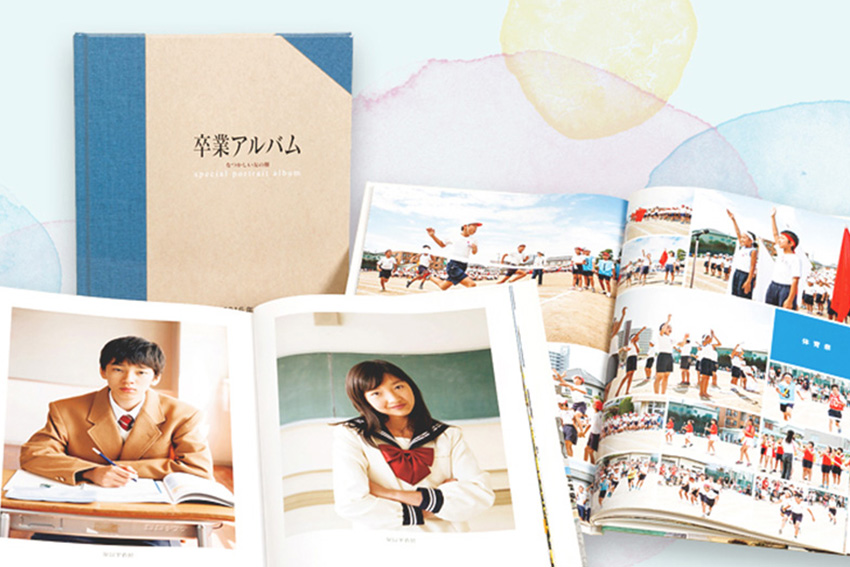
Graduation album
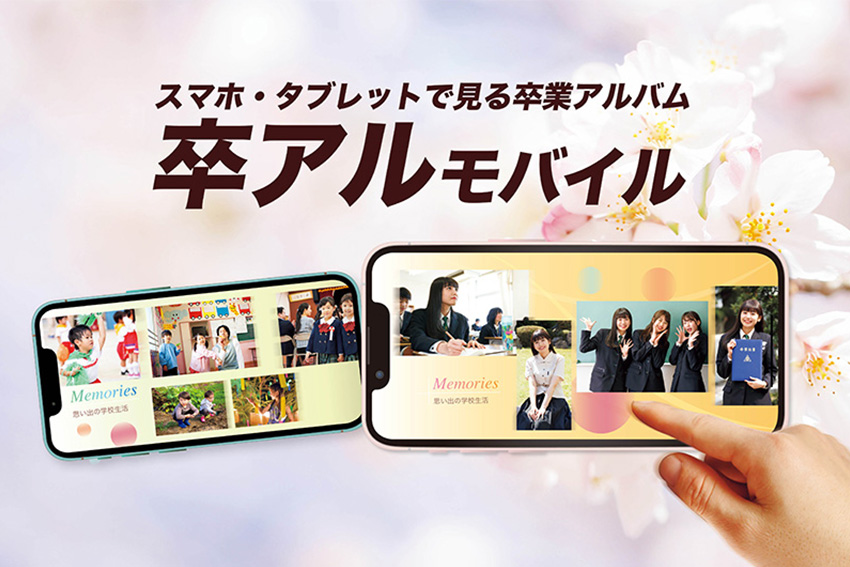
Mobile Graduation album
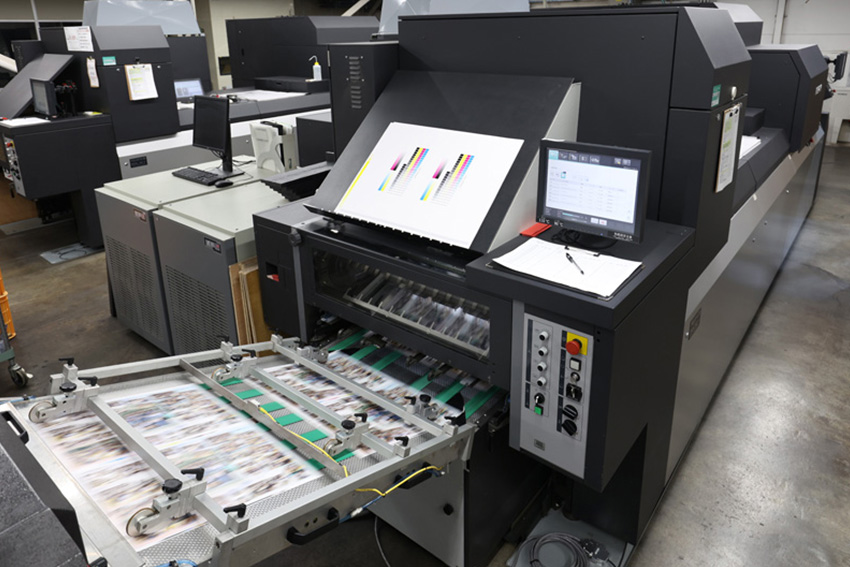
FUJIFILM Digital Press Co.,Ltd. Jet Press 750S

A graduation album filled with students’ cherished memories are now complete.
Previous Next
Before we move to your international business, I’d like to ask about your competitive advantage. You have about one-third market share in Japan, and strong trust from the market. Where do you believe your competitive strength come from?
I think about competition in two ways.
First is competition within our own industry. Nowadays, I believe there are only around 50 companies producing graduation albums nationwide in Japan. The remaining 70% is divided among those companies mostly regional players tied closely to local areas.
Within that group, the difference increasingly comes down to development capability: the ability to invest, innovate, and respond quickly to new needs. That includes capital strength and technical strength: our ability to change machinery,change systems, and modernize. Over time, that gap tends to widen.
The second competitive dimension is entry from other industries especially IT companies entering the graduation album space. This is already happening.
Interestingly, the entry barrier for them can be something very traditional: printing. We announced a mobile album, but we did not stop producing printed albums, and schools did not stop wanting printed albums. This reflects a Japanese mentality: people want something tangible to keep their important memories safe physically preserved in a book.
So even if an IT company is very strong in digital platforms, they often cannot produce high-quality printed books at scale. That is a major structural barrier.
On the other hand, we moved from print into IT. We can do both.
You’ve spoken about Japan’s demographic decline as a major driver. Why did you choose places such as Vietnam and Taiwan? Were you aiming to develop entirely new markets, or to expand Japanese culture abroad? And are there other countries you plan to enter?
The trigger was, again, the declining birthrate. But personally, that was the time I traveled across Asia with a single suitcase about ten years ago. I did it as an individual exploration more than as a large corporate project.
When I was younger, I lived in the United States for a short time, and I knew that yearbooks exist there. Because I work with graduation albums, I was naturally interested, and I looked at yearbooks from my own university.
One thing became clear: a yearbook is truly about “a year” Year 1, Year 2. The content structure is different. It is not only about graduating students. Japanese graduation albums (while perhaps more “emotional” in a culturally Japanese way) focus on graduation as a theme capturing past memories in one volume and marking the transition into the next step of life.
I became deeply curious: if we brought the Japanese graduation album what you might call a Japanese-style graduation book into other countries, would it be accepted or not?
I started in Taiwan because I had many friends there. It gained momentum. Then I expanded further. Today, Japanese-style graduation album formats have begun to spread still not to a very large number of schools, but steadily across 12countries.
What I felt strongly is that the hope to preserve the relationships and memories formed with friends is universal, and it is not limited by borders. And there are schools in every country. That realization gave me strong confidence that this business can be deployed globally.
In your overseas expansion, is demand coming primarily from students? r are parents also receptive to this kind of value?
What I found is that parents are receptive as well. Parents want to understand and preserve what their children’s school life looks like—what they did, who they spent time with, what moments shaped them. In that sense, this is not a value that exists only for students. And because there is no country without schools, the fundamental need is broadly present.
In Japan, the concept of a school photographer is well established. But in many overseas markets, that role doesn’t exist. How do you actually enter those markets? Do you partner directly with schools? And how do you make parents aware of the Japanese-style album?
In Japan, the composition has three players: the school, the photo studio, and Daicolo. That structure is essentially B to B to C.
However, it is different overseas. We operate more directly effectively B to C through the school relationship. Daicolo approaches schools directly, presents the concept. And if it is adopted, then we look for photographers.
In many countries, while there may be no dedicated “school photographer” profession that no one who stays close to a school across all its events there are always commercial photographers. They may be photographing food, architecture, and advertising. We start by working with those photographers.
When they discover that photographing children’s events can generate significant photo sales, the majority are genuinely surprised because they have never seen that kind of demand in that context.
So the business of producing graduation albums and selling school-life photos is a true blue ocean in many markets.
Where yearbooks exist, it is easier to enter. Even if the yearbook format is not identical (perhaps it doesn’t feature large), individual portraits in the same way we can position our product as a graduation-focused evolution: “For graduating students, why not create something like this?”
And in markets where there is no yearbook at all, we still find that schools often produce some kind of graduation commemorative item pens, for example. There is usually a budget allocated for graduation gifts. When we propose shifting that budget into a graduation album format, many schools adopt it.
Our magazine reaches 75 million readers. Around 40% are in Asia, and 60% are in the United States and Europe. Many of these readers are deeply interested in Japan and often purchase products connected to Japanese culture. If you had to express in one sentence how you want these readers to view your company, what would you say?
We say this constantly inside the company, and it is simple: we are a “memory maker.”
We are a company with a mission to give form to precious memories especially children’s precious memories. That is what we want to communicate. We do not think of ourselves as merely a printing company.
Thank you very much for your time today.
Thank you as well.
For more information, visit their website at: https://www.daicolo.co.jp/
AloJapan.com