

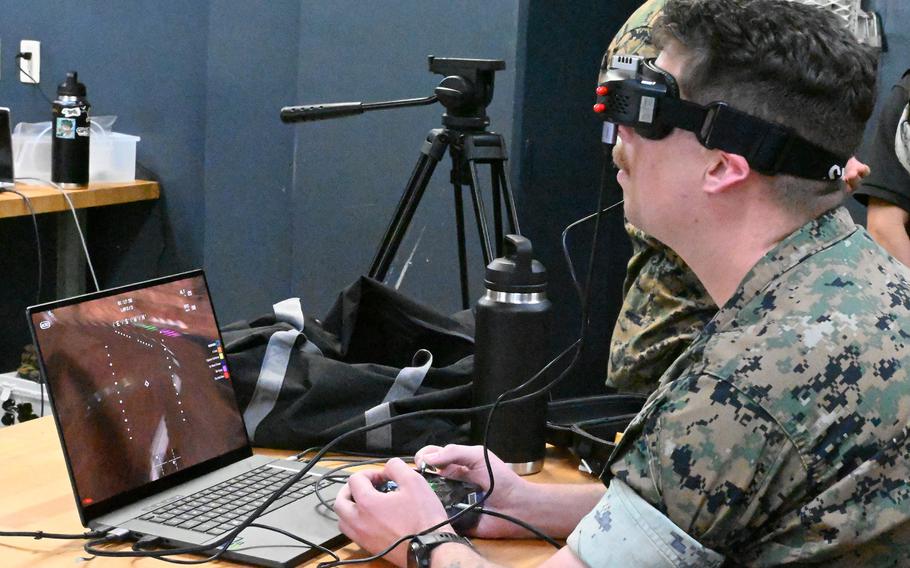
Staff Sgt. Shawn Carty of 3rd Battalion, 12th Marines, uses a drone simulator during the Basic Drone Operator Course at the III Expeditionary Operations Training Group headquarters on Camp Hansen, Okinawa, May 12, 2026. (Brian McElhiney/Stars and Stripes)
CAMP HANSEN, Okinawa — Marines on Okinawa are learning to build and fly surveillance and attack drones in new courses designed to help the service scale up its use of unmanned aircraft as the technology revolutionizes warfare.
The Basic Drone Operator Course is one of six piloting courses the Marine Corps announced in a December memorandum as the Corps works to field tens of thousands of commercial drones — or unmanned aerial systems — this year.
On Tuesday, reporters observed students during the second week of the course as they used computer flight simulators attached to joystick controllers and goggles and repaired training drones.
Students learn how to build a seven-inch, first-person view drone from a kit, then progress to hovering and maneuvering through obstacles, instructor Cpl. Austin Schiffer told Stars and Stripes.
“Toward the later part of the course, we start doing tactical employment — flight navigation,” he said after giving a lecture on electronic warfare to about 20 Marines. “And then, eventually, we’re going to get out to the range and see if they can execute some of the tests that we put them through.”
The three-week course launched on Okinawa in November, a month before the announcement, III Marine Expeditionary Force spokesman 2nd Lt. James Selcke said by email Wednesday.
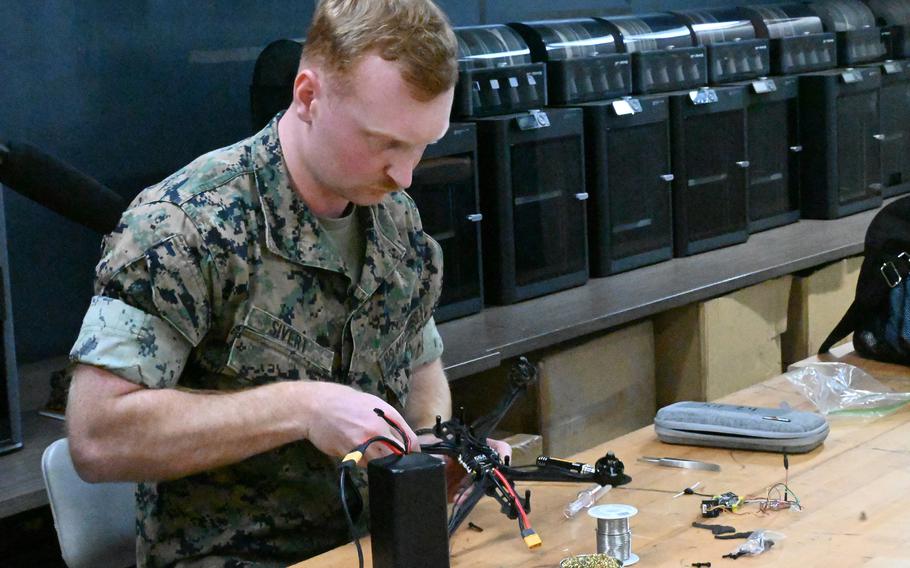
Cpl. Caleb Sivert, an instructor with the III Expeditionary Operations Training Group, assembles a training drone during the Basic Drone Operator Course at Camp Hansen, Okinawa, May 12, 2026. (Brian McElhiney/Stars and Stripes)
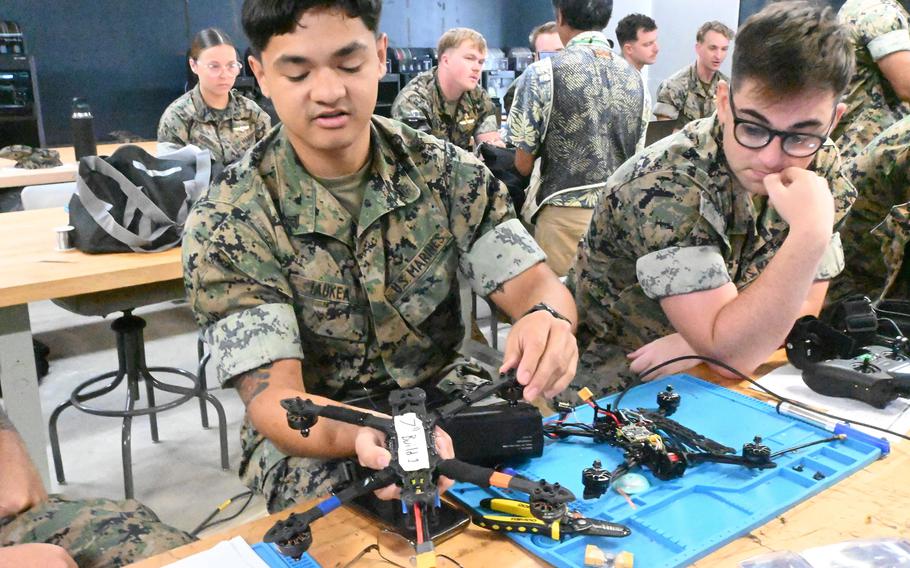
Cpl. Aidan Iaukea, of the 3rd Marine Division, troubleshoots a training drone during the Basic Drone Operator Course at Camp Hansen, Okinawa, May 12, 2026. (Brian McElhiney/Stars and Stripes)
Okinawa was selected as a regional training hub alongside Camp Pendleton, Calif., and Camp Lejeune, N.C., with Quantico, Va., serving as the central training site.
The courses create a “very formal, structured training organization” in response to Defense Secretary Pete Hegseth’s July 10 memo instructing combat units to incorporate more small drones into their arsenals, said Maj. Brant Wayson, the officer in charge of the III Expeditionary Operations Training Group’s Unmanned Systems Branch.
“I think all of us have seen in the news how effective drone warfare has been in places like Ukraine, Azerbaijan, in the Middle East, right?” he told reporters during a break in Tuesday’s course. “It’s had a huge impact on how forces are able to maneuver and conduct combat, so that’s incredibly important.”
Wayson declined to say how many drones are deployed to Okinawa or how many Marines have taken the course, citing operational security. Unit commanders determine how many operators they need, he said.
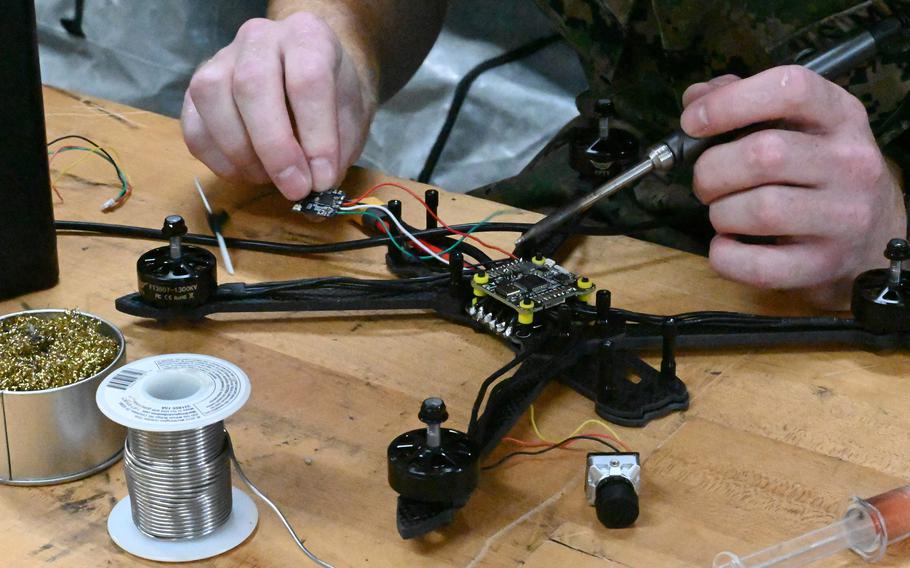
Cpl. Caleb Sivert, an instructor with the III Expeditionary Operations Training Group, solders electrical components on a training drone during the Basic Drone Operator Course at Camp Hansen, Okinawa, May 12, 2026. (Brian McElhiney/Stars and Stripes)
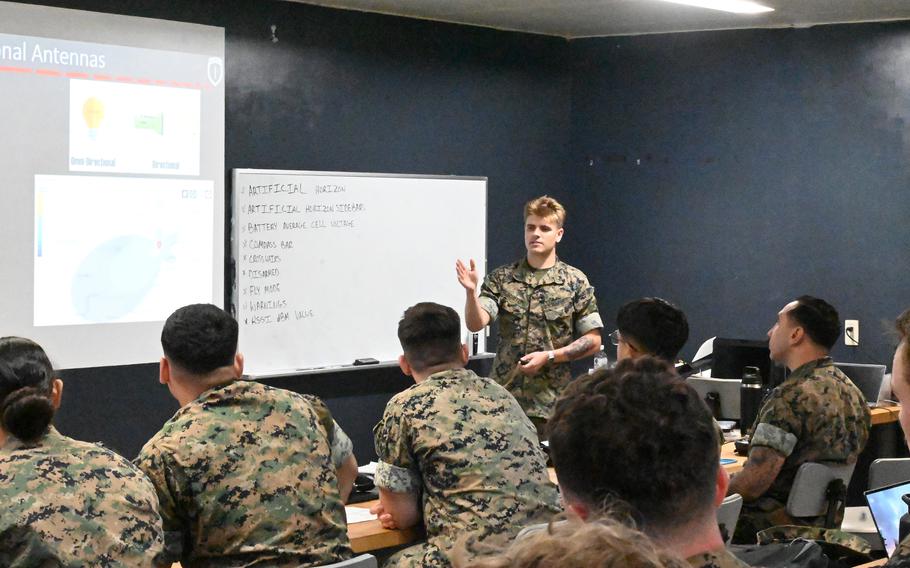
Cpl. Austin Schiffer, an instructor with the III Expeditionary Operations Training Group, gives a lecture on electronic warfare to students in the Basic Drone Operator Course at Camp Hansen, Okinawa, May 12, 2026. (Brian McElhiney/Stars and Stripes)
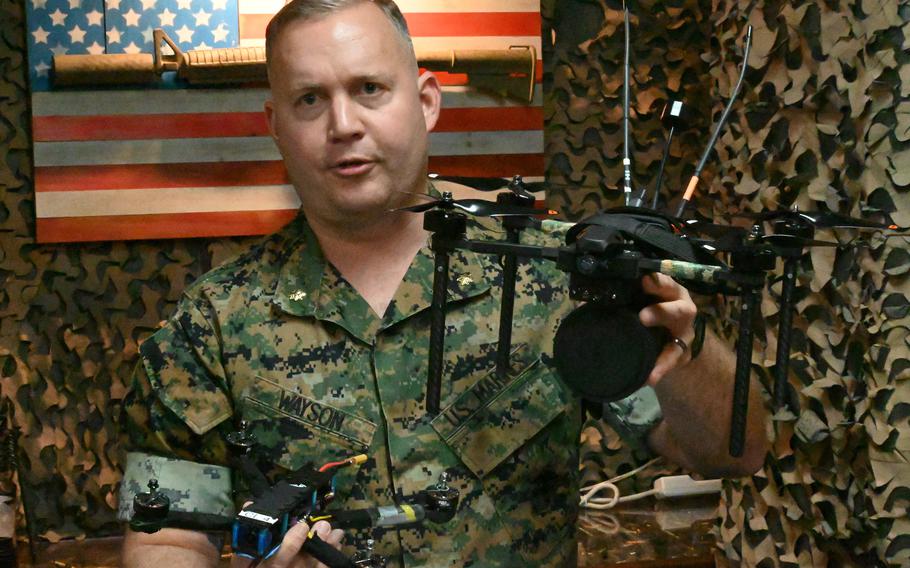
Maj. Brant Wayson, the officer in charge of the III Expeditionary Operations Training Group’s Unmanned Systems Branch, holds a seven-inch training drone in his right hand and and a Neros Archer attack drone in his left on Camp Hansen, Okinawa, May 12, 2026. (Brian McElhiney/Stars and Stripes)
After taking the basic course, Marines can take other training, such as the Attack Drone Operator Course, where they learn to deliver explosive payloads with Neros Archer drones, Wayson said.
In December, the Marines certified Okinawa’s first 12 attack drone operators during a two-week competition.
Staff Sgt. Shawn Carty, with 3rd Battalion, 12th Marines, was taking the course to explore how his unit might be able to use drones while fielding artillery.
“We don’t really have a program of record for drones yet,” he said while flying a forest course on the simulator.
Carty added he was interested in how his unit could use them for “reconnaissance, route observations, and just being able to identify friendly locations, enemy locations and figuring out which way we can maneuver to be more effective.”
Sgts. Brayden Davis and Ryan Hopkins of the 3rd Reconnaissance Battalion were working on elevation changes on their simulators.
“If we were to fly these out the gate, we would probably crash them,” Davis said. “But this is giving us a chance to improve those skills before we actually get to touch these.”
AloJapan.com