
travelogue
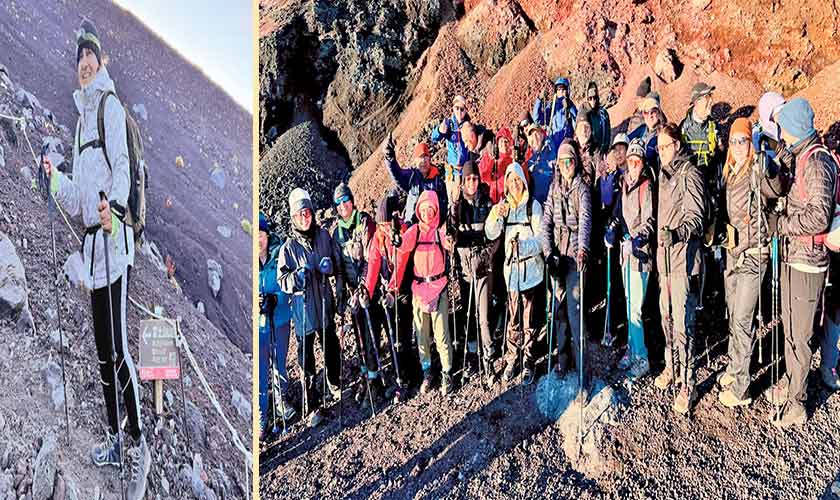
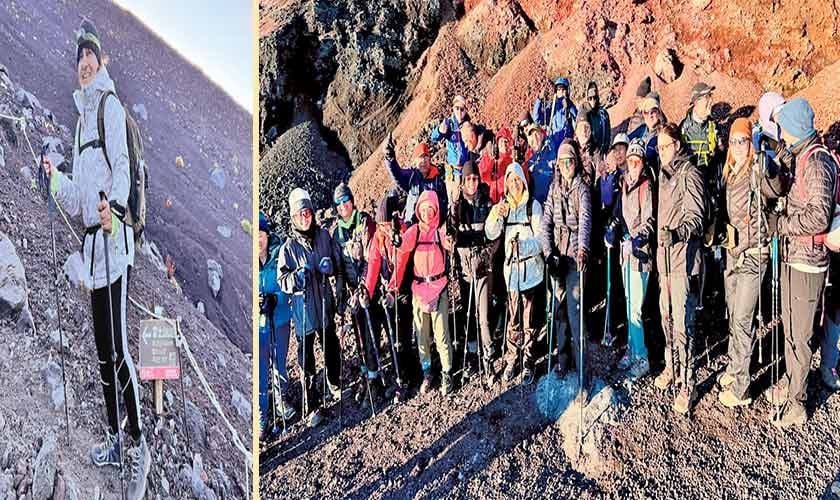
Beneath a clear Japanese sky, our journey up Mount Fuji began on an early afternoon in September last year. The air was fresh and invigorating and the sight of Japan’s most iconic peak rising above the landscape filled us with anticipation. With backpacks secured and trekking poles in hand, my husband, Shez and I joined our wonderful group of Kolachi trekkers and stepped onto the winding trail. Excitement mingled with determination as we knew this climb would be special, though none of us yet understood the challenges that awaited us.
Mount Fuji is more than Japan’s highest mountain; it is a national symbol that rises with quiet authority from the surrounding plains. Its graceful volcanic cone reflects the spirit of a nation that balances tradition with innovation. There is a striking harmony between Fuji’s disciplined symmetry and Japan’s remarkable advancement. Just as the country has transformed itself into a model of technological progress while preserving its cultural heritage, Fuji stands timeless and composed – a reminder of endurance and resilience.
The trail wound upward through fields of volcanic rock and ash, with loose gravel sliding beneath our boots and forcing us to tread carefully. In the steady light of the afternoon, the slopes appeared deceptively manageable, but the mountain gradually revealed its demands. Members of our group trekked at varying paces according to their stamina and rhythm. Shez moved ahead with the faster climbers, while I continued upward more steadily with a smaller cluster of trekkers. Though we remained connected by our shared purpose, the mountain naturally stretched us into smaller groups along the trail.
Having climbed Mount Kilimanjaro not long before, Shez and I had assumed that Fuji might be comparatively easier. Kilimanjaro had required days of trekking and gradual acclimatisation and Fuji seemed shorter and more accessible by comparison. Yet the mountain quickly proved that every summit has its own personality and its own trials. Fuji demanded intensity rather than duration: its steep slopes, shifting volcanic dust and relentless gradients tested both muscles and resolve alike.
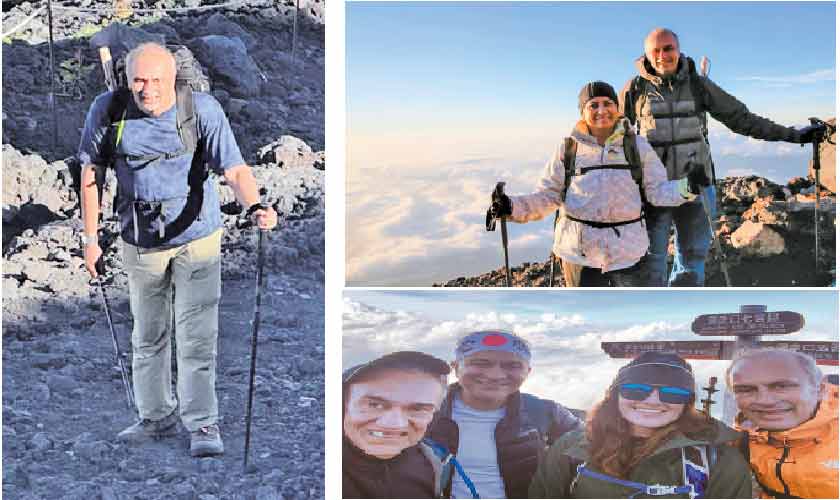
As the afternoon wore on, fatigue crept steadily into our limbs. The higher we climbed, the cooler the air became. Wind swept across the open slopes, carrying a sharp chill that reminded us how far we had already ascended. Every step required concentration and patience.
By evening, the advance party had reached the eighth station, our resting point before the summit attempt. The climb had stretched all of us to our limits and the shelter offered welcome relief from the wind and cold. Shez had arrived earlier with the faster climbers, while I continued upward more slowly with four fellow trekkers. The final stretch to the eighth station felt endless; each step demanded determination and the thinning air made even simple movements feel laborious.
I reached the eighth station much later than Shez, tired and ravenously hungry after the long climb. By the time my small group of four trekkers arrived well past sunset, the advance party had already eaten and turned in for the night, their exhaustion evident in the stillness of the crowded hut. Yet Shez remained awake; he had not touched his dinner, choosing instead to wait for me.
As I stepped into the dimly lit shelter, dusty and drained, a gentle cheer rose from those who were still awake. Someone called out that Shez had refused to eat until I arrived and I saw him look up with quiet relief. In that simple moment, more than in any grand gesture, I felt the enduring strength of a partnership forged over decades.
Thirty-four years into our marriage, I was reminded once again that the bond between us remained steadfast. As it had so often at ground level in the routines of ordinary life, it held firm even at altitude, under the strain of fatigue, cold and thin air. On that mountainside, amid physical exhaustion and emotional vulnerability, the constancy of that companionship felt like its own quiet summit.
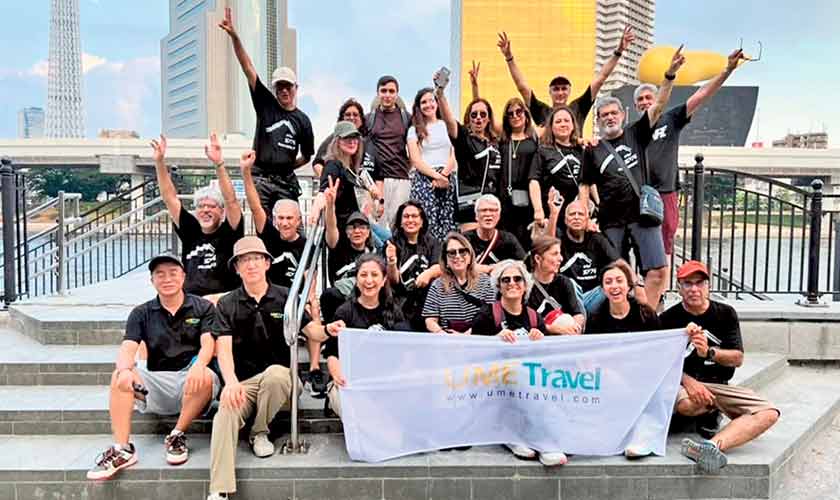
After dinner, we settled into the sleeping quarters. The mountain hut experience was compact, efficient and uniquely Japanese. Narrow bedding was arranged in tight rows, leaving barely enough space to turn. Climbers lay shoulder to shoulder, strangers united by exhaustion and purpose. Backpacks were stacked neatly and boots were lined carefully along the walls, reflecting the order and discipline that seemed to permeate everyday life in Japan.
Despite the cramped conditions, there was a sense of comfort. Everyone lay still, conserving precious energy for the final ascent.
At two o’clock in the morning, we rose again for the summit attempt. The hut stirred slowly to life: the rustle of jackets, the tightening of boot laces and the quiet murmur of voices breaking the silence. Outside, the air was cold and still and the darkness stretched endlessly above us.
Soon we were back on the trail, beginning the steep ascent in the beam of our headlamps. The pace was slower now, each step deliberate and measured. The incline seemed steeper than before and the altitude pressed heavily on our lungs. We encouraged one another with quiet words and steady presence, drawing strength from our shared determination.
As we climbed higher, the eastern horizon began to glow. Gradually, the sky softened into delicate shades of orange and pink. We paused often, partly to rest but mostly to absorb the unfolding spectacle. Watching the sunrise from Fuji is considered a special privilege and witnessing it first-hand felt like a reward earned step by step.
One principle remained constant throughout the climb: whatever we carried up had to be carried back down. Fuji’s trails are remarkably clean, reflecting Japan’s deep respect for nature and collective responsibility. There are no casual litter bins along the path; climbers must pack out everything they bring. Every wrapper and bottle went back into our packs. This discipline reinforced the sense that we were visitors entrusted with preserving the mountain’s beauty.
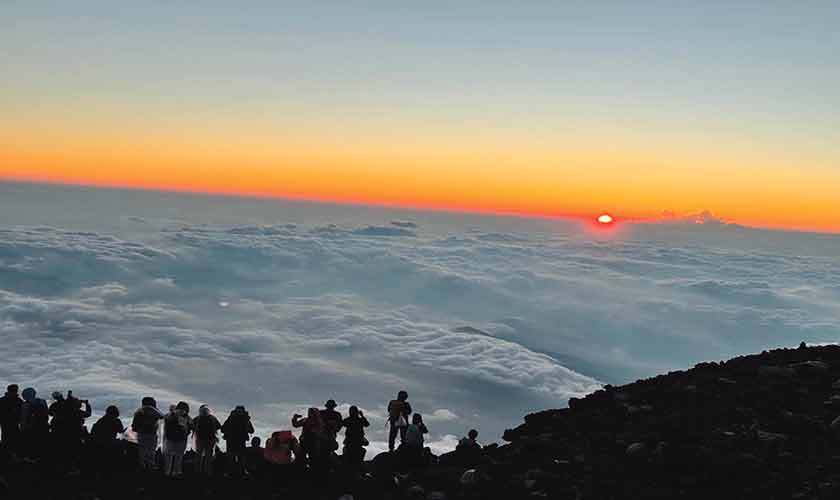
At last, after hours of steady effort, we reached the summit at 3,776 meters. The moment felt almost unreal. Clouds rolled beneath us like vast white oceans, while the sky stretched endlessly above. The rising sun cast a golden glow across the crater rim, transforming the volcanic landscape into something almost sacred.
Standing there beside Shez, surrounded by friends who had shared every challenge of the journey, I felt an overwhelming sense of gratitude. Fuji had tested us physically, mentally and emotionally, but it had also rewarded us with memories that would endure.
After spending precious moments at the summit, we began our descent back to the eighth station. The return trek was challenging in a different way – long, steep and punishing on tired knees. Yet reaching the station again felt reassuringly familiar. There, we finally enjoyed a proper breakfast, restoring some strength before facing the final stage of the journey.
The descent that followed proved gruelling. The loose volcanic gravel made footing uncertain and the long downward stretches required constant concentration. What had taken hours to climb felt even longer to descend. Yet, with every step downward came the satisfaction of knowing that we had stood at the summit.
Fuji was not simply another peak to be checked off a list; it became a symbol of resilience, friendship and partnership. Kilimanjaro had been magnificent, but Fuji possessed a character entirely its own – quieter perhaps, yet deeply profound.
Standing at the summit of Mt. Fuji, I realised something essential: mountains are not conquered by strength alone. They are climbed with determination, resilience, and heart, and above all, with the people who walk beside you.
As Shez and I completed our descent, carrying everything we had brought with us back down the mountain, I knew that Fuji would remain one of the most meaningful chapters in our travels – a journey beyond limits and a memory that would endure long after the trail had faded from sight.
Ainee Shehzad is an educationist, scholar, Cambridge-certified trainer and an avid trekker with the Kolachi Trekkers. She can be reached at [email protected]
AloJapan.com