
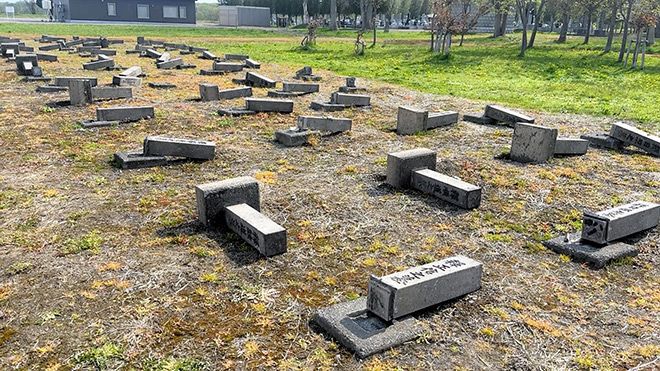
Vandals toppled 58 historic gravestones at a cemetery in Tsukigata, Hokkaido, sparking outrage over the desecration of the final resting place of prisoners who helped develop the region. (Chieko Hara)
TSUKIGATA, Hokkaido—An act of vandalism that toppled 58 historic gravestones at the final resting place of prisoners who died building modern Hokkaido has sparked shock and anger in this small northern town.
The desecrated graves at Shinotsuyama Reien cemetery in Tsukigata belong to prisoners from the 19th-century Kabato Shujikan, a prison whose inmates performed the brutal labor of carving roads and farms out of Japan’s northern wilderness.
A cemetery employee discovered the damage on the morning of May 4. All the gravestones in one section of the prisoners’ plot had been knocked over, some torn from their foundations. Graves belonging to the general public were untouched.
Town officials, who manage the cemetery, said the area was fine when staff left the previous evening. The town ruled out natural causes, such as high winds, and reported the vandalism to Hokkaido prefectural police who have opened a property damage investigation.
“This is an act that defiles the dignity of the pioneers who laid the foundation for Hokkaido’s development,” a town official said.
Another speculated that it may have been a prank that went too far.
The vandalism has been especially painful for those who preserve the prisoners’ history.
Kazuhiro Nomoto, a curator at the Tsukigata Kabato Museum, was speechless with frustration when he arrived at the scene.
“To subject people who died after such harsh labor to such a cruel fate. … It’s a desecration of the deceased,” Nomoto said. “A place that the community holds so dear has been treated with contempt.”
PIONEERS IN CHAINS
This deep sense of offense is rooted in the inhumane history that these graves represent, Nomoto explained.
The Kabato Shujikan was established in 1881 during the turbulent beginning of the Meiji Era (1868-1912) to house political dissidents and serious criminals far from Japan’s main island of Honshu.
Incarcerated within were peasant rebels from the Chichibu Incident, murderers and master thieves, all sentenced to 12 years or more.
The government’s goal was threefold: isolate dangerous elements, use cheap prison labor to develop and defend the northern frontier against Russian expansion and populate Hokkaido by having former convicts settle there.
Initially used for land reclamation, the prisoners were soon tasked with the urgent priority of road construction. They worked from sunrise to sunset in Hokkaido’s harsh climate, wearing thin linen uniforms even in the extreme cold.
Malnourished and tormented by the fear of brown bears and the despair of never returning home, many died from accidents, illness and the grueling conditions.
The roads they built—including the predecessor to National Route 12 connecting Sapporo and Asahikawa—became the backbone of Hokkaido’s development.
The five prisons across Hokkaido—Kabato, Sorachi, Kushiro, Abashiri and Tokachi—were responsible for carving out 820 kilometers of roads and clearing 690 hectares of land.
By the time the prison closed in 1919, more than 46,000 people had been incarcerated there, and 1,046 had died. The cemetery is the resting place for the 1,022 prisoners whose remains were never claimed by family.
The prisoners’ legacy is woven into the town’s identity. Tsukigata is named after the prison’s first warden, Kiyoshi Tsukigata. The local community still reveres the inmates as pioneers, holding an annual memorial service and tending to their graves.
“If people knew the history, I don’t think they could commit such a crime,” Nomoto said, urging the public to visit the museum housed in the prison’s original headquarters. “I don’t want this to be dismissed as just a sensational incident; I want people to know the history behind it.”
REBUILDING AND REMEMBERING
In recent years, the museum has seen a surge in younger visitors, partly due to the popular manga “Golden Kamuy,” which is set in the era.
“Many say they learned about a shadow history of Japan’s modernization that they were never taught in school,” Nomoto said.
The town plans to restore the 58 toppled gravestones by the Obon summer festival and has already received offers of private support.
Citing online rumors that the cemetery is a “haunted spot,” which may attract trespassers, officials will also install security cameras to prevent a recurrence.
AloJapan.com