
 사진 확대
사진 확대
When asked to choose a company representing Kyoto, six to seven out of 10 people think of Kyocera. This is because Kazuo Inamori’s management philosophy, which is called the founder and the god of management, is so famous that the company’s name is strong enough to be the abbreviation of “Kyoto Ceramic.”
Since the advent of artificial intelligence (AI), a crisis in the manufacturing industry has been discussed, but Kyocera belongs to a wind-free zone. This is because the growth of semiconductor-related parts and equipment, which are essential for AI, is so strong.
Kyocera recently announced that it recorded an operating profit of 118.1 billion yen (about 1.1 trillion won) in the 2026 fiscal year (April 2025 to March 2026) and expected to make a profit of 130 billion yen (about 1.21 trillion won) next year, up 10%. In particular, the profit growth rate of the “core components” business, which includes semiconductor-related ceramic parts, is expected to be 28%.
Stock prices have also been soaring amid strong performance, recently breaking new highs every day. As of the 8th, the market capitalization was 4.2512 trillion yen (about 39.67 trillion won), ranking 68th.
Shiro Sakushima (small photo), who took office as Kyocera president on the 1st of last month, joined Kyocera in 1990. As the first CEO appointed after the death of Inamori founder in 2022, he is expected to bring new changes to Kyocera.
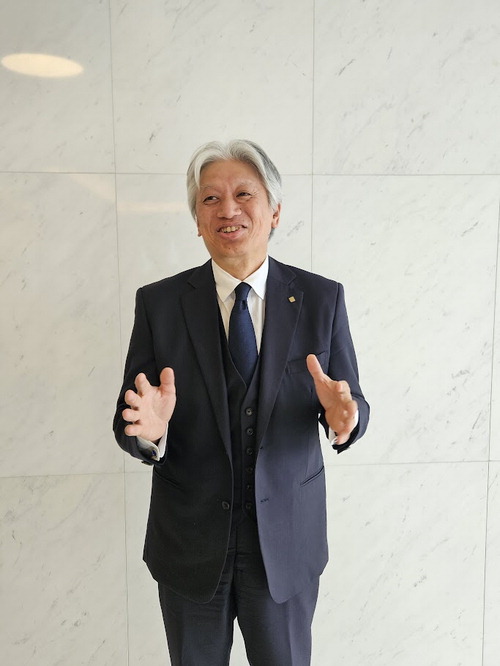 사진 확대
사진 확대
Sakushima chose Maeil Business Newspaper as his first interview with foreign media since taking office. In an interview conducted last month, he said, “Inamori’s management philosophy is not just an ideology, but a common basis for management judgment,” adding, “I think the most important thing is how to implement it in the field.”
President Sakushima cited “what is right as a human being” emphasized by founder Inamori as the core of Kyocera’s philosophy. This refers to putting management and life judgment standards on universal morality and ethics, that is, human conscience.
“In the end, it is important to see and judge the nature of things,” he said. “In times of high market volatility, such as in recent years, we should not move away from the essence.”
Kyocera is recently experiencing a surge in demand for semiconductors triggered by AI. In the field of semiconductor manufacturing equipment, AI packages, and electronic components, customer orders are increasing rapidly. With the expansion of the market, this year’s facility investment plan also reached 225 billion yen (about 2.1 trillion won), up 51 percent from the previous year.
President Sakushima cited “Ameva Management” as Kyocera’s competitive edge. The core of Amoeba management proposed by Inamori founder is for field employees to directly understand and judge the profitability of their products. The division of a large organization into a small organization capable of independent profitability is named because it resembles an endlessly divisive amoeba.
“In Kyocera, through ‘glass management’ and ‘all participatory management’ where everyone sees numbers, field employees are also well aware of the product price and profit structure,” he said. “This is the basis for not making a deficit until now.”
Kyocera is incorporating AI into it recently. It has already created in-house AI usage regulations and introduced a closed AI environment. “In the past, running amoeba management took a lot of time and effort,” Sakushima said. “In the future, we can use AI and data to operate more precisely and quickly.”
In the long run, Kyocera is paying attention to fine ceramics with core technology. Currently, the semiconductor sector is the center, but it is highly likely to expand into the space, nuclear fusion, and energy industries in the future. “Ceramics are materials that have strengths in extreme environments,” he said. “They will play an important role in new industries in the future.”
[Kyoto correspondent Lee Seunghoon]
AloJapan.com