
The Bangladesh Special Economic Zone is showing promise as a manufacturing hub, with swift land handover and private-sector efficiency drawing investments into the zone, according to the Bangladesh Economic Zones Authority (Beza).
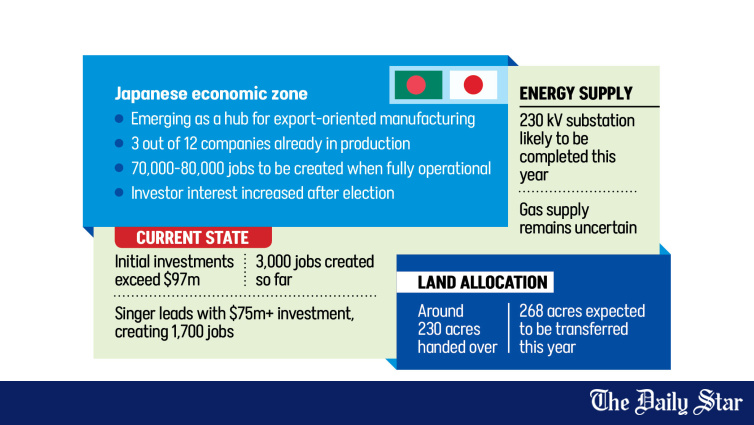
Three companies currently in operation are driving initial industrial activity at the zone, widely known as the Japanese economic zone, with combined investments exceeding $97 million and generating thousands of jobs, said the authority.
The investment pipeline at the Japanese economic zone shows a growing mix of manufacturers at various stages of approval.
New proposals are emerging in battery manufacturing, with discussions underway with potential Japanese investors.
Mohammad Zakaria Mithu Director at Beza
Out of the 12 companies that have entered the zone so far, three are already in production — Singer in electronics, ArtNature in specialised manufacturing, and Lion Kallol in the chemical sector, said Mohammad Zakaria Mithu, director (MIS and research) at Beza.
This pipeline highlights rising interest in sectors such as electronics, packaging, chemicals and engineering, signalling an expanding industrial base.
“New proposals are emerging in battery manufacturing, with discussions underway with potential Japanese investors,” he added.
Singer Bangladesh Limited leads in both scale and employment, having invested more than $75 million and employing over 1,700 local workers. The company has plans to nearly double its workforce.
Lion Kallol Limited, though smaller in scale, is gradually expanding. ArtNature Bangladesh Limited stands out for its labour-intensive operations, employing more than 2,500 locals alongside a significant number of foreign staff.
Together, these three reflect steady progress in positioning the zone as a hub for export-oriented manufacturing, with further investment and employment expected in the coming years.
Mithu described the progress as encouraging, noting that more investors are expected as pending land issues are resolved.
Around 230 acres have already been handed over, while the remaining 268 acres are expected to be transferred within this year under the development agreement. An additional 500 acres is under discussion for future expansion, subject to negotiations involving the Economic Relations Division and development partners.
According to the Beza director, infrastructure development is also progressing. A 230 kV substation is likely to be completed this year and handed over through the Power Grid Company of Bangladesh, which is expected to significantly improve electricity supply to the zone.
However, Mithu said that gas connectivity remains uncertain amid the ongoing national energy crisis. Although the central gas station has already been constructed, supply will depend on availability.
Employment generation is beginning to take shape, with around 3,000 jobs already created. Once fully operational, the zone is expected to employ between 70,000 and 80,000 people.
Mithu said investor enquiries have increased significantly since February 12, signalling growing confidence among foreign investors under the elected government.
Ashik Chowdhury, executive chairman of Beza, said the zone’s rapid progress highlights the advantages of government-to-government (G2G) collaboration when paired with experienced foreign developers.
“Once the zone was handed over, the Japanese side moved very quickly with development,” he said.
Chowdhury noted that foreign partners typically operate with clear commercial targets, enabling faster decision-making and higher execution standards.
“They have experience running economic zones elsewhere, and that reflects in both speed and quality,” he added.
He said the zone’s progress underscores the importance of completing key agreements early. Once foundational arrangements are in place, developers can move independently, maintaining momentum without prolonged administrative delays.
He described this model as essential for Bangladesh as it seeks to attract foreign investment and build competitive industrial infrastructure.
“Our priority is to ensure development happens quickly and efficiently– and this model helps achieve that,” he said.
AloJapan.com