
KOCHI—U.S. President Donald Trump’s complaint about Japan not deploying troops to support the U.S.-Israeli war against Iran brought back a teacher’s fond memories of a student and his letter addressed to Americans.
“Japan didn’t help us,” Atsuko Takase heard Trump grumble on a TV news program.
The 80-year-old teacher who lives in Hyogo Prefecture couldn’t help but wonder what her student from 35 years ago would say about the U.S. criticism if he were still alive.
CITING ARTICLE 9
Takase was teaching English at the private Tosajuku Senior High School in Kochi in spring 1991 when a third-year, red-faced student came running up to her.
It was Bunzo Kashiwagi, who was aspiring to move on to a medical school.
Seemingly in a panic, he showed his teacher thick bundles of airmail letters in both hands.
“Ms. Takase, I need to study for entrance exams and don’t have time to write replies,” she recalled him saying. “What should I do?”
At that time, Japan had also faced criticism from the United States for not sending the Self-Defense Forces to the Middle East to fight Iraq in the Persian Gulf War.
When Kashiwagi was watching TV, he saw a U.S. soldier say, “Japanese only pay a great deal of money.”
The student was worried that Americans would dislike Japanese without knowing that Japan renounces war in Article 9 of its Constitution.
He decided to write a letter to Bob Greene, a renowned U.S. columnist whose works he had read before.
“We have a reason that no soldiers were sent,” Kashiwagi said in the letter. “This is the Constitution of Japan, Article 9. … We have renounced war since 1945.”
He attached the preamble and Article 9, which he translated into English using vocabulary notebooks.
Kashiwagi’s letter asked Americans, especially U.S. service members, to become pen pals with him because he wanted to explain directly why Japan wouldn’t put boots on the ground.
The letter appeared to move Greene.
In the Chicago Tribune edition published on April 15, 1991, after the Persian Gulf War intensified, Greene wrote, “Some Americans may think … Kashiwagi to be naive. Sure–Japan can cite Article 9 while keeping its citizens out of international military danger spots.
“But Japanese schoolchildren grow up learning about Article 9,” he continued. “He asked me to print his address, so he could correspond with Americans–particularly American military men and women … . Sometimes a little naivete isn’t the worst thing in the world, though.”
Greene included Kashiwagi’s address at the end of the article to comply with his wish.
LETTERS FLOOD IN
With no social media or even mobile phones around to share information back then, more than 100 airmail letters soon arrived in Kochi from the United States, causing a commotion at Takase’s school.
She asked first- and second-year students to translate the letters into Japanese to give Kashiwagi more time to concentrate on his studies.
The letters came not only from military personnel but also from students, engineers, homemakers and retired veterans.
After Kashiwagi’s graduation, the school compiled the messages into an A4-sized booklet of nearly 150 pages.
The principal at the time wanted to memorialize how the 17-year-old became a symbol of the hope for peace and titled the booklet, “The International Impact of Bunzo’s Letter.”
REVISITED MEMORIES
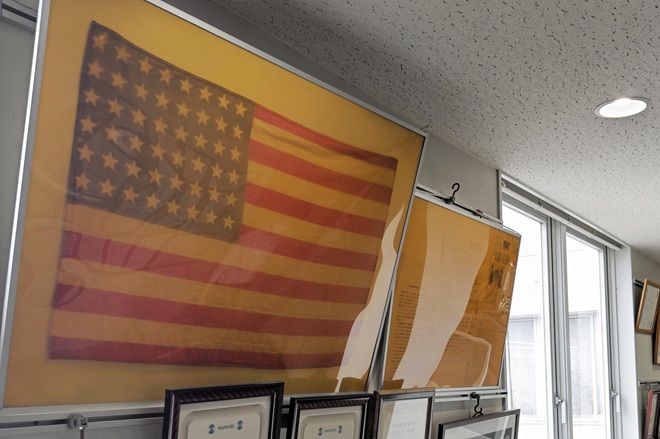
A copy of “The International Impact of Bunzo’s Letter” is housed at the senior high school’s library, while an old Stars and Stripes flag sent from the United States and the letters are on display in a corridor.
Kashiwagi remains known among current students.
However, he died young about 10 years ago after working as a doctor in Gunma Prefecture.
Thirty-five years after the booklet was created, the United States launched military strikes against Iran, and Japan’s “contribution” again became a topic of discussion.
“I wonder what he would do given the current international situation,” Takase said of Kashiwagi. “I wish I had a chance to ask him.”
Takase, who now teaches at an English cram school in the Kansai region, recently opened the booklet for the first time in many years and read the awkward translations of the letters by her students.
In one letter, a reservist severely criticized Japan for sitting idly by when innocent people were brutally killed.
In another, a high school student from a Chicago suburb said Japan’s ability to avoid war would be tested, not its ability to start one.
Others said that it would be good to have a similar clause in the U.S. Constitution, and that they wanted to know more about Japan’s politics and Constitution.
“The U.S. government and citizens didn’t necessarily share the same opinions at the time,” Takase said. “I think they sent those letters to tell Kashiwagi what they really felt because they were impressed by his feelings.”
Prime Minister Sanae Takaichi said she told Trump at their summit in March that there are things Japan can do and cannot do within the boundaries of the law.
She also said she did not cite constraints under Article 9 as an excuse for not dispatching SDF vessels to the Strait of Hormuz.
“I fear that someday Japan may turn what it cannot do into what it can do,” Takase said. “I want current politicians to know that there was a high school student whose straightforward appeal attracted sympathy in the United States.”
AloJapan.com