
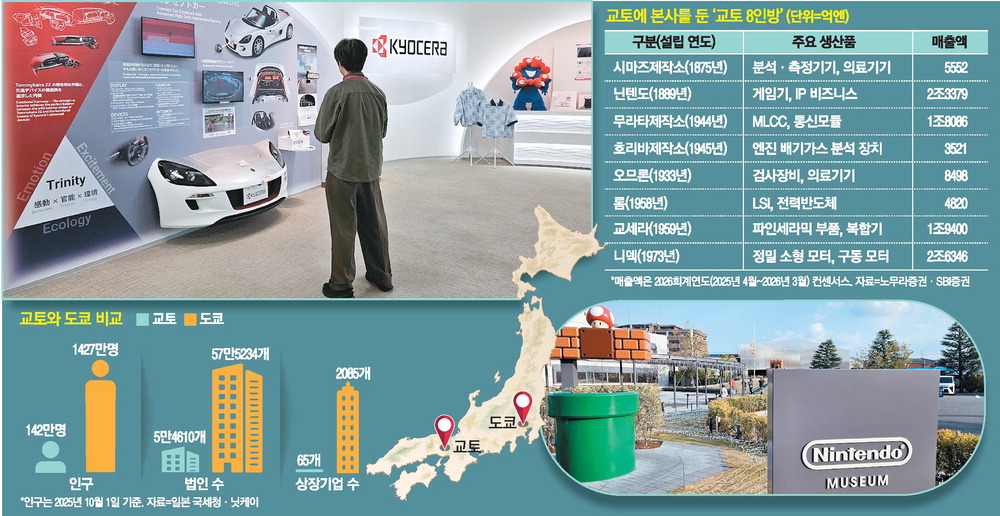
 사진 확대 Showroom (top) displaying Kyocera major products inside Kyocera headquarters in Kyoto, Japan, and a panoramic view of the Nintendo Museum in Uji, Kyoto, Japan (bottom). Kyoto correspondent Lee Seung-hoon
Murata Production Company, Kyocera, and Nidek, Japan’s leading parts and equipment companies, are called “Kosanke” companies in Kyoto.
Gosanke refers to the three most important families, Owari, Kishu, and Mito, who supplemented Tokugawa Shogun during the Edo period (1603-1867). These three key companies that support the Japanese economy are comparable to this.
Murata Production Company, which is considered the oldest, recently announced that its consolidated net profit in fiscal year 2026 (April 2026 to March 2027) is expected to be 293 billion yen (about 2.75 trillion won), up 25% from the previous year. This is because sales of multilayer ceramic capacitors (MLCCs), which are essential for artificial intelligence (AI) servers, are increasing rapidly.
MLCC serves to store electricity in the circuitry of electronics and supply it stably when needed. 15,000 to 25,000 AI servers are needed per AI server. It is also called the “rice of the electronics industry” because it is essential not only for servers but also for all electronic devices in which semiconductors enter. Murata’s production company has a global market share of 40 percent. “The growth of data centers centered on AI servers is strong,” said Noriko Nakajima, president of Murata Production Center. “The number of customers looking for large-capacity MLCCs as well as small ones is steadily increasing.”
Kyocera, another axis of Ko San-ke, also expects sales to increase 6% to 1.94 trillion yen (about 18.2 trillion won) in fiscal 2026, and operating profit to increase 10% to 130 billion yen (about 1.22 trillion won). Increasing demand for semiconductor-related ceramic components is driving the strong performance. In response, Kyocera plans to raise facility investment to 225 billion yen (about 2.1 trillion won), up 51 percent from the previous year.
Tokyo, the capital of Japan, is by far the city that supports the Japanese economy. It is a typical ‘software’ city with major corporate headquarters and financial, service, and platform.
Kyoto, which served as Japan’s capital for 1,200 years before Tokyo, is completely different. It is a tourist city with a long history for the general public, but in reality, it is a “hardware” city that combines materials, parts, and precision technologies.
Kyoto has a population of 1.42 million and an area of 828 square kilometers. Although it is incomparably small compared to Tokyo, which is 2,194 square kilometers in size and has 14 million people, the manufacturing industry accounts for 20 to 25%. This is two to three times greater than Tokyo, and the industrial density is overwhelming. In this narrow city, global companies such as Nintendo, Murata Production Company, Kyocera, and Omron were born one after another. With the recent era of artificial intelligence (AI), the competitiveness of these companies has begun to be clearly revealed. AI looks like a software industry, but its actual competitiveness is influenced by physical technologies such as semiconductors, sensors, and precision parts. In the end, it will be difficult to find the power of Japan to lead the AI era without the Kyoto of technology.
Then, why have Kyoto companies grown so much and what is their competitiveness. First of all, the compact urban structure can be cited. Kyoto is a small and medium-sized city, but companies, universities, and research institutes are concentrated in a small space. Due to the short physical distance, information exchange and collaboration speed are fast and decision-making is made efficiently.
In particular, the existence of Kyoto University, called the birthplace of the Nobel Prize in Japan, cannot be left out. Starting with Hideki Yukawa, Japan’s first Nobel Prize winner in 1949, there are 10 Nobel Prize winners from Kyoto University.
The second is the culture of “honmono.” A culture that values “real value” rather than trends or short-term performance is taking root throughout the company. Some say that the strict taste of aristocratic culture, which has been maintained for 1,200 years, is projected here. For this reason, technology development also focuses on long-term accumulation rather than short-term profits, resulting in competitiveness that is difficult to catch up with easily.
The third is “unreversible 易.” This means changing what is changed, but keeping what is kept to the end. Kyoto companies are based on traditional technology and philosophy but boldly accept new technologies when necessary. This becomes a structure in which companies with a history of more than 100 years can continue to grow.
The fourth is an eco-system in which companies, universities, and finance are organically intertwined. In particular, the role of Kyoto financial institutions, led by Kyoto Bank, founded in 1941, cannot be left out. Kyoto Bank owns all 65 listed companies based in Kyoto. Of these, 36 are major shareholders in the top 10. Kyoto Bank prioritized investment over loans in the process of corporate growth. It has played the role of venture capital since 80 to 90 years ago.
The last is exchanges between industries and a global perspective. In particular, it is noteworthy that it tried to pioneer overseas markets from the beginning without staying in Japan. Some interpret this as Kyoto’s cultural pride. In order to sell parts and equipment, you have to go to a large company in Tokyo and put your head down, but Kyoto’s pride did not allow it. Instead, it succeeded overseas first, and created a structure in which a large Tokyo company came to ask for parts supply.
[Kyoto correspondent Lee Seunghoon]
AloJapan.com