
Japan yesterday confirmed the first fatal bear attack of the year after a record 13 deaths last year, with reports pointing to a jump in sightings as the animals emerge hungry from hibernation.
A spate of bear encounters including at hot spring resorts and in supermarkets last year sparked alarm, with the government deploying troops to help trap and hunt the animals.
Record sightings have been reported again this year as the bears emerge from their winter slumber, local media reported.
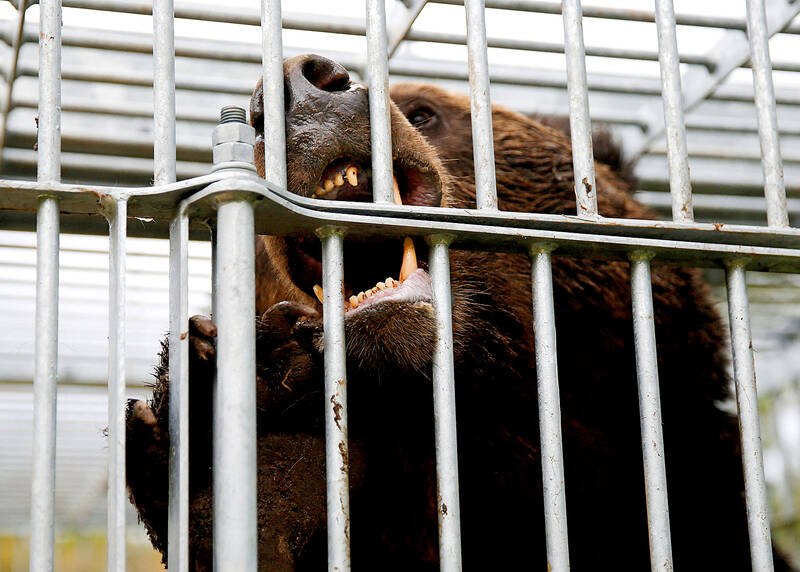
Photo: Reuters
This year’s first confirmed fatality, reportedly a 55-year-old woman, was discovered on April 21 in Iwate Prefecture, the Japanese Ministry of the Environment said.
Two more sets of human remains were found this week, police said, with media reports drawing a link to bear attacks.
One of the two bodies was discovered elsewhere in the Iwate Prefecture on Thursday, while another was found in a forest in Yamagata Prefecture on Tuesday, police said, without providing the cause of the deaths.
Broadcaster NHK identified one of the two as Chiyoko Kumagai, 69, who went missing after going to a mountain forest to pick edible wild plants.
Police and rescuers on Thursday launched a search in the forest where her car was parked and found her body shortly after 8am, NHK reported.
She reportedly had injuries on her face and head that appeared to have been caused by an animal’s claws.
City officials said local hunters were expected to begin patrolling the area yesterday.
Last year’s record number of fatal attacks was more than double the previous high of six. More than 200 people were also injured.
The animals were seen entering homes, roaming near schools, and rampaging in supermarkets and hot spring resorts almost on a daily basis.
Between April 1, 2025, and March 31 last year more than 14,000 bears were culled, official data showed, almost three times the previous year.
Scientists say that last year’s upsurge was driven by fast-growing numbers of bears, combined with a falling human population, especially in rural areas.
Bears are thriving thanks in part to an abundance of food — including acorns, deer and boars — due to a warming climate, experts say.
The brown bear population has doubled in three decades and now stands at about 12,000, while the number of Asian black bears has climbed on Honshu island, reaching 42,000, a 2025 government report said.
This in turn has led to “overcrowding,” forcing some bears to stray out of the mountains toward areas inhabited by humans, experts say.
Cubs in particular can become less fearful, and develop a taste for farmed produce and common fruits such as persimmon, but poor harvests in 2025 pushed bears to seek food elsewhere.
This year forecasts for nuts and other food are better, but as the animals have emerged from winter hibernation there have also been record numbers of sightings, local media reported.
In Miyagi, Akita, and Fukushima prefectures, the number of sightings last month was about four times that of the previous year, the Yomiuri Shimbun reported.
Brown bears — which can outrun a human — are found only in the main northern island of Hokkaido, while smaller Japanese black bears are common across Japan and are responsible for most of the attacks.
AloJapan.com