
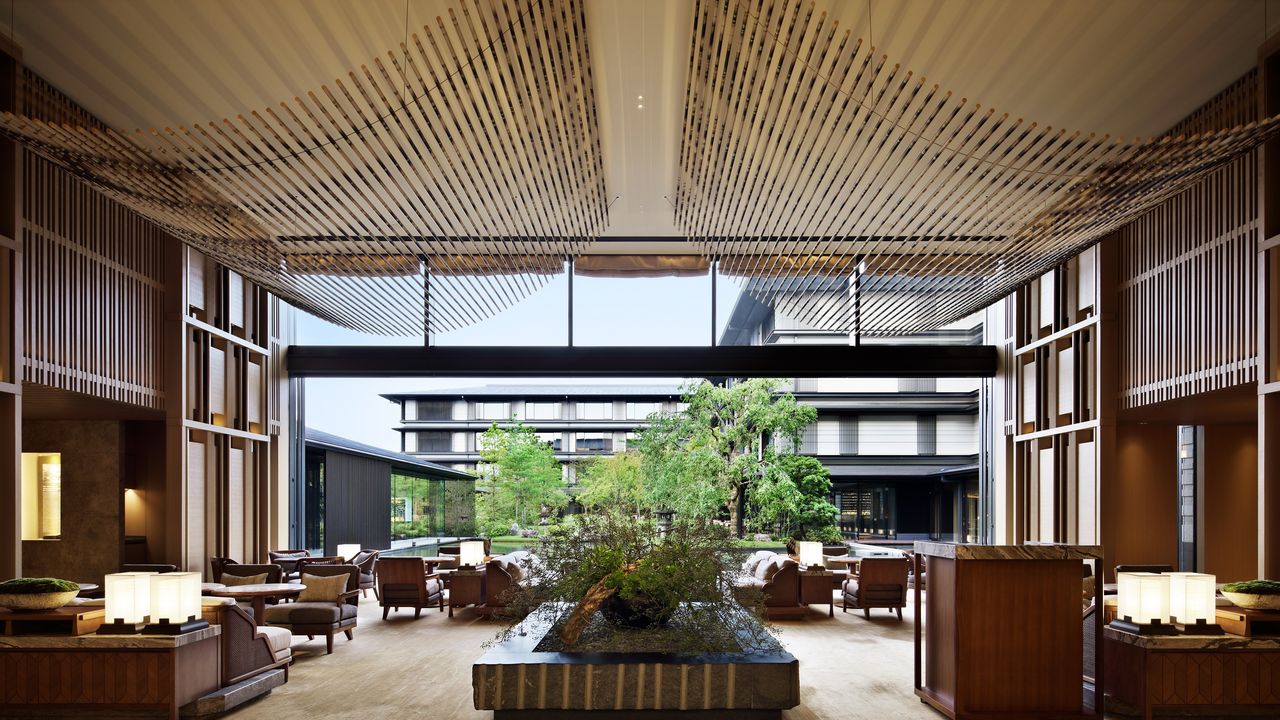
The original wooden Kajiimiya gates that once belonged to Kajiimiya court, and were bought by the Mitsui family in the 1930s, have been painstakingly restored and today mark the entrance to the grand hotel. Without them, you might very well walk past the building, the sleek façade of which is otherwise discreet and vernacular. The hotel’s sanctuary-like ethos hits you the moment you walk over the threshold and into the impressive lobby.
Arranged in a U-shape around the traditional Japanese garden, the hotel is configured to celebrate the extraordinary planting and the ever-changing views outside. In autumn, it is rust-coloured leaves and the silhouettes of Japanese red pine, black pine and blue oak that fill the lobby’s floor-to-ceiling windows. Though, of course, many visitors come to the city in spring to see the exceptional cherry blossom that has earned the city such international fame. The movement of water in the garden’s shallow pond is echoed throughout the hotel; above the lobby, a bamboo installation designed to mimic the way a kimono flows hangs above the low seating, while the carpets throughout are a bespoke design made up of fluid lines and undulating curves. Such details are the brainchild of designer André Fu, who is responsible for the hotel’s deeply considered interiors.

One of the hotel’s suites.
Miyuki Kaneko (Nacasa & Partners inc.)
One-hundred-and-sixty bedrooms and suites are arranged over the hotel’s four floors, though thanks to clever design and the quiet, respectful Japanese sensibility, there is a real sense of seclusion and calm. We recommend requesting a room that overlooks the garden, which is arguably at its finest when lit up in the evening. Inside, the fusion of old and new, tradition and innovation, continues: headboards made from vintage kimono silk rub shoulders with upholstered walls and furniture in solid walnut. The design cites the simplicity of the Japanese aesthetic but marries it with the opulence you would expect from such a hotel – and it does so effortlessly. Two of the suites boast their own private onsen (a traditional Japanese natural hot spring heated geothermally) and satisfy any need for an authentic experience.
.jpg)
TOKI restaurant.
Miyuki Kaneko (Nacasa & Partners inc.)
AloJapan.com