
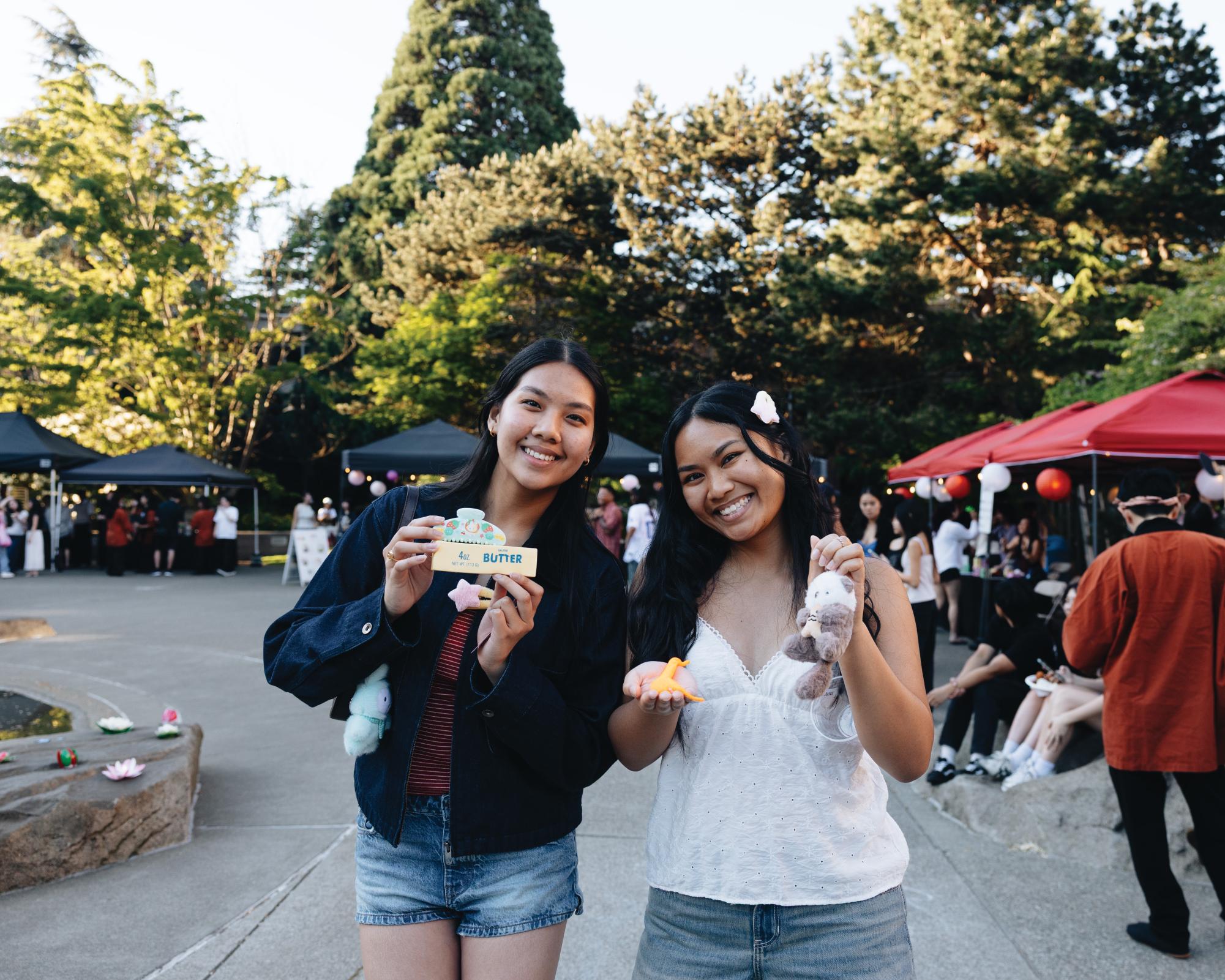
The sounds of drums echoed through campus during the evening of May 2, followed by gnarly guitar riffs and, eventually, traditional Japanese folk music. If you walked in the general vicinity of the Quad that evening, you may have stumbled across dozens of people from the Seattle University community gathered to celebrate the new beginnings of spring with Seattle U’s Japanese Student Association (JSA).
Since 2020, JSA has hosted their annual spring festival; in previous years, this event was known as Obon. This festival was a fusion of traditional Japanese beliefs in ancestral spirits and Buddhist customs of honoring the spirits. Because the festival always takes place during the spring quarter and Obon traditionally occurs in the later months of the summer (normally July or August), Seattle U’s JSA decided that this year, they would rebrand. Instead of Obon, this year’s festival was called Harumatsuri.
“Obon is celebrated later in the summer and is kind of more, not really to celebrate, but more of a remembrance of people who have passed away… we wanted to change the vibe a little bit and go for more of a happy vibe, more festive,” JSA President Rocky Xiao said.
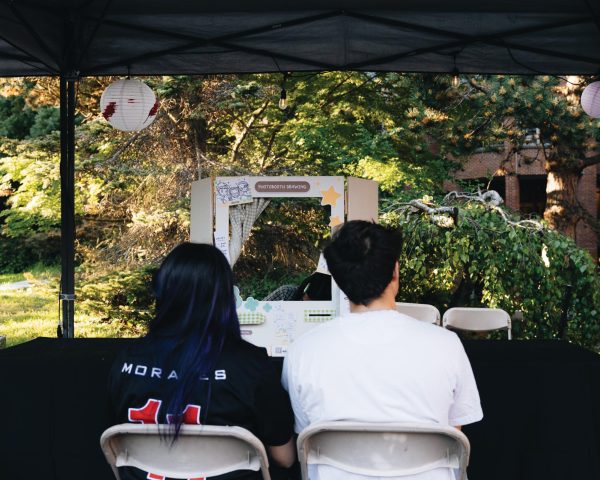 Two students sit as an artist sketches their portrait at a photo-drawing booth during Harumatsuri. (Noelle Lee)
Harumatsuri directly translates to “spring festival,” with “haru” being the Japanese word for spring and “matsuri” meaning festival. It is typically held between January and May. The festival celebrates the arrival of spring, new beginnings and the blooming of cherry blossoms.
This year’s theme was “Kizuna,” meaning bond or connection. The club emphasized the Japanese concept of the “Red Thread of Fate,” which serves as a metaphor for interconnectedness. JSA aimed to embody the spirit of Kizuna by hosting an event that brings people together through dance, music, food and honoring Japanese traditions.
Harumatsuri was planned and put on by Co-Chairs Jazmine Abarratigue and Michelle Liang. Both second-year cell and molecular biology majors, the two began planning the festival during the summer of 2025 and managed over 20 committee chairs across nine different committees.
“A lot of the job is communication, not just between the two of us [co-chairs] but other committees and people around the school that have been helping us make this happen,” Abarratigue said.
Unlike other cultural showcases on campuses, Harumatsuri does not require a ticket to attend. It is completely free to listen to the performances and participate in the interactive dances, but the food and games required purchasing tickets, which were used as currency throughout the event.
The night kicked off with a speech from the co-chairs and a blessing from Taijo Imanaka, the chief-priest of the Seattle Koyasan Buddhist Temple. This was followed by one of three performances from Seattle U’s Hidaka Taiko, a group of students who play Japanese-style ensemble drums. Taiko was followed by Seattle U’s dance collective, Rhythmix, who performed to “Different” by Lesserafim, one of the group’s singles. After a short break, the local Japanese music and dance group, Northwest Minyo Kai, led the crowd through group dances accompanied by Japanese folk music.
The last musical performance of the night came from the Seattle U band, Floor 2. The band played three Japanese rock songs, “Natsumatsuri” by Jitterin’ Jinn, “Chiisana Koi no Uta” by Mongol800 and “Haruka Kanata” by ASIAN KUNG-FU GENERATION. Floor 2’s lead singer and guitarist, Lucas Smith, comes from a Japanese background and was grateful for the opportunity to perform live at this event.
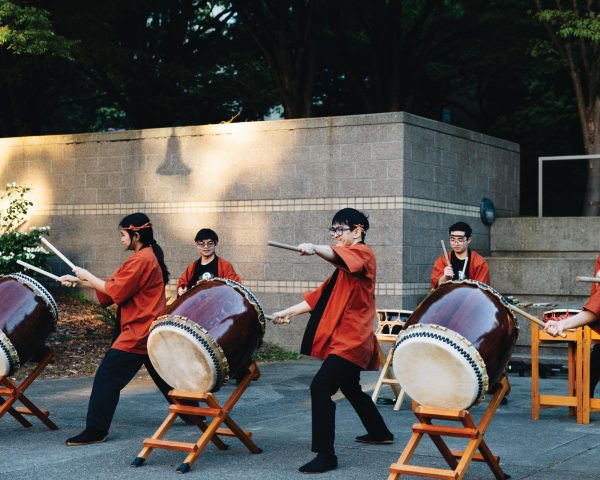 Members of Hikada Taiko perform their drumming routine at Harumatsuri. (Noelle Lee)
“It was really cool. Especially getting into college, I’ve been wanting to get more tapped into my culture on my mom’s side, so being able to do that through music was very nice,” Smith said.
One very popular vendor throughout the night was an interactive live photobooth by local artist Kyla Buenarte, also known as Kylatte. A pair could sit down in front of Buenarte’s table, and she would draw a sketch of the two on a photostrip. Once she is done with the drawing, Buenarte hands a ticket to the people being drawn and closes a curtain, blocking the view from outside. The people with the ticket are then prompted to insert it into a hole on the front of her trifold, decorated to look like a photobooth, and the finished sketch is ejected from the other side.
“I’ve always drawn my friends and family for their birthdays and in their daily lives,” Buenarte said. “I also always liked seeing their reactions [to] it, and I wanted to capture that feeling by giving it to other people as well… It makes it feel more positive and fun and different.”
Buenarte was joined by two other outside vendors: Peachyxnoodles, a Japanese-style illustrator who creates cute trinkets, mugs and other practical collectibles, as well as Koto Jelly Cafe, a local cafe that specializes in drinks with Japanese coffee jelly and other Japanese desserts.
It wouldn’t be a cultural event at Seattle U without a delicious food menu curated by members of the club. This year’s menu consisted of Chicken Karaage (Japanese-style fried chicken), Yakisoba Noodles, Miso Soup, Andagi (deep-fried donut) and, of course, White Rice.
Though Harumatsuri is over, JSA still has plenty planned for the rest of the year. JSA holds bi-weekly meetings every other Wednesday from 6 p.m. to 8 p.m. in Chardin 142.
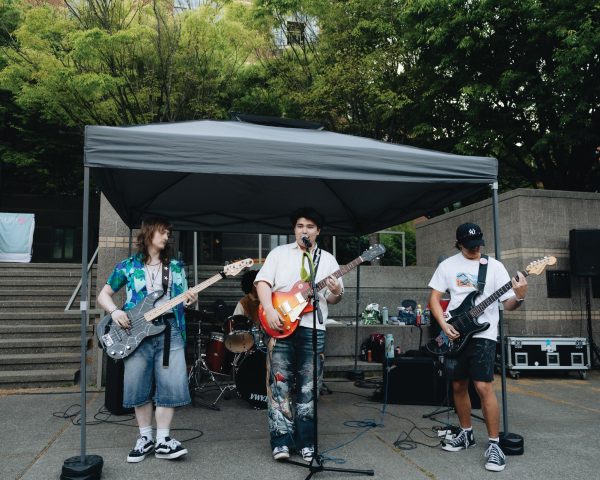 The band Floor 2 performs live music for attendees at Harumatsuri. (Noelle Lee)
AloJapan.com