
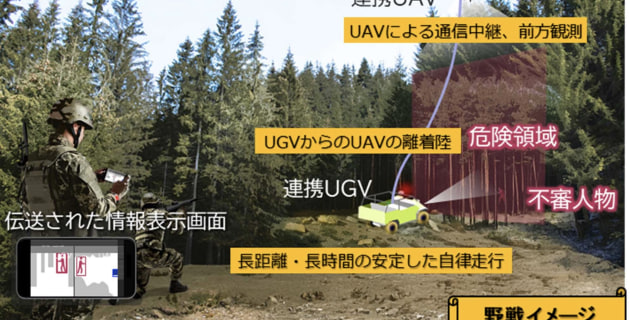
Japanese AI/neurotech start-up Araya has successfully undertaken proof-of-concept (PoC) trials on unmanned ground vehicle (UGV) autonomous target tracking capabilities, a company press release stated on 27 April.
The study, overseen by Japan’s Acquisition, Technology & Logistics Agency’s (ATLA) Ground Systems Research Center (GCRC), was completed in only three months, following the company’s successful 62 million yen (approx. A $550,000) tender bid in mid-January.
The project affirmed the core requisite capabilities set out in the tender’s specification document, according to Araya’s statement.
These included image recognition for targets such as personnel and vehicles, recognising targets after a break in visual contact, forecasting target movements based on previous behavior, generating suitable routes in off-road terrain, and retaining a stable distance from the target.
Araya researchers also positively appraised the potential of using UGV ready to equip technologies, including cameras and compact light detection and ranging (LiDAR) sensors, to autonomously generate mapping and other environmental data.
The development follows ATLA commissioning Japanese AI start-up Abeja for research on visual language action (VLA) models for UGVs’ autonomous navigation in late January.
It also comes after months of intensive UGV-related research in the GCRC, including work on the use of LiDAR and simultaneous localisation and mapping (SLAM) to enable UGVs to operate in GNSS-denied off-road environments.
Progress by the GCRC led to ATLA successfully submitting a funding request for “Research on a UAV-teamed, AI driven offroad unmanned ground vehicle (UGV)” capable of multiple roles including sentry, reconnaissance and combat support to the Japanese Ministry of Defense (MoD), which supported the proposal in its 2025 Policy Evaluation Report.
The MoD’s 2026 budget overview, published shortly after, listed research on a UAV-teamed “AI-driven off-road UGV” as one of its top three priority research projects.
Researchers in Japan, as well as the United States, have placed growing attention on defence applications for UAV-linked, AI-driven scouting/reconnaissance UGVs since the release of a study by University of Texas researchers in 2022 on autonomous tracking systems employing UAV-UGV teaming.
Surge in developments for unmanned systems
Araya’s statement also coincided with a number of high-profile announcements concerning the development and application of unmanned systems in Japan.
On 27 April, the Yomiuri Shimbun revealed that GSI Creos was part of a research team led by ATLA engaged in a study on the use of carbon nanotubes (CNT) to improve energy efficiency in autonomous underwater vehicles (AUVs).
ATLA on the same day released a video explaining the results of its fourth Air Combat AI Challenge; an open competition in which participants submitted algorithms which were trialled in simulated air combat battles between combat-support UAV teams.
That day also saw Japan’s Defence Minister Shinjiro Koizumi post a picture of a meeting with Japanese defence tech start-up AirKamuy in which the company showcased one of its low cost, cardboard-made drones.
“Since the Self Defence Force aims to become the world leader in using unmanned assets like drones, strengthening collaboration with start-ups interested in the defence sector is essential,” Koizumi said in the post on X.
The growing momentum for showcasing developments in unmanned systems occurred against the backdrop of a roundtable discussion, hosted in the Prime Minister’s official residence on the same day (27 April), on the expedited revision of Japan’s three security documents (National Security Strategy [NSS], National Defence Strategy [NDS], Defence Buildup Program [DBP]).
Proposals for more funding for drones, AI, and for programs to induce tech start-ups into the industry were major themes in the meeting.
The need for Japan to develop AI-driven unmanned systems were already prominent in the 2022 NDS and DPP, which cited the need to invest in asymmetric warfare capabilities and offset manpower shortages.
On 28 April, the MoD’s official X account posted that Japan now faces a forecast 26 per cent reduction in the target demography for military recruitment by 2045 (from 17.3 million to 12.8 million), with increasing automation/the use of unmanned systems listed as one of the four main measures the MoD aims to implement to compensate for recruitment shortfalls.
AloJapan.com