

Tokyo Metro Co., Ltd. reported past full-year results to March 31, 2026, with sales rising to ¥422,414 million and net income to ¥59,015 million, while proposing a reduced year-end dividend of ¥21.00 per share versus ¥40.00 a year earlier. Alongside this, management issued guidance for the year to March 31, 2027 and signaled a planned dividend increase to ¥22.00 per share at both mid-year and year-end, highlighting a recalibration of payouts relative to expected earnings of ¥86.10 per share. We will now examine how Tokyo Metro’s dividend reset and forward guidance shape its investment narrative for long-term-focused investors.
Capitalize on the AI infrastructure supercycle with our selection of the 38 best ‘picks and shovels’ of the AI gold rush converting record-breaking demand into massive cash flow.
What Is Tokyo Metro’s Investment Narrative?
To own Tokyo Metro, you need to be comfortable backing a regulated urban rail operator whose appeal rests on relatively steady demand, modest growth and disciplined capital allocation rather than outsized upside. The latest results and guidance largely reinforce that picture: revenues and earnings moved higher, but the sharp cut in the FY2026 year-end dividend, followed by a modest step-up in FY2027 payout guidance, points to management prioritising balance sheet strength and investment needs over maximizing near-term income. That reset may slightly dull the dividend appeal in the short term, especially after a weak share price run, but it also lowers the risk of overdistribution if profits track the more conservative FY2027 outlook. Key questions now center on governance stability, cash flow coverage of debt and how investors digest this new payout baseline.
However, there is one governance-related risk that deserves closer attention from shareholders.
Tokyo Metro’s share price has been on the slide but might be dropping deeper into value territory. Find out whether it’s a bargain at this price.Exploring Other Perspectives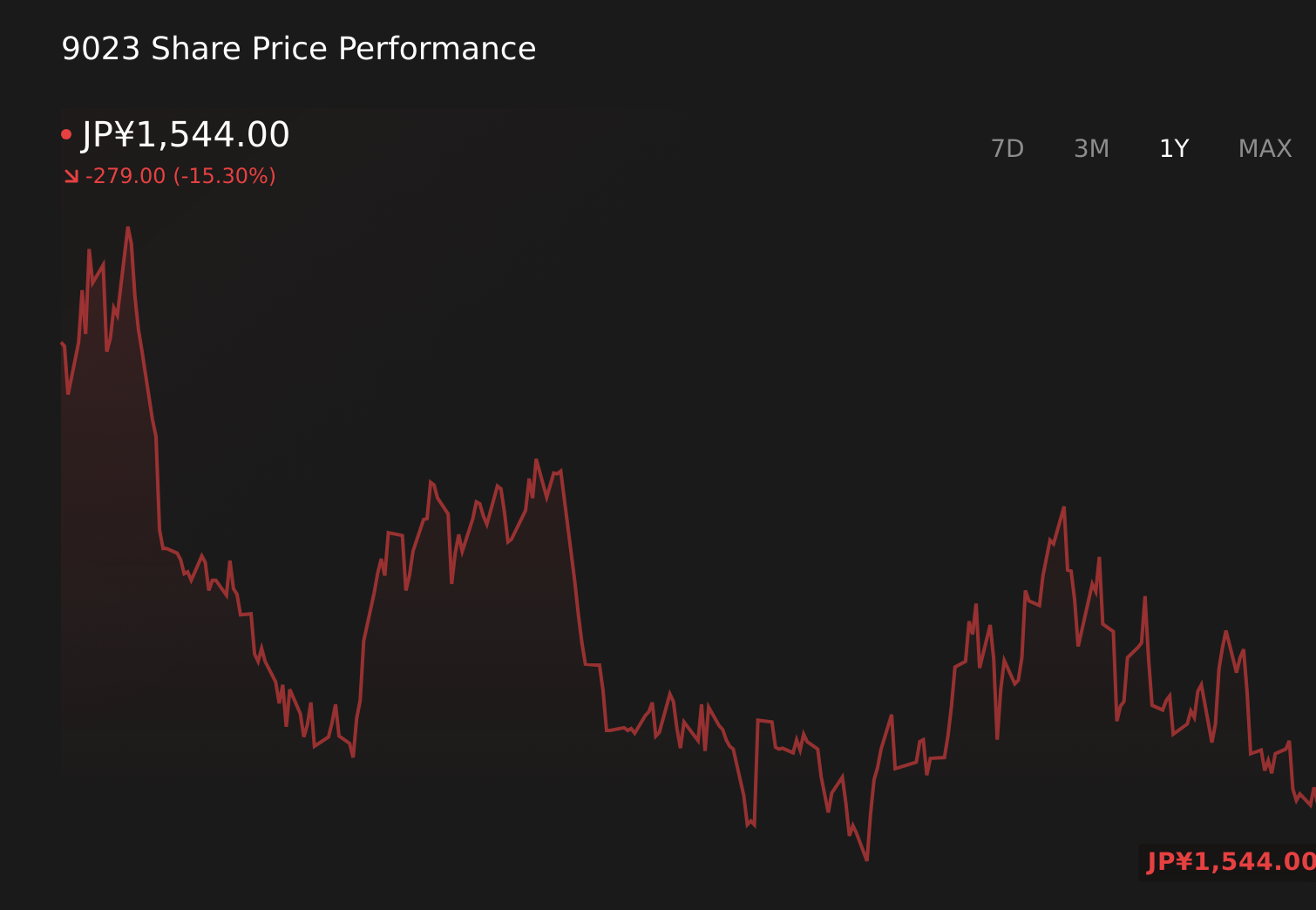 TSE:9023 1-Year Stock Price Chart Investors in the Simply Wall St Community have only two fair value views so far, spanning roughly ¥947 to ¥1,624, underlining how far opinions can stretch. Set against that wide band, the recent dividend reset and softer FY2027 profit guidance give you a concrete reminder that cash generation, governance and capital needs may matter more for Tokyo Metro’s future than any single valuation point.
Explore 2 other fair value estimates on Tokyo Metro – why the stock might be worth as much as 5% more than the current price!
The Verdict Is Yours
Disagree with this assessment? Extraordinary investment returns rarely come from following the herd, so go with your instincts.
Ready To Venture Into Other Investment Styles?
Don’t miss your shot at the next 10-bagger. Our latest stock picks just dropped:
This article by Simply Wall St is general in nature. We provide commentary based on historical data
and analyst forecasts only using an unbiased methodology and our articles are not intended to be financial advice. It does not constitute a recommendation to buy or sell any stock, and does not take account of your objectives, or your
financial situation. We aim to bring you long-term focused analysis driven by fundamental data.
Note that our analysis may not factor in the latest price-sensitive company announcements or qualitative material.
Simply Wall St has no position in any stocks mentioned.
Valuation is complex, but we’re here to simplify it.
Discover if Tokyo Metro might be undervalued or overvalued with our detailed analysis, featuring fair value estimates, potential risks, dividends, insider trades, and its financial condition.
Access Free Analysis
Have feedback on this article? Concerned about the content? Get in touch with us directly. Alternatively, email editorial-team@simplywallst.com
AloJapan.com