
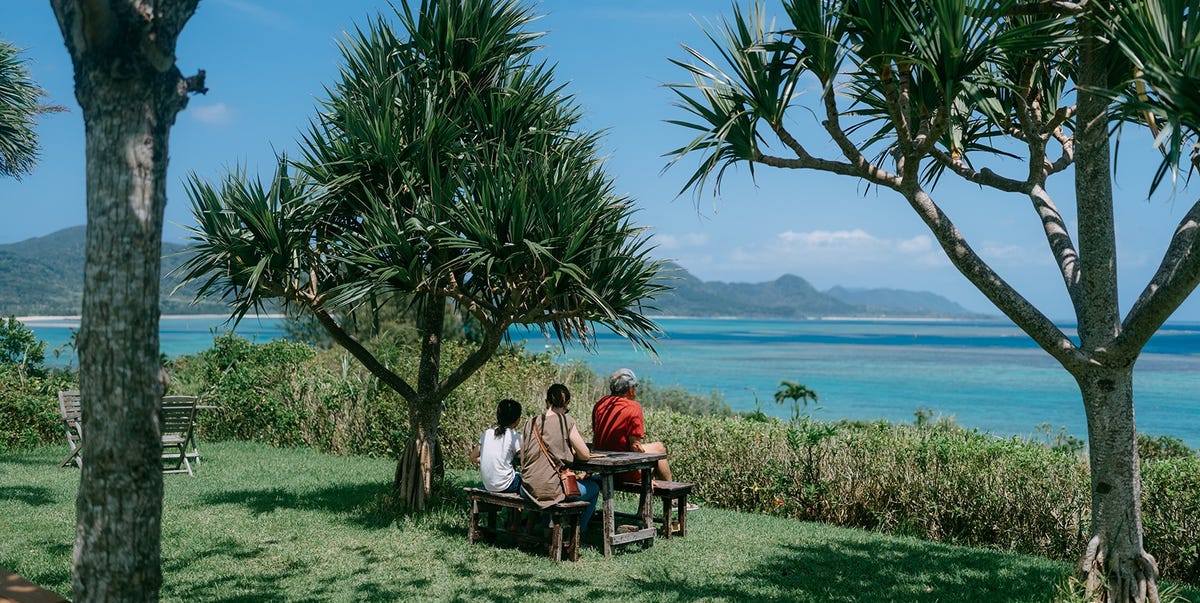
My trip to Okinawa, three months ago, changed my life. If you haven’t heard of it, it’s a Japanese island that’s classed as one of the world’s so-called Blue Zones, places where people reach 100 more often than elsewhere. They not only live longer but stay vital into their 90s and beyond. I was the guest of the supplement brand Solgar, and we were there to explore why.
One day, I found myself sitting cross-legged on a tatami mat in Okinawa, watching a woman in her eighties lower herself to the floor and stand up again with total ease. Not only was she as limber as a gymnast, but her eyes shone with life, more life than I had aged 48. I wanted what she has now – let alone in 30 years.
I was searching for sustainable health
I’d just got (most of) my energy back after three years of long COVID. I caught COVID just as perimenopause was doing its worst and during a very intense period of overwork, writing my book, Love Me!
By the time I went to Japan, my energy levels were much better. But I hadn’t worked out how I needed to live in order to stay healthy. I’m not the kind of person who will ‘go hard or go home’, to do hot yoga and take green powders. I knew there had to be a simpler way – and it was from the people of Okinawa that I found it.
How do we make energy?
On the trip, I also learned a lot about how we make energy. I met Professor Bradley Willcox, who has studied Okinawan ageing for decades. I learnt that ‘energy’ isn’t just how you feel, it’s cellular. Inside every cell are tiny ‘power stations’ called mitochondria. Their job is to turn food into energy. In every cell, we also have a coenzyme called NAD+ that helps these power stations work properly. As we age, both our mitochondria and NAD+ decline.
Maintaining optimal NAD⁺ levels is increasingly recognised by scientists as a cornerstone of healthy ageing. I learnt that the way of life in Okinawa seems to create the perfect conditions for this. As Paul Chamberlain, Lead Nutritionist at Solgar, explained it: ‘In Okinawa, you’re seeing a lifestyle that naturally supports mitochondrial health — regular low-level movement, nutrient-dense food, social connection, consistent rhythms. In the West, our diets are more processed, stress is higher, sleep is disrupted and daily movement is often low. All of that increases strain on the system.’
I vowed to take what I learned from the Okinawans, and put it into practice at home.
1. I’m moving little and often
Okinawan elders don’t exercise; they move. They walk to see friends. They garden. They sit on the floor and stand up again. This daily movement, sometimes called NEAT, helps maintain muscle, balance and metabolic health.
Okinawans are fans of little and often, so I’m building movement into my day with small breaks from my desk: walking to the post office, stretching between emails, walking to the shops. Sometimes I put on Florence and the Machine and dance in my kitchen for three minutes. I don’t know if this will carry me into my 90s. Often, I now find that moving does more to energise me than rest.
2. I’m eating to 80 per cent full
Many older Okinawans still follow hara hachi bu, stopping when they are about 80 percent full. For me, I’ve found the key to this is to eat more slowly. I grew up in a house where if you didn’t eat quickly, someone else’s fork might swoop in. So, I learned to gobble. Even as an adult, I barely tasted my food.
So I’ve slowed down enough to notice I was getting fuller. I try to put my fork down between bites and after I’ve finished the first plate, to give myself five minutes before deciding on seconds. After that pause, I almost always discover that I feel full. Except for dessert, which still seems to occupy a different space in my tummy.
3. I’m eating loads more plants 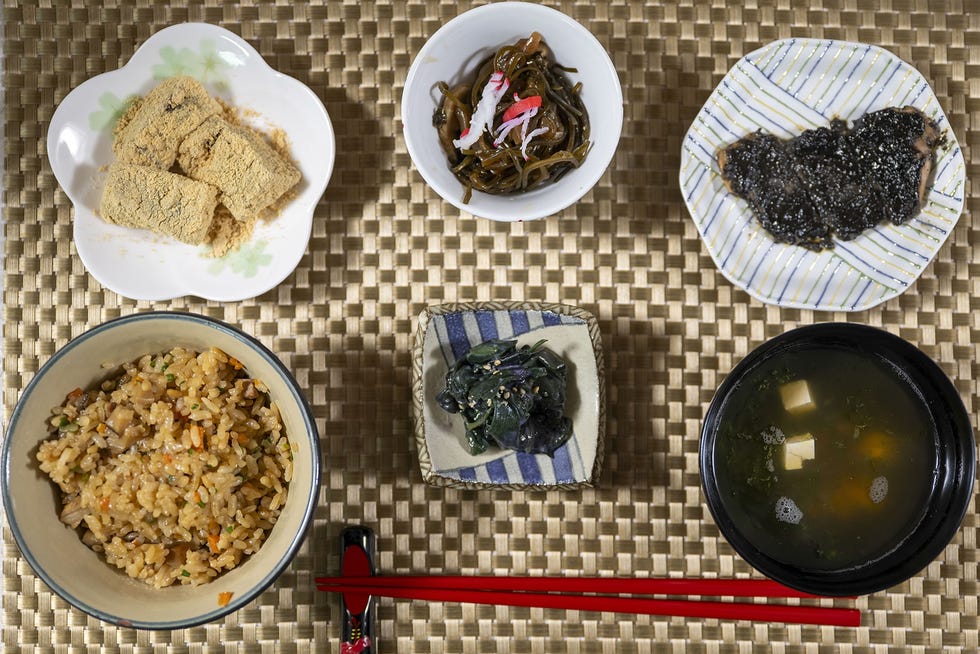 Simon John Owen
Some of the many plant foods we ate in Okinawa
Traditional Okinawan meals are colourful and plant-heavy. Sweet potatoes, greens, tofu, seaweed and turmeric feature prominently. Meat and fish appear too, but vegetables form the bulk of every meal, even breakfast.
Our hotel breakfast buffet had pastries… and also noodle soup and bowls of seaweed. On the first morning, I tried the seaweed out of curiosity. It was delicious: I hoovered it up and felt incredibly energised, as if my body got an actual high from it. After that, I ate seaweed at every meal – and if one of my travel mates didn’t want theirs, I ate that too.
Seaweeds eaten in Okinawa are rich in iodine, magnesium and soluble fibre that support gut bacteria and metabolic health. At home, I discovered dried seaweed in health food shops, so I now soak it and add it to soups, salads and noodle dishes. And I discovered that our local Waitrose sells a Japanese-style seaweed salad with sesame dressing. This has become a lunch staple for me.
4. I’m looking after my friendship group
Okinawans have a gorgeous concept called moai, long-standing groups of friends who support each other for life. It’s well known that loneliness is dangerous to our health and that close friends matter not just for our happiness but for our immune system, our blood pressure and our life expectancy.
In this area, I am lucky. I live on a street surrounded by people I love. My neighbours are my family and my mum and sister live nearby too. What I saw in Okinawa made me determined to protect my moai. When life gets busy, my usual instinct is to work and retreat, but I’m now convinced that tea and biscuit breaks with my neighbours are essential. I tell myself that I’m not being lazy and avoiding work – I’m looking after my health and theirs too.
5. I’m switching off consciously
Okinawans know how to end the day. They walk by the sea, sit on benches and watch the light change. When work ends, they rest. Thanks to my phone, before the trip I was always consuming, always on, even during work breaks. I felt as if I never fully switched off.
I realised when I was in Okinawa, that the idea that you can have a break on your phone is nonsense. They aren’t breaks at all. In Okinawa, people not only take proper breaks, but they go out in nature.
They also see life from a bigger perspective, that they are part of something older and ongoing. They remember their ancestors as part of their day; some have little altars with photos of past generations.
Since coming home, I’ve been taking phone-free walks and, sometimes, standing in the park looking up at the sky. I’ve also framed a photo of my beloved grandmother when she was young and put it on my desk, to remind me that my life is part of a longer story. When I look at her, I think, would she want me to be stressed about this silly thing? The answer, of course, is always ‘no’.
6. I’ve redefined my purpose
Many of the older people I met were still working, farming, repairing boats, running small shops. In Japan, ikigai, a reason to get up in the morning, is often cited as part of healthy ageing.
My reason for getting up used to be ‘success’. I was always reaching for the next achievement. Then, as I got older, my ambition seemed to vanish. For a while, I worried I had lost purpose altogether. But then I saw much satisfaction the Okinawans get from simple things, and I realised that my ikigai has not disappeared, it has changed.
I love teaching people how to write. I love noticing small moments and turning them into sentences. I love seeing my friends and my mum. I can now see that purpose doesn’t have to be a big thing; it’s often the small things that make a life worth living.
And I’m taking some supplements.
I’m not saying that a supplement should (or could) replace movement, good food or community. But as insurance, I take vitamin D, C, zinc and fish oils every day and magnesium at night. I also started taking Solgar Cellular Energy. It contains Niagen®, a patented, clinically studied form of nicotinamide riboside shown in trials to significantly raise NAD+ levels, with research into longer-term outcomes ongoing. This is especially important in a high-stress Western context, according to Chamberlain. ‘If you can’t recreate the Okinawan environment perfectly, you can at least support the biology from another angle.’

Solgar Cellular Energy Vegetable Capsules, pack of 28, £65.
Related Stories
AloJapan.com