

Global startups entering Japan often prepare for higher manufacturing costs. What many fail to anticipate is how those costs are actually structured.
Japan’s manufacturing system does not simply price output. It reflects labor shortages, production constraints, and strict quality expectations that shape how suppliers evaluate every project. As Korean startups expand into Japan’s industrial ecosystem, this gap between expectation and reality is becoming a recurring friction point, not at execution or access, but at the level of cost itself.
Cost in Japan Reflects System Constraints, Not Just Production
Japan’s manufacturing base is built on small and medium-sized enterprises. According to the 2025 SME White Paper from Japan’s Ministry of Economy, Trade and Industry, SMEs account for 99.7 percent of all companies in the country.
At the same time, these firms are operating under sustained pressure. The same report highlights rising production and investment costs, persistent labor shortages, and limited room for further cost-cutting. Many businesses are also managing aging leadership and succession challenges, which add to operational strain.
These conditions shape how suppliers price work. Quotes are not simply based on materials and labor. They reflect the broader constraints under which production must take place.
For global startups, this creates a structural gap. Cost assumptions built on flexible or scalable manufacturing environments do not translate cleanly into systems where capacity is limited and risk must be carefully managed.
Why Price Alone Fails to Capture Real Manufacturing Cost
One of the most consistent miscalculations comes from treating manufacturing cost as a static figure.
Continuing the discussion on Japan’s manufacturing system, Yoshiyuki “Zenko” Tamura, Founder and CEO of BITMOVES JAPAN Inc., explained in correspondence with KoreaTechDesk that overseas companies often misunderstand how cost is formed in Japan.
“Manufacturing in Japan is by no means cheap. However, if evaluated by total lifetime value, including design-stage improvements and low defect rates, Japan has some of the highest competitiveness in the world.”
This distinction is critical. Initial pricing does not capture the full value chain. Japanese suppliers often contribute to design refinement, quality assurance, and long-term reliability. These elements are embedded in the cost structure, even when they are not explicitly itemized.
As a result, companies focusing only on upfront price may underestimate both the value delivered and the constraints that shape pricing decisions.
 Illustration of people working in manufacturing | Freepik
The Quality Paradox That Expands and Compresses Cost
Japan’s global reputation for manufacturing quality is well established. Yet this strength can create unexpected cost behavior.
According to KOTRA’s market insights, Japanese buyers often apply strict standards around quality, delivery accuracy, and defect rates when evaluating partners. These expectations influence how suppliers approach production.
Tamura describes two recurring patterns.
The first is over-specification. Suppliers may raise precision levels beyond what the client initially requires. This is often driven by risk sensitivity and a desire to avoid failure or complaints. The result is increased cost and extended timelines.
The second pattern emerges under pressure. When resources are constrained, quality may decline if alignment and trust are not fully established. In such cases, output reflects not technical capability but operational capacity.
This dual dynamic creates a paradox. Quality can drive cost expansion in one scenario and execution risk in another. For global startups, failing to define “sufficient quality” early often leads to cost drift during production.
Why Change Is the Most Misunderstood Cost Driver
Many startups approach manufacturing with an iterative mindset shaped by software development. Frequent adjustments are expected and often encouraged.
In Japan’s manufacturing system, this iterative approach carries a different cost implication.
METI’s 2025 manufacturing white paper notes that rising labor shortages and production constraints continue to affect operational stability. Production systems are often optimized around limited resources, leaving little room for flexibility.
Tamura points to a more specific issue that affects cost directly.
“Overseas companies repeatedly change specifications using agile as an excuse, but for Japanese worksites optimized with the bare minimum personnel, a process change means the collapse of the entire system.”
This dynamic explains why cost assumptions often fail early. Iterative changes are not absorbed smoothly. They introduce additional coordination, disrupt production flow, and increase the total cost of delivery.
In practice, what appears as a minor adjustment at the design stage can require reworking production processes that were calibrated for efficiency under tight constraints. These changes carry real cost implications that are rarely reflected in initial estimates.
The gap is not technical. It comes from how different systems treat change. Startups assume flexibility as a default. Japan’s manufacturing environment treats stability as a requirement, and prices accordingly.
Hidden Cost Layers in Supply Chain Structure
Beyond production, cost is also shaped by how supply chains are organized.
Japan’s Fair Trade Commission revised subcontracting rules in 2025 to strengthen fair transactions and promote proper price pass-through across supply chains. The reform reflects ongoing challenges in cost allocation between contractors and subcontractors.
While these policies aim to improve transparency, they also highlight the complexity of supplier relationships.
Tamura points to the impact of multi-layer subcontracting structures. Large firms often coordinate multiple vendors, which can introduce additional margins and communication inefficiencies.
For startups, this creates another layer of cost that is not immediately visible. Working with established partners may reduce risk, but it does not necessarily simplify pricing. Instead, it shifts cost into coordination and structure.
Capacity Pressure Changes How Suppliers Price Risk
Another overlooked factor is how suppliers evaluate new projects.
The 2025 SME White Paper indicates that labor shortages remain severe across industries, and cost-cutting strategies have largely reached their limit. Under these conditions, production capacity becomes a critical constraint.
New projects are not always treated as opportunities. They are assessed in terms of resource allocation and operational risk.
Tamura describes this dynamic directly.
“Japanese worksites are pushed to their limits just responding to the demands of existing clients.”
This environment changes pricing behavior. Suppliers may include implicit risk premiums or limit flexibility to protect ongoing operations. For foreign startups, this means that pricing reflects not only the work itself, but the impact it has on the supplier’s existing commitments.
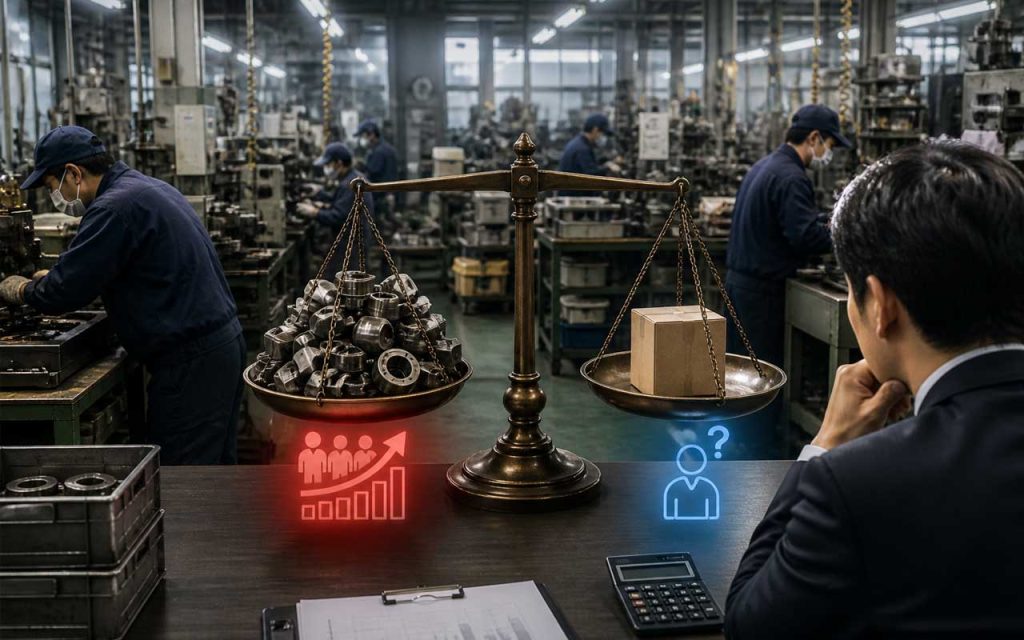 AI illustration of Japan’s manufacturing system.
What This Means for Korean Startups Expanding into Japan
Korean startups are increasingly entering Japan, supported by strong product development capabilities and proximity to the market.
However, the cost dynamics require a shift in approach.
KOTRA notes that Japanese partners prioritize reliability, quality, and long-term relationships before committing to initial transactions. These expectations extend into how cost is structured and evaluated.
For Korean founders, this means cost planning must go beyond benchmarking unit price. It requires understanding:
how quality expectations influence scope
how change management affects production cost
how capacity constraints shape supplier decisions
Without this adjustment, even technically strong companies may find their cost assumptions breaking during project development.
Cost Miscalculation Is a System Problem, Not a Negotiation Issue
The recurring pattern across cross-border manufacturing projects is not mispricing at the negotiation stage.
It is a mismatch in how cost is understood.
Japan’s manufacturing ecosystem remains highly competitive. However, its cost structure reflects labor shortages, production constraints, and embedded quality standards that differ from more flexible systems.
For global startups, the challenge is not simply paying more. It is recognizing that cost is formed through a system that prioritizes stability, reliability, and long-term performance.
In that system, price is only one part of the equation.
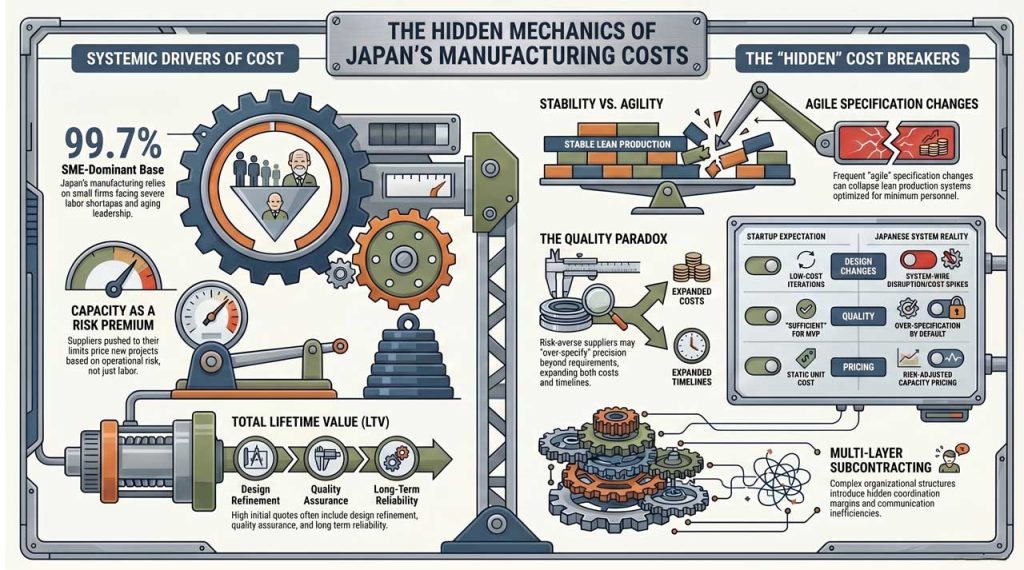 Hidden cost in Japan manufacturing system. | AI infographic
Key Takeaway
Japan’s manufacturing costs reflect system constraints, including labor shortages and limited production capacity
SMEs dominate the industrial base, shaping how pricing decisions are made
Quality expectations can increase cost through over-specification or misalignment
Frequent design changes create disproportionate cost increases in constrained production systems
Supply chain structure introduces hidden coordination and transaction costs
Korean startups must adapt cost models to account for stability-driven manufacturing environments
Cost miscalculation in Japan is primarily a system understanding issue, not a pricing or negotiation issue
🤝 Looking to connect with verified Korean companies building globally?
Explore curated company profiles and request direct introductions through beSUCCESS Connect.
– Stay Ahead in Korea’s Startup Scene –
Get real-time insights, funding updates, and policy shifts shaping Korea’s innovation ecosystem.
➡️ Follow KoreaTechDesk on LinkedIn, X (Twitter), Threads, Bluesky, Telegram, Facebook, and WhatsApp Channel.
AloJapan.com