

On the western littoral of Okinawa’s primary island, perched along the East China Sea, the city of Urasoe stands as the primordial cradle of the former Ryukyu Kingdom (1429-1879). Situated just north of Naha, the contemporary prefectural capital, the region flourished as an early mercantile polity, building its own networks of exchange with Japan, China, and Southeast Asia and amassing power that would ultimately unify the Okinawan archipelago. Urasoe is a pivotal nexus of history, geopolitics, and cultural interchanges in Okinawa and in the East Asian region.
Urasoe offers a juxtaposition of nature and urbanity, antiquity and modernity, whether it’s extending a monorail to the foot of historical hills, or adding a mall complex along its pristine aquamarine shorelines. It is also home to the JICA (Japan International Cooperation Agency) Okinawa Center, which has invited and taught around 15,000 trainees from over 160 different developing countries how to better lead and achieve SDGs in their home countries. It preserves vestiges of its storied past while embracing a cosmopolitan and heterogeneous present; reflective of its steadfast vision of aspiring to be a “culturally rich international city overflowing with sunshine and greenery.”
Maeda Escarpment — castle and cliffs
Urasoe’s most prominent geographical feature, Maeda Escarpment, forms the city’s broadest plateau, with walking paths weaving through the woodland, ruins, and sweeping views of the city and sea. Visitors who make their way up these slopes are rewarded with one of the most layered historical environments on the island. Furthermore, near the summit stand the “Urasoe Gusuku” castle ruins. This site was the capital of the Chuzan Kingdom, which went on to unite the archipelago and found the Ryukyu Kingdom. A short walk away lies the solemn “Urasoe Yodore,” a royal mausoleum built into the cliffside that holds King Eiso, one of the forefathers who stabilized and brought about great prosperity to Chuzan — so much so Urasoe made an anime about him.
Maeda Escarpment is also known by the U.S. military as Hacksaw Ridge — familiar to Western audiences for its war-torn history during the Battle of Okinawa toward the end of the Pacific War and depicted through the eponymous book and film. Today, the ridge feels remarkably tranquil, serving as a contemplative lookout that contrasts sharply with its turbulent past.
From walkathon to whimsical wandering — Tedako Walk and West Coast Parco City
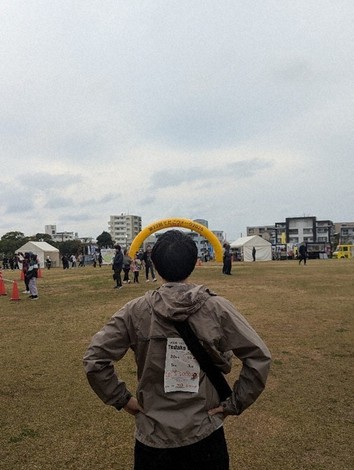
The author is seen at the goal of the annual Tedako Walk. (Photo courtesy of the author)
Among Urasoe’s signature annual events, the Tedako Walk stands out for the way it links participants to both the city’s heritage and its international ties. Held each February, the walkathon offers several routes, including a 10-km course that passes through Makiminato Service Area, also known as Camp Kinser, a U.S. Marine Corps logistics base normally closed to the public, even to American civilians. This extraordinary opportunity allows walkers to enjoy classic American fast food and browse on-base goods rarely encountered elsewhere in Japan.
For those seeking a deeper cultural experience, the 20-km route traces many of Urasoe’s historical landmarks before culminating at Shuri Castle, the celebrated capital of the unified Ryukyu Kingdom. There is also a 4.5-km Night Course, which goes to Urasoe Gusuku and Urasoe Grand Park Observation Deck, whose panoramic view is hailed as one of the “Three Greatest Night Views of Okinawa.”
For visitors arriving at other times of the year, San-A Urasoe West Coast Parco City serves as a vibrant, year-round destination. Situated along the reclaimed shoreline, this expansive mall features extensive shopping, a diverse food court, a modern cinema offering 4D entertainment, and sweeping views of Okinawa’s radiant, jewel-toned waters, making it an inviting place to relax, dine and enjoy the coast.
Small-scale craftmanship and sustainability — sericulture and shimaguwa
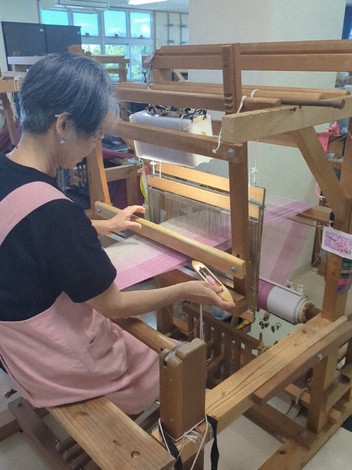
Silk is woven into textile using a loom, at Urasoe City Sericulture and Silk Weaving Facility — Sun Silk. (Photo courtesy of the author)
Urasoe’s defining local specialties are “Urasoe-ori” silk and “shimaguwa” (island mulberry) products. Although Urasoe-ori’s history is very recent, the city is cultivating a distinctive craft culture through its artisanal “Urasoe City Sericulture and Silk Weaving Facility — Sun Silk.” Wallets, accessories, decorative bookmarks, and more produced here are made entirely by hand, reflecting a commitment to small-scale craftmanship rather than industrial output.
Visitors can also experience weaving firsthand. The facility offers weaving experiences for silk bookmarks, coasters and more, using a wooden loom, allowing guests to feel the rhythm of manual weaving and understand how each thread is guided by human skill. The finished keepsakes serve as uniquely personalized memorabilia or gifts for you to take home.
Sustainability is another focus at Sun Silk. Silkworms feed exclusively on shimaguwa leaves, which often accumulate as surplus outside the rearing season. Instead of letting them go to waste, Sun Silk spent years developing a method to repurpose these leaves into a finely milled powdered, caffeine-free tea, naturally rich in antioxidants.
The mulberry fruit is also utilized to its fullest, transformed into products such as jams, juices, drinkable vinegar and liqueurs. Together, these efforts form a small but inventive industry, one that reflects Urasoe’s resourcefulness while giving visitors a glimpse of a modern craft culture built on creativity, sustainability and local initiative.
Cosmopolitan cravings — ice cream and international comforts
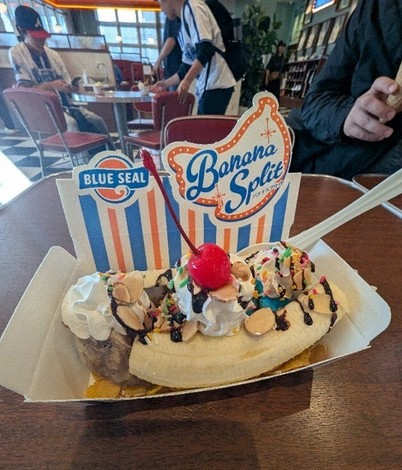
A banana split with Okinawan-flavor scoops, at the Blue Seal Urasoe Makiminato store. (Photo courtesy of the author)
Down here in the tropical heat of Okinawa, the popular domestic ice cream chain, Blue Seal, dominates the summer. It has its origins on U.S. bases in Okinawa, but broke away and became independent in 1963, and is now headquartered in Urasoe, bringing delicious American-style dairy treats to the public! Its retro-themed, flagship parlor, Blue Seal Urasoe Makiminato, offers classic American-style scoops alongside uniquely Okinawan flavors such as the “beniimo” purple potato, salted “chinsuko” shortbread cookies, Ryukyu black-tea “warabimochi,” and refreshing “shikuwasa” sherbet. The second floor hosts a small museum, where visitors can explore the history of the brand and its cultural connection to Okinawa’s postwar era.
Along the Urasoe section of the Okinawa monorail is the JICA Okinawa Center. On the premises, JICA opens its “OIC Dining Hall (OIC)” to the public. It offers a different country’s dish every day, and multinational limited menus during annual events like the Tedako Walk and JICA Fest. This means visitors have the opportunity to explore a myriad of global comfort foods in Urasoe. OIC is also Halal-certified and lists food allergens for all of its dishes, standing out as a foreigner-friendly establishment.
City information
Population: 114,854 (as of March 2026)
Number of foreign residents: 1,821 (as of March 2026)
Area: 19.09 square kilometers
Convenient access to the city: 1 hour away from Naha Airport by bus or monorail or 25 min drive
About the writer
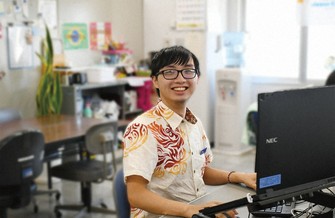
The author, Jason Cheng. (Photo courtesy of the author)
Name: Jason Cheng
Country of origin: United States of America
Years living in Japan: Three
Favorite Japanese foods and drinks: yakitori (negima and gizzard), Hokkaido soup curry, Kumamoto ramen, negitoro gunkanmaki (sushi with minced tuna and green onion), nankotsu-soki (Okinawan soft-bone pork spare ribs) and tebichi (Okinawan braised pig’s trotter), unaju (grilled eel over rice in a box), warabimochi (bracken starch jelly) and mitarashi dango (rice dumplings with sweet soy glaze); and hojicha (roasted green tea) and mugicha (barley tea)
Favorite things about Japan: Public transport, cuisine, cleanliness, kindness of the people, seasonal and regional products, the variety of natural and manmade landmarks
Instagram (urasoe_cir) https://www.instagram.com/urasoe_cir/
***
In this “Japan Uncovered” series, coordinators for international relations from around the world introduce the charms of the municipalities where they live and work in Japan.
AloJapan.com