
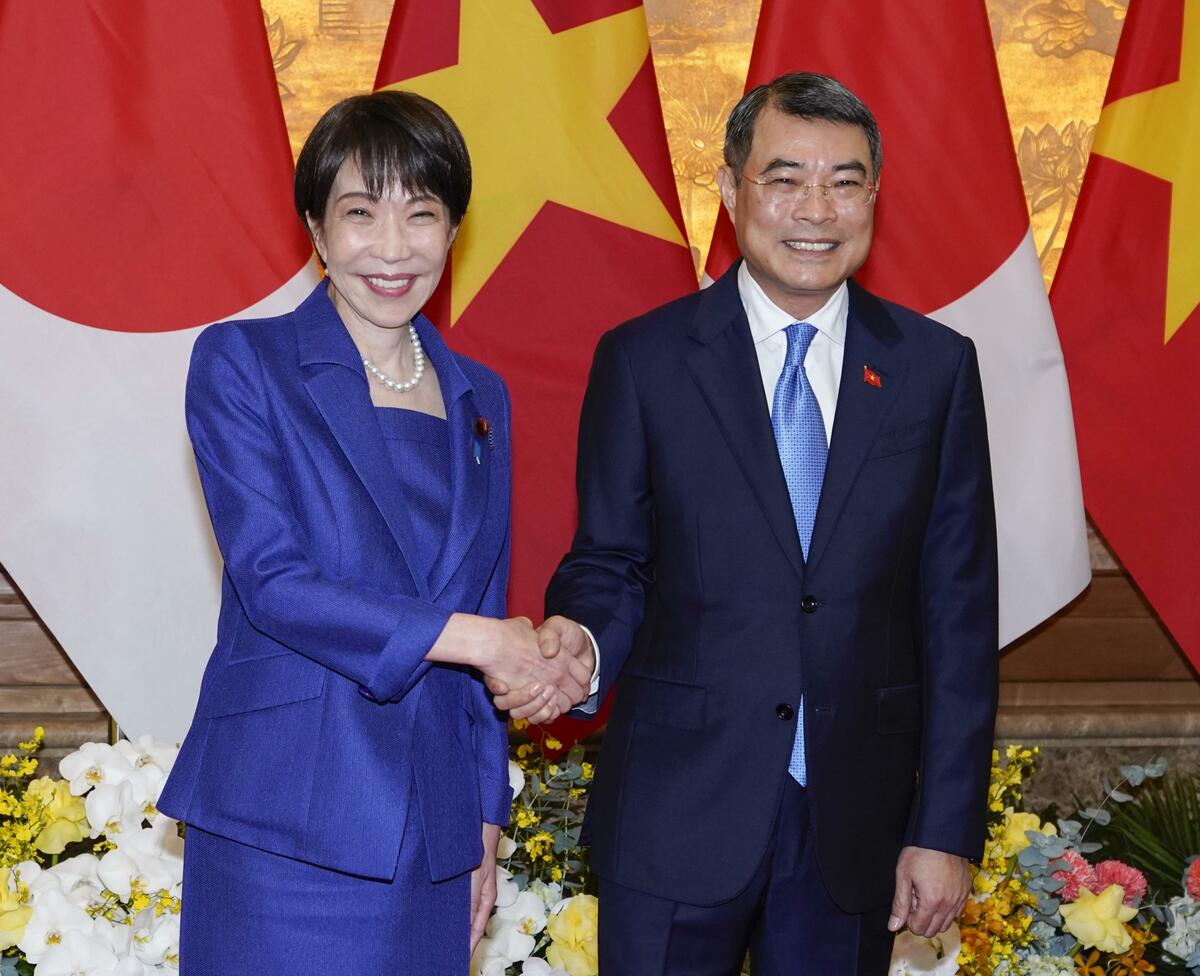
HANOI – Prime Minister Sanae Takaichi vowed Saturday to take an active role in building international order and economic security in a speech on the next stage of the free and open Indo-Pacific, as Japan eyes increasingly assertive moves by China in the region.
Takaichi delivered the speech on the initiative’s 10th anniversary after holding talks with Vietnamese Prime Minister Le Minh Hung and President To Lam in Hanoi, as Japan looks to deepen its ties with Southeast Asian nations by increasing economic engagement with the region.
The two countries agreed to boost their partnership in economic security including Japan’s aid for oil procurement, as it seeks to strengthen supply chains for critical resources amid the Middle East crisis.
Outlining the evolved form of the Indo-Pacific initiative in an address at a university in Hanoi, Takaichi said it will focus on cooperation to strengthen supply chain resilience, promoting economic growth through shared rules, and on enhancing security cooperation for regional peace and stability.
“In this challenging environment, it is essential for countries in the region to acquire ‘resilience,'” she said, saying it is decisive in economic, social and security areas to allow countries to “determine their own future.”
Since Japan’s free and open Indo-Pacific initiative was devised by then Prime Minister Shinzo Abe in 2016 as a veiled counter to China’s increasing assertiveness in the region, international order has been challenged by Russia’s invasion of Ukraine, Beijing’s maritime assertiveness and an increasingly unilateral United States.
Takaichi said the policy is being updated as “we must adapt to new realities” and the “structural change in the international order” such as “intensifying geopolitical competition.”
Earlier in the day, Takaichi and Hung agreed in their talks to further discussions for building resilient supply chains for critical minerals and to work to support oil procurement for one of the Southeast Asian nation’s largest oil refining facilities, according to an outcome document outlining the priority areas for bilateral cooperation.
“Strengthening our partnership with Vietnam is extremely important to the evolution of a free and open Indo-Pacific,” Takaichi said after the meeting. Hung said Vietnam “supports Japan’s active efforts toward regional stability and development.”
The Nghi Son Refinery and Petrochemical Complex, located over 200 kilometers from Hanoi, is a joint venture involving Vietnamese, Japanese, and Kuwaiti partners.
Japan’s plan to support the Vietnamese complex is part of its pledge announced last month to provide $10 billion in financial support to other Asian countries to weather the fuel supply shortage and supply chain disruptions amid the effective closure of the Strait of Hormuz, a key artery for global energy trade.
Resource-poor Japan imports petroleum-derived products from Southeast Asia, including items used at medical facilities. Vietnam, meanwhile, possesses abundant mineral resources and rare earth reserves, with the U.S. Geological Survey estimating it held some 3.5 million tons in reserves of rare earths in 2025.
Other cooperative areas that Japan and Vietnam decided to prioritize include artificial intelligence, with Japan calling itself a “reliable partner” for Vietnam, according to the outcome document. They also cited the potential of nuclear energy cooperation as early as 2040.
On national security, Tokyo has sought to enhance ties with members of the Association of Southeast Asian Nations, including Vietnam, as China intensifies its military activities in the resource-rich South China Sea, home to one of the world’s busiest maritime sea lanes.
Japan and Vietnam held the first two-plus-two meeting of their vice foreign and defense ministers in Tokyo in December. Japan is also inclined to include Vietnam in its Official Security Assistance framework launched in 2023 to provide defense equipment to like-minded countries.
Japan and Vietnam face territorial claims from Beijing in the East China and South China seas, respectively.
The prime minister arrived in Vietnam on Friday. She will next travel to Australia for talks with Prime Minister Anthony Albanese on Monday, before returning to Japan on Tuesday.
AloJapan.com