
このページを
日本語
で読む
The government announced on April 28 that Prime Minister Sanae Takaichi will visit Vietnam and Australia from May 1 to 5.
In Vietnam, she is expected to deliver a major foreign policy speech setting out the next stage of the Free and Open Indo-Pacific (FOIP), which she has made a central pillar of her diplomacy.
Against the backdrop of instability in the Middle East, Takaichi will also call for deeper cooperation on economic security, including energy supplies. As China expands its maritime activities and intensifies its use of economic coercion, Japan aims to strengthen ties with like-minded countries across a broad range of fields.
Vietnam and Australia Summits
Summits With Vietnam on May 2 and Australia on May 4. On May 2, Takaichi will hold talks in Vietnam with Communist Party General Secretary and State President To Lam, and Prime Minister Le Minh Hung. The two sides are expected to confirm their cooperation in areas such as energy, artificial intelligence, and semiconductors. She will also deliver a speech at a local university on the future direction of FOIP.
Australia, meanwhile, is marking this year the 50th anniversary of the signing of the Basic Treaty of Friendship and Cooperation with Japan. On May 4, Takaichi will meet Prime Minister Anthony Albanese, with the two leaders expected to agree on expanding cooperation in security, the economy, and people-to-people exchanges.
At a press conference, Chief Cabinet Secretary Minoru Kihara stressed that stronger ties with both countries are “extremely important” to realizing FOIP. In her February policy speech, Takaichi said Japan would “strategically evolve” FOIP in response to changes in the international environment.
POWERR Asia Takes Shape
In the upcoming foreign policy speech, she is expected to emphasize cooperation on energy, AI, and security, while calling for greater regional “autonomy” and “resilience.”
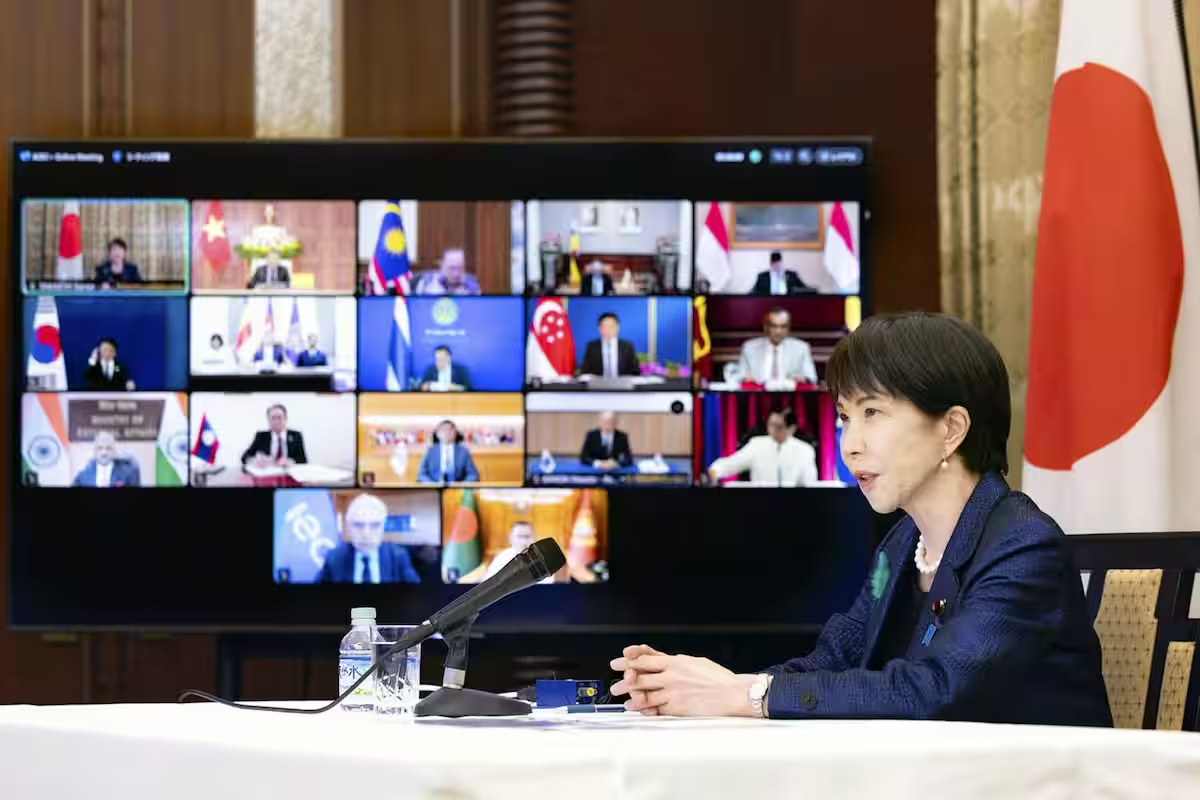
Earlier this month, Takaichi announced a new cooperation framework with Asian countries in response to the worsening situation in the Middle East. Centered on $10 billion in support, the framework will cover areas such as securing crude oil supplies.
The initiative, called POWERR Asia, is being presented as a concrete embodiment of FOIP. Through her visits to Vietnam and Australia, Takaichi aims to discuss specific forms of cooperation and use them to deepen ties with both countries.

Abe’s FOIP Vision, 10 Years On
First proposed in August 2016 by then-Prime Minister Shinzo Abe, FOIP sought to connect a vast region stretching from the Americas through Asia and the Middle East to Africa. It was built on shared principles such as the rule of law to promote stability and prosperity. Since then, it has become a guiding framework for Japanese diplomacy.
Now, a decade after its launch, Prime Minister Sanae Takaichi—who has inherited Abe’s political vision—is seeking to update FOIP by incorporating new priorities.
FOIP was born in Kenya, a key maritime crossroads on the Indian Ocean. Abe first unveiled the idea in Nairobi while attending the Tokyo International Conference on African Development.
Japan, he argued, had a responsibility to help make the meeting point of the Pacific and Indian Oceans a region “free from force or coercion,” and grounded instead in freedom, the rule of law, and the market economy.
China Spurs Supply Chain Resilience
Abe’s push for FOIP was driven in large part by China’s growing influence across Asia and Africa through its vast Belt and Road Initiative.
With China’s drive for regional dominance in mind, FOIP was built around three pillars: spreading and entrenching the rule of law, freedom of navigation, and free trade; pursuing economic prosperity; and ensuring peace and stability.
The vision won broad support as a shared framework among countries, including the US, Australia, and India, and became a de facto counterweight to China.
In March 2023, then-Prime Minister Fumio Kishida unveiled a new action plan during a visit to India, which included support measures for the Global South.
Since taking office last October, Takaichi has shown a strong desire to inherit and further develop FOIP. In her February policy speech, she highlighted new challenges, including the race for AI dominance and other emerging technologies, as well as the need to make supply chains for critical goods more resilient.
A senior Ministry of Foreign Affairs official said Takaichi’s new FOIP vision will incorporate priorities such as supply chain resilience. “FOIP will continue to evolve,” the official said.
RELATED:
(Read the article in Japanese.)
Author: Shingo Nagahara, Keita Ozawa, The Sankei Shimbun
このページを
日本語
で読む
Continue Reading
AloJapan.com