
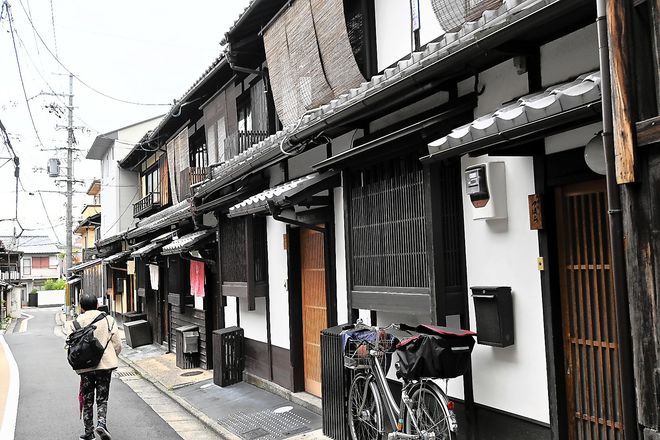
KYOTO–Yukihiro Sugatani was born in the Rokuharagakku community in the ancient capital’s Higashiyama Ward, where the alleyways are lined with traditional “kyo-machiya” wooden townhouses.
The neighborhood, home to Rokuharamitsuji temple, is within walking distance of Kiyomizudera temple, a UNESCO World Heritage site, and Yasakajinja shrine.
Sugatani, 73, has lived in the community his entire life.
“All the units in this row are used as ‘minpaku’ private lodgings, except one,” he said, pointing at an old, two-story wooden “nagaya” rowhouse one day in November last year.
There are about 1,700 households in the Rokuharagakku area. Of these, about 130 are minpaku facilities, he said.
“I wanted to drive them out, thinking they were poisonous to our community,” he continued. “I thought so at first.”
Each alley is barely wide enough for people to pass each other. Buildings standing along the alleys are designated as “non-rebuildable properties,” which cannot be rebuilt once they are demolished.
Such properties attract no buyers and remain unoccupied when their occupants die.
The number of empty homes grew at a faster rate in or around 2010.
To prevent the community from being hollowed out and preserve the townscape, he thought about bringing in young people to live in vacant homes.
A community development committee consisting of residents and experts was set up in 2011, and Sugatani became chair to make efforts to attract new tenants.
When vacant homes started selling like hotcakes in or around 2014, committee members expected new tenants to move in.
But the properties were utilized as minpaku facilities.
As is increasingly common with areas offering minpaku, a spate of complaints arose about noise and improper use of residential garbage disposal sites.
According to a survey conducted by a neighborhood association in 2017, 36 of 64 minpaku facilities operated without proper permission.
Driven by a sense of crisis that his community would fall apart, Sugatani called for measures to deal with the problem.
The city government moved to give guidance to minpaku operators and introduced strict regulations.
When the central government enforced the Private Lodging Business Law to set rules on minpaku in 2018, the city adopted an ordinance to introduce stricter regulations for private lodgings in zones designated exclusively for residences.
These regulations include operating for only two months from Jan. 15 and their managers having to be based within a 10-minute access to quickly respond to problems.
Illegal minpaku facilities disappeared from the Rokuharagakku area.
But the number of facilities that meet the regulations continued to increase, while the figure for minpaku-like budget facilities approved for operation by local governments under the Hotel Business Law also rose sharply.
Sugatani and other residents thought it was impractical to drive legitimate minpaku facilities out of their community.
But they also realized that the townscape remains unchanged because many minpaku operators kept the exterior of kyo-machiya intact while strengthening their earthquake resistance.
Having seen residents leave and vacant homes become dilapidated, they decided to make full-scale efforts to live with minpaku facilities even though they were caught up in a dilemma.
To build a face-to-face relationship, the committee made it a rule to ask operators to join a neighborhood association when they open for business and to sign an agreement on dealing with noise, litter and other problems.
The committee received fewer complaints than previously.
Their effort to establish a symbiotic relationship is beginning to show results.
Kaoru Nakano, an administrative scrivener who represents several minpaku operators in the Rokuharagakku area, said she was once invited by neighbors to join a local summer event known as “Jizobon.”
“In Kyoto, many people cherish their communities. I place importance on exchanging greetings with residents,” she said.
However, the community continues to be hollowed out.
According to an estimate by the city, the population of the Rokuharagakku area was 2,937 as of October 2025, down by about 12 percent over the past decade.
MORE COMPLAINTS, TOUGHER RULES
Rising land prices are one of the underlying causes for the population decline.
Business operators offer to purchase some of the non-rebuildable properties for several hundred million yen.
While residents constantly sell their homes and move out of the neighborhood, young people cannot afford such a luxury.
Sugatani is aware that some residents say their community is no longer affordable to live in.
Complaints against minpaku services continue to rise.
The city government announced in late January this year that it is planning to impose even tougher regulations on private lodging.
Sugatani has mixed feelings about the situation.
“It is also true that minpaku facilities fill in vacant homes, resulting in the preservation of the townscape,” he said. “Right now, I’m afraid of what will come when minpaku operators leave the properties.”
AloJapan.com