
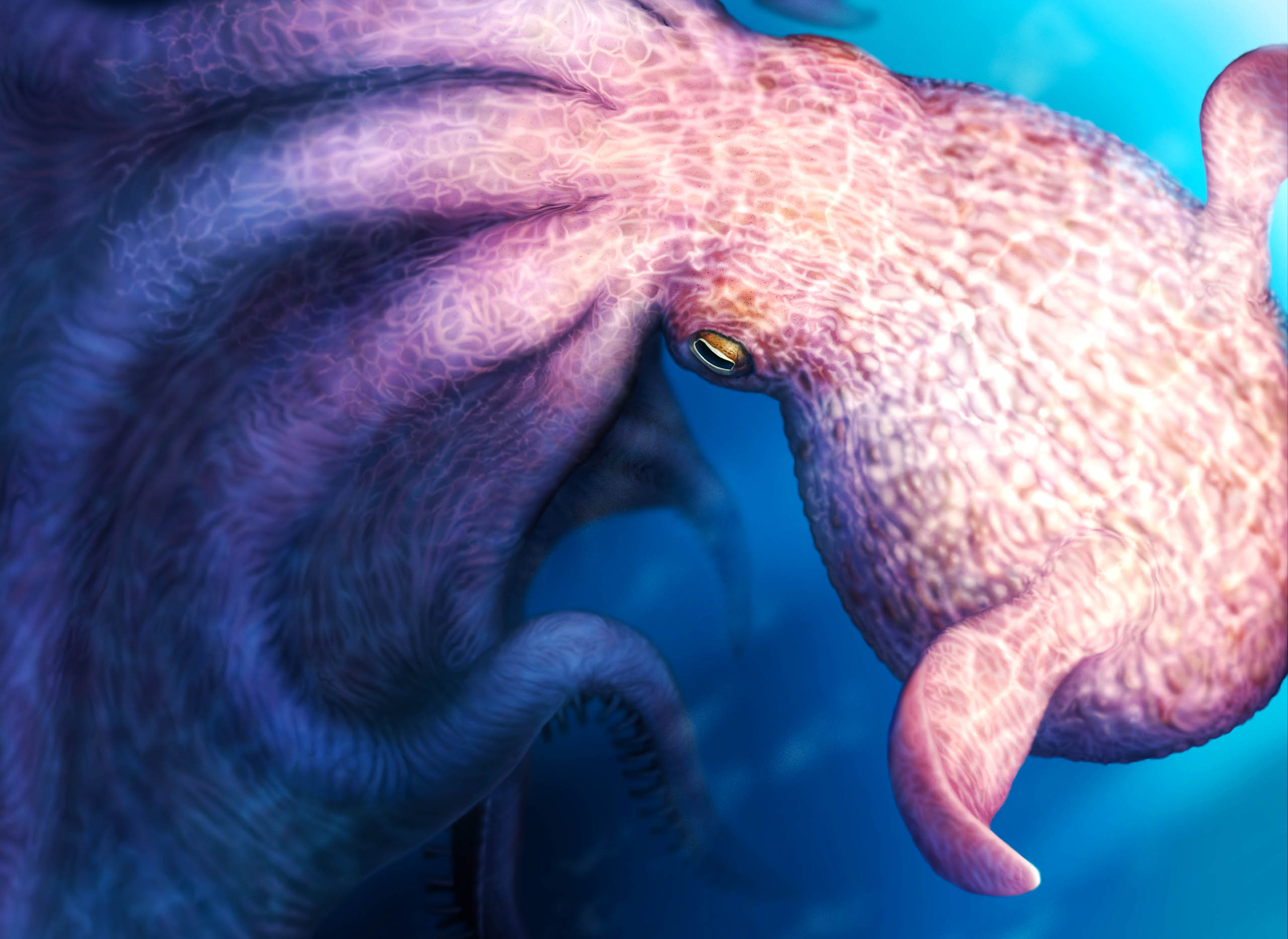
Today’s octopuses are usually imagined as clever, elusive animals – the sort that vanish into cracks, change color, and stay just out of reach.
But new research suggests their distant ancestors may have lived very differently. Instead of hiding from larger hunters, some of the earliest octopuses may have been enormous predators that sat right at the top of the marine food chain.

By studying fossil jaws from the Late Cretaceous, researchers from Hokkaido University argue that ancient octopus relatives were not minor players in prehistoric seas.
They may have been among the largest and most formidable hunters in the water.
Octopus fossils are rare
One reason this story has stayed hidden for so long is simple: octopuses are terrible at becoming fossils.
They do not have the kind of hard skeleton that usually survives for millions of years – no bones, no shell, no obvious record.
Compared with animals that leave behind teeth or thick skulls, octopuses tend to disappear from history almost without a trace.
That is what makes this study so interesting. Instead of looking for whole bodies, the researchers focused on fossil jaws – one of the few parts of an early octopus relative that had a decent chance of surviving.
Using high-resolution grinding tomography and an artificial intelligence model, they searched rock samples from Japan and Vancouver Island dating from about 100 to 72 million years ago.
Hidden inside those rocks were fossil jaws from extinct finned octopuses, known as Cirrata. These were not just rough fragments.
Preservation kept some specimens intact enough to retain tiny wear marks left by feeding.
Built to hunt and bite
By looking at the size, shape, and wear patterns of the jaws, the researchers concluded that these early octopuses were active predators.
They were not softly nibbling at whatever drifted by. They were biting hard, repeatedly, and apparently going after prey tough enough to wear their jaws down in the process.
“Our findings suggest that the earliest octopuses were gigantic predators that occupied the top of the marine food chain in the Cretaceous,” said Yasuhiro Iba from Hokkaido University.
“Based on exceptionally well-preserved fossil jaws, we show that these animals reached total lengths of up to nearly 20 meters (about 65 feet), which may have surpassed the size of large marine reptiles of the same age.”
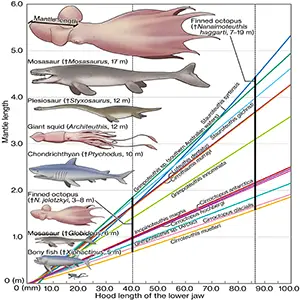 Body size estimation of Late Cretaceous Cirrata octopuses. The graph shows an allometric relationship between the length of the jaw and mantle in long-bodied species of extant finned octopus (tables S3 and S4) (31). The name of the corresponding species is shown along each growth curve. Credit: Science. Click image to enlarge.Jaws built for damage
The fossil jaws showed chipping, scratching, cracking, and polishing. These marks suggest repeated, forceful contact with prey and significant pressure during biting.
“The most surprising finding, perhaps, was the extent of wear on the jaws,” Iba said.
“In well-grown specimens, up to 10 percent of the jaw tip relative to the total jaw length had been worn away, which is larger than that seen in modern cephalopods that feed on hard-shelled prey.
This indicates repeated, forceful interactions with their prey, revealing an unexpectedly aggressive feeding strategy.”
These animals were using their jaws in a way that suggests power, persistence, and a pretty brutal feeding style. Whatever they were going after, they were not handling it gently.
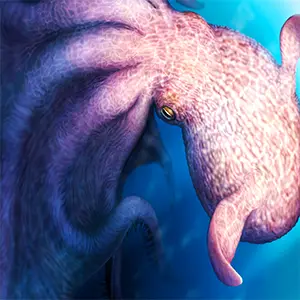 A sketch of the giant octopus, Cirrata, that ruled Earth’s oceans over 100 million years ago. Credit: Yohei Utsuki, Department of Earth and Planetary Sciences, Hokkaido University. Click image to enlarge.Octopus evolution took a strange turn
The fossils also push the known history of octopuses further back.
According to the researchers, the new material extends the known record of finned octopuses by around 15 million years and the broader octopus record by around 5 million years. This places them at about 100 million years ago.
The fact that they had already reached the top tier of their ecosystem suggests octopus evolution may have been much bolder and perhaps far stranger than people had assumed.
There was also one more clue hidden in the jaws. In the two species the researchers studied, one side of the biting surface was more worn than the other.
That may mean these animals favored one side of the jaw, a behavioral asymmetry known as lateralization. In modern animals, more advanced neural processing often drives that sort of asymmetry.
This hints that some of the behavioral complexity we associate with octopuses today may have deeper roots than expected.
Late Cretaceous oceans
For decades, scientists have mostly pictured ancient marine ecosystems as being dominated from the top by vertebrates, while invertebrates filled lower roles in the food web.
This study complicates that picture. At least in some places, giant octopus relatives may have been a rare but important exception.
They were invertebrates that rose all the way to the top and competed with the largest vertebrate predators around them.
“This study provides the first direct evidence that invertebrates could evolve into giant, intelligent apex predators in ecosystems that have been dominated by vertebrates for about 400 million years,” Iba said.
“Our findings show that powerful jaws and the loss of superficial skeletons, common characteristics of octopuses and marine vertebrates, were essential to becoming huge, intelligent marine predators.”
Octopuses have always seemed a little alien, even now. The idea that their ancestors were once giant apex predators somehow makes perfect sense. At the same time, it feels completely surprising.
The study is published in the journal Science.
—–
Like what you read? Subscribe to our newsletter for engaging articles, exclusive content, and the latest updates.
Check us out on EarthSnap, a free app brought to you by Eric Ralls and Earth.com.
—–
AloJapan.com