
The following is a guest post by Sayuri Umeda, a foreign law specialist who covers Japan and other countries in East and Southeast Asia in the Global Legal Research Directorate of the Law Library of Congress. Sayuri has previously authored numerous posts for In Custodia Legis, including Food Delivery in Japan – History and Current Regulation; Tradition vs Efficiency: ‘Hanko’ Affects Workplace Efficiency and Telework in Japan; The History of the Elimination of Leaded Gasoline; The Law Library’s New Report on Public Prosecution Reform in South Korea; Law Library’s New Report Reviews Foreign Ownership of Land Restriction in Major Economies; FALQs: The Conscription System of South Korea; and many more!
At the Milano Cortina Olympics 2026, Japan placed fifth in overall medal count and tied for 10th in the gold medal count (5 gold, 7 silver, and 12 bronze). It was an all-time high medal number for Japan’s Winter Games. I am from Japan and was surprised by the result. I remember that Japan got only one medal (gold) at the Turin Olympics in 2006, when I lost hope in Japan’s winter sports.
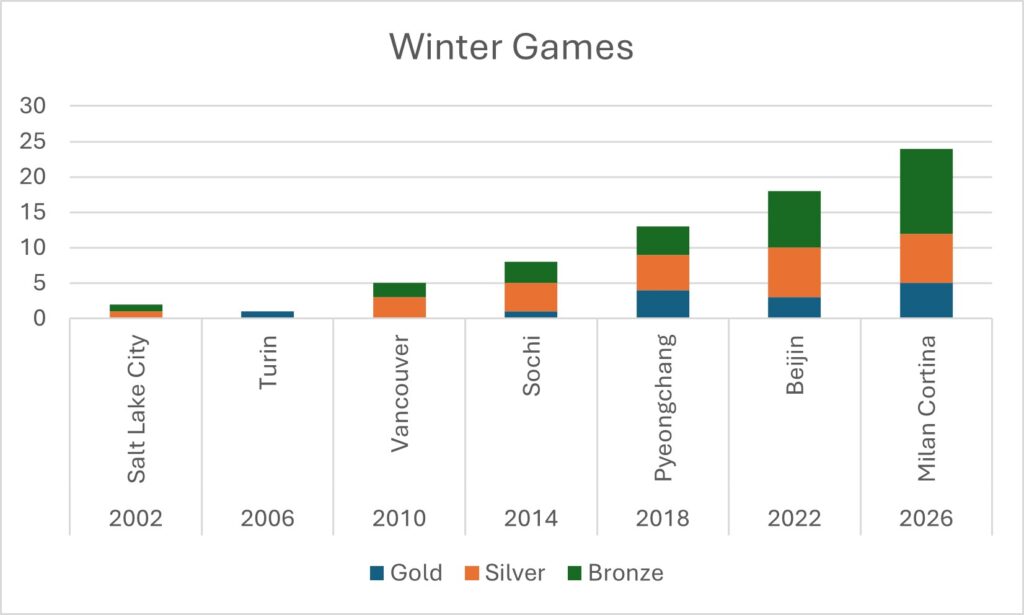 Japan Winter Olympic Games Statistics Medal Count. Graphic by Sayuri Umeda.
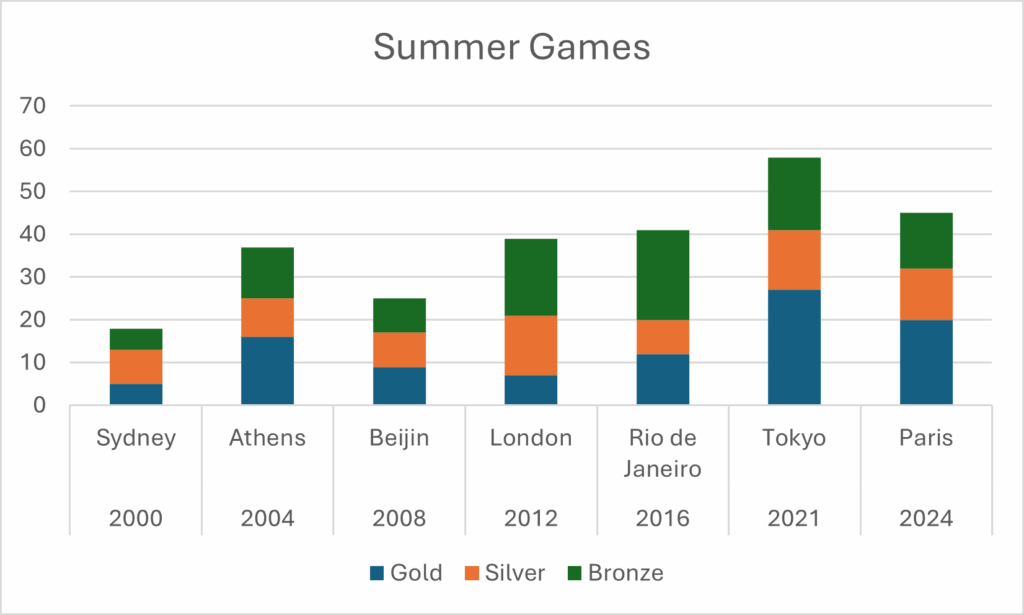 Japan Summer Olympic Games Medal Statistics. Graphic by Sayuri Umeda.
Yet, Japan has performed better in recent Olympics. Intrigued, I researched the system that has made Japanese players more competitive in the 21st century. It appears that the Japanese government, along with each sports association, has made efforts in this regard.
Law
The first law to promote Japanese sports was the 1961 Sports Promotion Act (Act No. 141 of 1961). The act established the fundamental principles for sports promotion measures and defined their implementation as a government duty. Based on this act, initiatives such as developing physical education facilities and enhancing sports instruction systems were advanced.
In 2011, the Basic Act on Sports (Act No. 78 of 2011) revised and replaced the Sports Promotion Act to align with the changing times. It includes an article about the development of outstanding athletes (article 25). It states:
“The State shall take necessary measures to secure and develop outstanding athletes, including providing support for training camps conducted by sports organizations, the dispatch of athletes, coaches, and other personnel to international competitions or nationwide sports tournaments, and the provision of guidance and other activities for youth possessing exceptional potential; and establishing the necessary environment to facilitate the improvement of athletes’ competitive skills and the full realization of their potential.”
Basic Plan for Sports
According to the 2011 act, the Ministry of Education, Culture, Sports, Science and Technology (MEXT) formulates the Basic Plan for Sports for comprehensive and systematic sports promotion. (2011 Act art. 9, para. 1.) The first plan was established in 2012. One of the key principles of sport promotion in the plan is “training human resources and developing the sport environments in order to enhance international competitiveness.” (MEXT, Sports Basic Plan, p. 5.) It also states that one of the policy objectives is to establish a systematic talent development framework, spanning from junior to elite levels, and to improve the sports environment within disciplines where strong competitive potential is found. It set concrete goals, as follows:
the medal count in both the Summer and Winter Olympic Games will exceed Japan’s respective historical records, and
rankings in the Olympic gold medal standings will be a top-five finish in the Summer Games and a top-ten finish in the Winter Games. (p. 34.)
The second and third Basic Plans for Sports also aimed to enhance competitive strength and achieve an all-time high medal count.
Sports Agency
The 2011 Basic Act also prompted the establishment of the Sports Agency in its supplemental provision. (Basic Act on Sports, sup. art. 2.) In 2015, the Sports Agency was established under the jurisdiction of the MEXT. The Sports Agency is engaged in various support initiatives and efforts to improve the sports environment, among other measures, aimed at enhancing Japan’s international competitiveness in sports.
There are other sports organizations. Among them, the Japanese Olympic Committee (JOC), an incorporated foundation that is separated from the government, is a National Olympic Committee (NOC). The Japan Sport Council (JSC), an independent administrative institution, serves as the core, specialized organization dedicated to promoting sports and fostering the health and physical well-being of children and students in Japan.
Budget for Sports
National budgets for sports have been increasing. An article stated that, in fiscal year 2013, the sports budget was 24.3 billion yen (US$154 million), which was double the amount allocated in fiscal year 2012. The budgets were increase to 33.4 billion yen (US$211 million) in 2017 and 43 billion yen (US$272 million) in 2022. These “sports budgets” include various things, e.g., spending to improve school physical education. The budget for improving the competitiveness of Japanese athletes was 9.15 billion yen (US$ 57.9 million) in 2017 and 17 billion yen (US$107.5 million) in 2022. Most recently, for fiscal year 2026, the MEXT asked 11.1 billion yen (US$70.2 million) for this purpose.
To serve as an additional source of funding for the promotion of sports, the sports promotion lottery “toto” was introduced based on the Act on the Implementation of Sports Promotion Betting (Act No. 63 of 1998, as amended) in 2001. It is a system of betting on the results of football games operated by the J-League. The profits are used for the identification and development of athletes possessing exceptional potential, and the development of core facilities for the improvement of the competitiveness of athletes and hosting international competitions and similar events, among other purposes.
Competitiveness Support Programs
There are various programs to improve the competitiveness of athletes. As a foundational strengthening measure, the Sports Agency provides support for the activities that individual sports federations undertake on a routine and continuous basis in preparation for major international competitions. The Sports Agency also implements “High-Performance Support Programs” that are designed to provide specialized and advanced assistance to those competitive disciplines where medal-winning potential is high. Specifically, this program entails athlete support using sports medicine, sports science, and information technologies that are provided by expert staff in their respective fields during training camps and competitions, including motion analysis, game analysis, information gathering, nutritional support, conditioning support, and psychological support.
Development of Facilities
The government has endeavored to establish an environment that effectively enhances athletes’ competitive performances. In 2001, it opened the National Institute of Sports Sciences (JISS), which has training facilities, sport-specific practice facilities (competitive swimming, rhythmic gymnastics, etc.), and sports medicine and science research facilities, such as high-performance gyms and wind tunnels. Since 2003, the JISS has been under the jurisdiction of the JSC. In 2008, JISS opened the National Training Center (NTC) as a training facility dedicated to the comprehensive enhancement of the international competitive capabilities of top-level athletes. For sports that cannot be handled by the NTC, the government has designated sports-specific NTCs.
It appears the government’s efforts paid off at the 2026 Milan Cortina Winter Olympics. I am looking forward to watching the 2028 Los Angeles Olympics to see if the trend will continue.
Subscribe to In Custodia Legis – it’s free! – to receive interesting posts drawn from the Law Library of Congress’s vast collections and our staff’s expertise in U.S., foreign, and international law.
AloJapan.com