
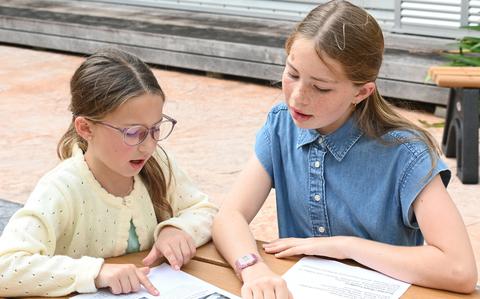
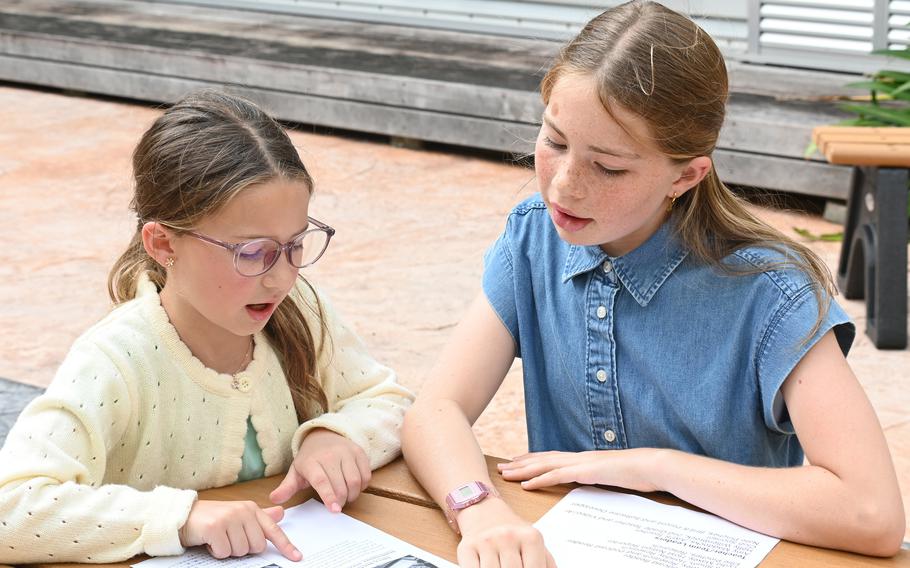
Bob Hope Elementary School students, fourth grader Lydia Maxey, left, and fifth grader Olive Wilson review their proposal for the podcast “Hello From Here, Konnichiwa From There,” at the school on Kadena Air Base, Okinawa, Japan, on April 22, 2026. (Brian McElhiney/Stars and Stripes)
CAMP FOSTER, Okinawa — Two student teams on Okinawa were among winners from nine Defense Department schools who used artificial intelligence to solve problems in a first-ever national competition.
Teams from Bob Hope Elementary School on Kadena Air Base and Zukeran Elementary School on Foster were among Department of Defense Education Activity schools recognized for their projects in the inaugural Presidential AI Challenge, according to a DODEA news release April 13.
The challenge, created by an April 2025 executive order establishing an AI literacy strategy, asked students and educators in elementary, middle and high schools to create AI-powered solutions to problems, according to ai.gov.
Teams nationwide submitted 2,500 entries, according to a Feb. 11 Facebook post by first lady Melania Trump. Fifty-three DODEA teams participated, spokeswoman Miranda Ferguson said by email Monday.
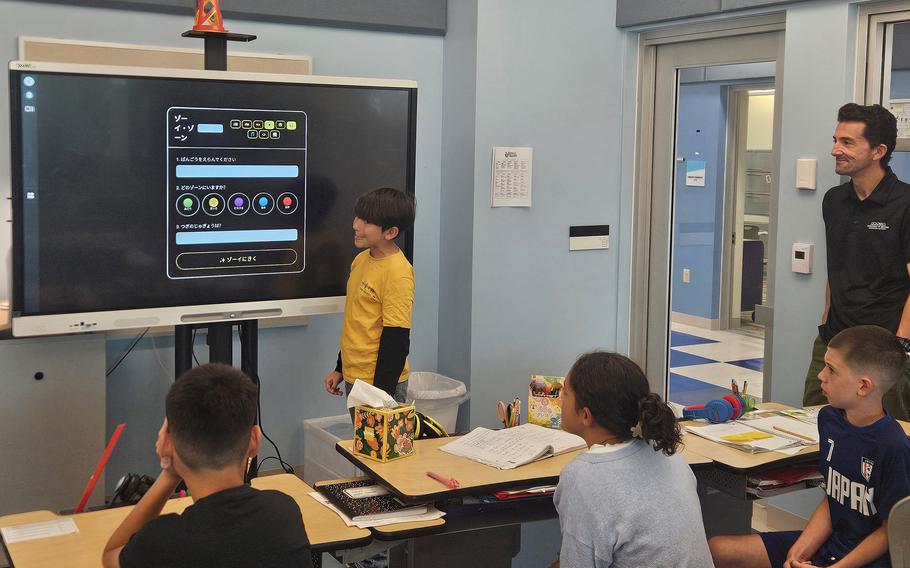
Fourth-grade student Andres Rodriguez demonstrates the Japanese language version of the app, Zoe Zones, that his class created for the first Presidential AI Challenge, at Zukeran Elementary School on Camp Foster, Okinawa, Japan, April 27, 2026. (Brian McElhiney/Stars and Stripes)
Students at Zukeran created an emotional wellness app. The Bob Hope team demonstrated a podcast for encouraging cultural exchanges.
DODEA winners also included teams from Daegu Elementary School in South Korea; Brussels Unit School in Belgium; Sevilla Elementary Middle School in Spain; Sigonella Middle High School in Italy; and Spangdahlem Middle School and Stuttgart High School in Germany.
A DODEA team from Stowers Elementary School in Georgia was declared a Georgia state winner.
None of the DODEA winners were among the five regional winners announced in April.
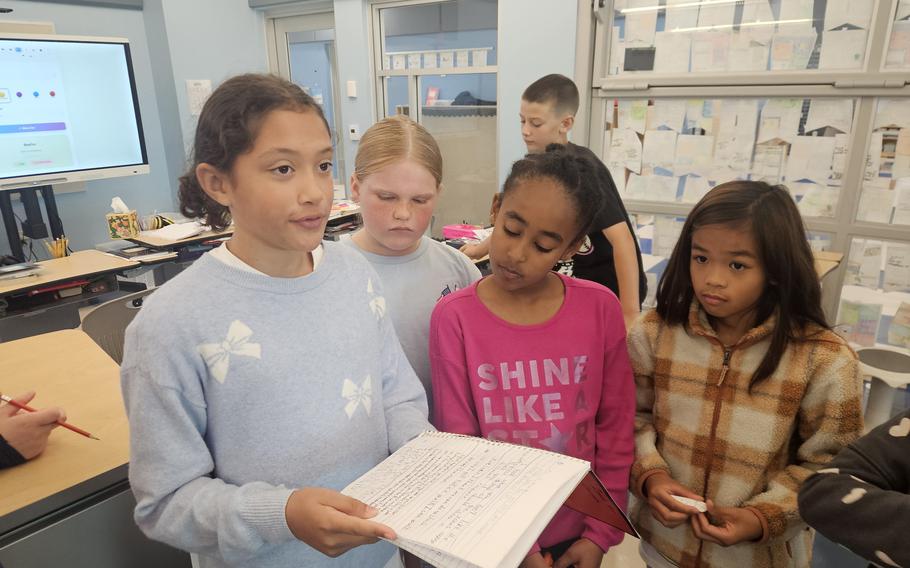
Students in Cameron Perry-Kline’s fourth-grade class look over their notes for an online app that helps students regulate their emotions, at Zukeran Elementary School on Camp Foster, Okinawa, Japan, April 27, 2026. (Brian McElhiney/Stars and Stripes)
At Zukeran, Cameron Perry-Kline’s fourth grade class created the Zoe Zones app based on Zones of Regulation, in which students express how they are feeling using a color-coded system.
The initiative has been used at Zukeran for at least five years, according to Ferguson.
However, teachers don’t always have time to offer strategies to help kids get into the “green,” or ready-to-learn, zone, Perry-Kline told Stars and Stripes at the school on Monday.
“They’re feeling something that’s going on from a situation at home and a lot of the time it’s directly related to the fact that they’re a military child,” he said.
The app suggests strategies for each color: green for happy, yellow for excited, blue for sad or tired, red for angry and purple for needing to talk.
During a demonstration Monday, students who selected yellow or red received suggestions to practice regulated or “square breathing” or to drink water.
Perry-Kline coded the app with suggestions from his students using AI software Gemini, ChatGPT and Claude. Over time, the AI tailors its suggestions to each student, he said.
The app has a “try another one” button “because some of them didn’t work for us but worked for others,” student Makinley Phillips said.
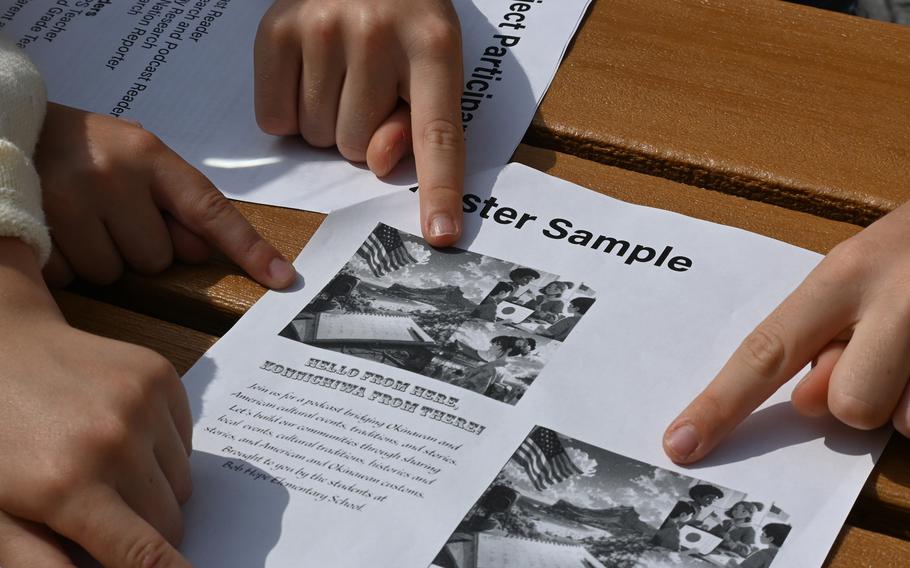
Bob Hope Elementary School student go over their proposal for the podcast “Hello From Here, Konnichiwa From There,” entered in the first national Presidential AI Challenge, at the school on Kadena Air Base, Okinawa, Japan, on April 22, 2026. (Brian McElhiney/Stars and Stripes)
At Bob Hope, five fourth graders and five fifth graders proposed a podcast, “Hello From Here, Konnichiwa From There.”
The group submitted a proposal under Track I rather than build an AI solution under Track II, according to Holly Willenbrock, a second grade teacher, video/AI club sponsor and one of three project leaders.
The students used Adobe Podcast to record a sample episode about American holidays and translated it to Japanese using WeVideo’s AI translation.
“Here on Okinawa, we have a very difficult language barrier, so we decided to make something with AI to try to get over that and communicate easier,” fourth grader Lydia Maxey said at the school on April 22.
Fifth grader Olive Wilson said the project helped her realize AI can be a useful tool — but it can’t do everything.
“After I did the AI challenge, I learned that it can be really useful and it can help you do lots of things,” she said. “But you can’t rely on it too much because we have brains for a reason.”
AloJapan.com