
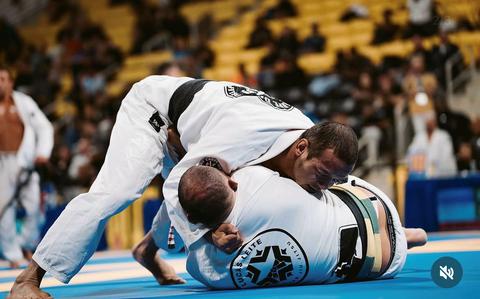
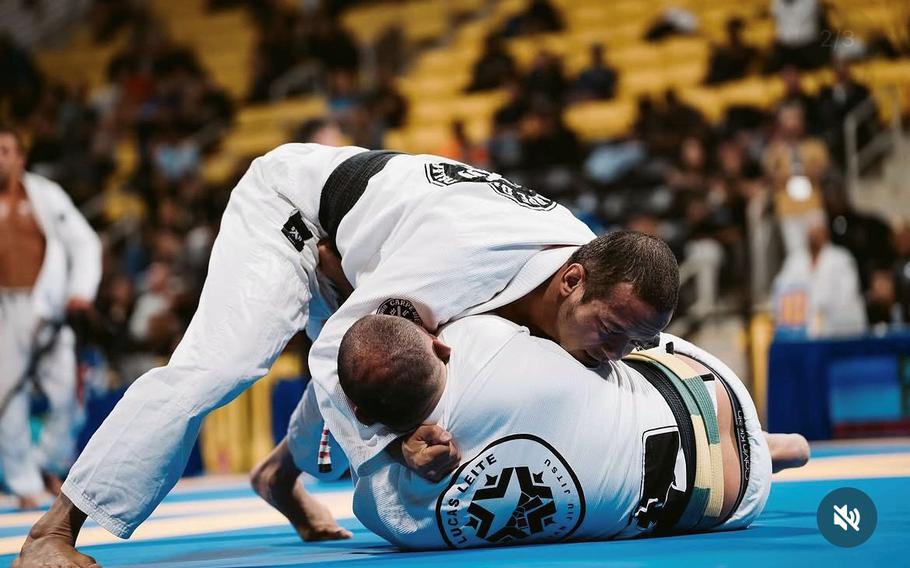
(Photo cortesy of Marine Air Control Group 18 leadership, Colonel Sanders and SgtMaj Sanchez, with Marines at Marine Corps Air Station Futenma)
Okinawa offers more than world-class beaches and countless sushi merry-go-rounds. It has a well-established Jiu-Jitsu community that continues to grow among service members and their families.
For some Brazilian Jiu Jitsu (BJJ) practitioners, it’s a way to stay sharp off duty- physically, mentally, and even spiritually. It becomes a tribe: a place to build confidence and community outside the demands of military life. For many, like me, the hardest part is simply walking through the door the first time.
I remember stepping onto the mats at a BJJ Academy in Corpus Christi, Texas. I didn’t know what to expect. There was no pressure to pay or commit. The decision was mine. Even after three classes over two weeks, no payment was expected by the owner. That reflects something consistent across great academies: a genuine focus on people over transactions.
I learned quickly. Clean attire mattered. Nails were trimmed for safety. Respect for training partners and the academy was non-negotiable. Sportsmanship was enforced. “No one is going home with a gold medal for winning at practice” was repeated often. Progress came through consistency, not ego.
That same environment exists across Okinawa.
“There are several academies on Okinawa offering both Gi and No-Gi training, and I teach both,” said Andy Murasaki, a Leos BJJ Academy BJJ black belt instructor and multiple-time champion who has competed across Japan and internationally. “For service members and those in security fields, No-Gi tends to be more practical.”
For service members, the value is clear. Grappling builds control under pressure, real-time problem-solving, and endurance in uncomfortable positions.
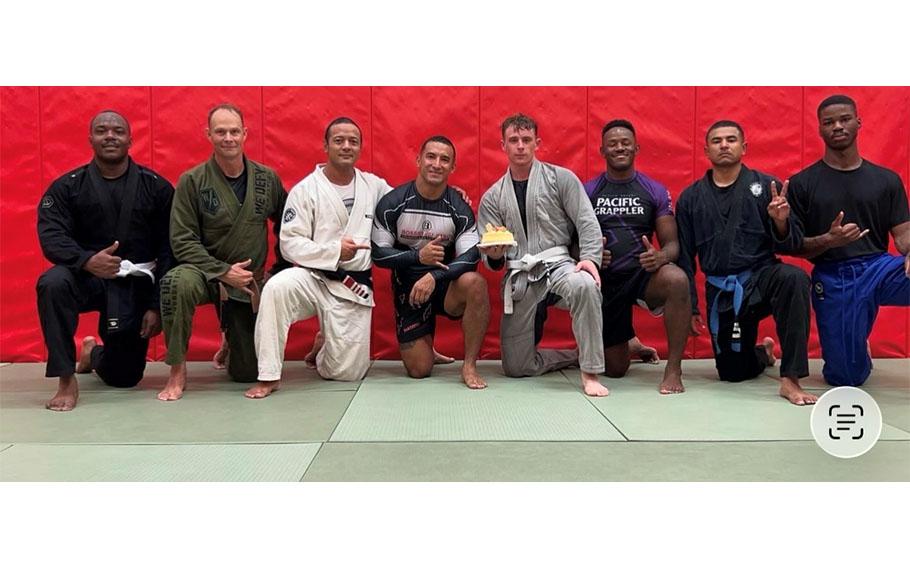
1. What to Expect Your First Day
Walking into a BJJ gym for the first time is unfamiliar, but classes are structured to support beginners. Most sessions follow a predictable format: warm-ups, technique instruction, drilling, and optional live sparring.
You’ll also notice a code of conduct immediately. Shoes and socks stay off the mat. Close physical contact is part of training, and most people leave class drenched in sweat.
No one expects you to know anything on day one. Leave your ego at the door.
“Jiu-Jitsu teaches more than techniques—it builds a philosophy and a lifestyle that carries over on and off the mat,” Murasaki said.
2. Five Common Brazilian Jiu-Jitsu Terms to Know
Gi / No-Gi “Gi” refers to the traditional uniform (kimono), which allows grips on the jacket and pants. “No-Gi” uses athletic wear like fitted shirts and pocketless shorts.
Tap (Tapping Out) When caught in a joint lock or choke, you tap your partner or the mat to stop safely.
Rolling Live training where partners apply techniques in real time.
Mount A dominant position where one person controls their opponent from the top.
Submission A technique that forces an opponent to tap, usually through a joint lock or choke.
3. A Culture That Extends Beyond the Mat
Across the island, strong BJJ academies emphasize discipline and respect. As in the Marine Corps, climate and culture matter.
“We emphasize protecting women and children, respecting the mat, and following martial arts principles,” Murasaki said. “At the same time, we maintain a culture of kindness and mutual respect.”
From personal experience, I’ve seen how one-on-one, full-contact sports build confidence and resilience. My daughter wrestled in high school, and the impact extended far beyond competition. She learned to manage pressure, stay composed in difficult positions, and compete in an environment where discipline determined outcomes.
The growth of female participation reflects that value. According to the National Federation of State High School Associations (NFHS), girls’ wrestling participation grew from just over 21,000 athletes in 2018–2019 to more than 74,000 by 2025, with all 50 states offering programs. In 2023, the NCAA formally recognized women’s wrestling as a championship sport.
For parents, the appeal is straightforward. BJJ teaches children to manage pressure, build toughness, and develop disciplined aggression in a controlled setting. Whether it’s a mother wanting her daughter to learn self-defense or a father wanting his son to build confidence, the environment supports both.
“In my classes, women and couples feel comfortable,” Murasaki said. “I always encourage them to try a trial class.”
4. The Reality on Base
While BJJ is available on base, consistency can be difficult due to personnel turnover.
“At Marine Corps Air Station Futenma, it’s challenging to maintain consistent classes because units rotate so frequently,” Murasaki said. “Many students are only here for a few months, which makes continuity difficult.”
“Lunchtime classes at Futenma were discontinued due to low attendance,” he added.
For many service members and families, off-base academies provide more stable opportunities to train.
Six Steps to Your First Class
Show up No experience required. This is the hardest step.
Wear clean, simple gear Athletic clothing works for your first class. Invest in a uniform (Gi) later if you commit.
Prioritize hygiene Clean clothes and trimmed nails are mandatory.
Remove shoes Shoes and socks stay off the mat. Flip flops are common but optional.
Focus on learning, not winning You will get outmatched early. That’s part of the process.
Give it time Commit to 2-3 weeks before deciding. One class isn’t enough.
Final Thoughts
“If you’re thinking about trying Jiu-Jitsu, come [into Leos Academy] with confidence and enjoy the process,” Murasaki said. “If you’re not learning, that’s on me.”
For service members, it reinforces the Warrior Ethos. For families, it builds confidence and discipline together.
The only requirement is stepping onto the mat for the first time.
Just remember… Tap early and often.
AloJapan.com