
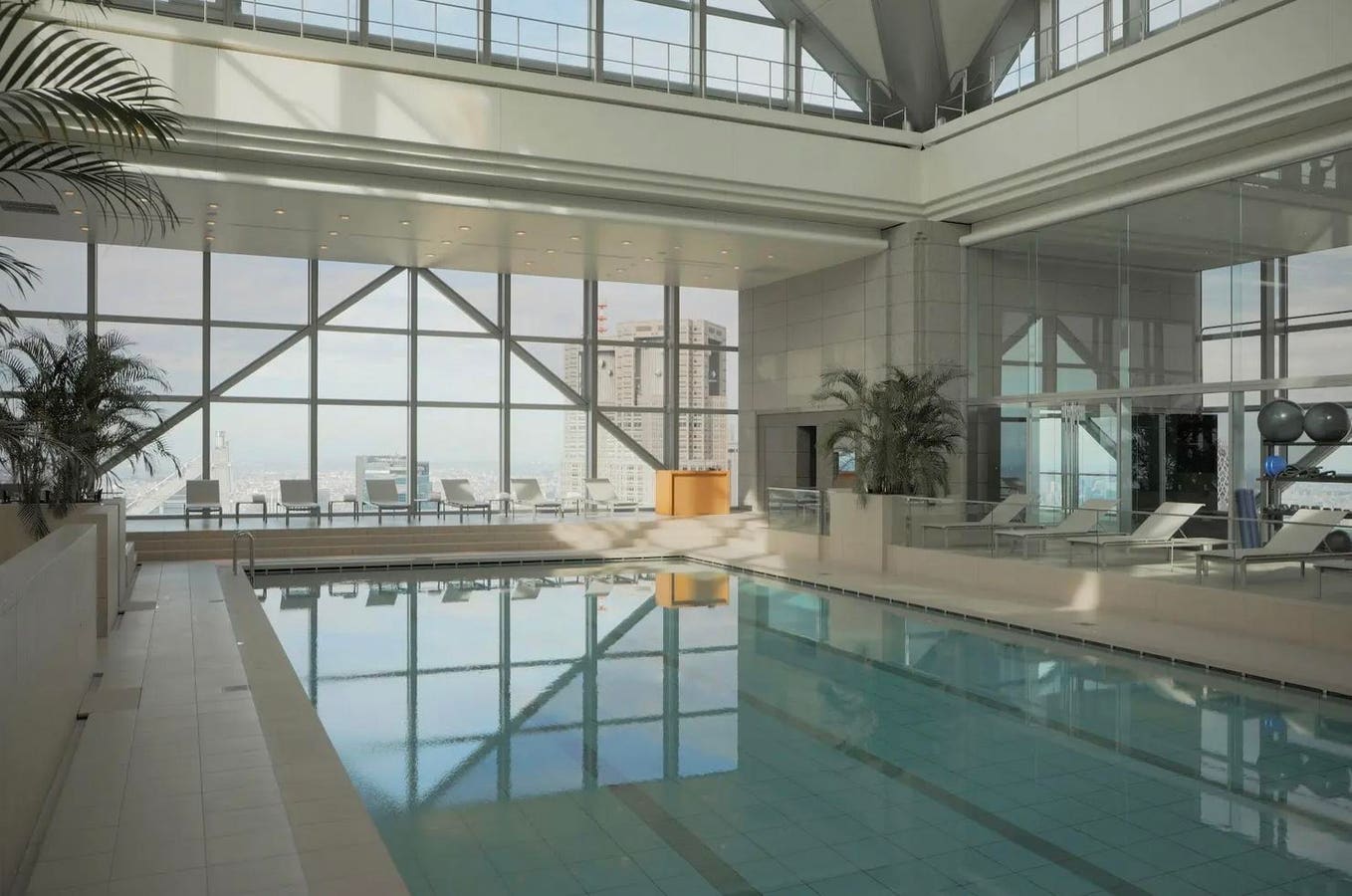
Guests of the refurbished Park Hyatt Tokyo may recall the 47th floor pool from scenes from “Lost in Translation.” The 171-room property recently emerged from a $25 million refresh that upgraded the facilities and designs, while staying true to the cinematic soul.
Park Hyatt Tokyo
You probably know it as the “Lost in Translation” hotel, the place where Scarlett Johannson and Bill Murray sort-of, almost-but-not-quite canoodled in Sofia Coppola’s wistful 2003 comedy about two Americans adrift in Tokyo. With its sweeping views and quiet remove from the city, The Park Hyatt Tokyo became a kind of emotional stand-in for the main characters: suspended, lonely, observant, just out of reach.
Being one of my all-time favorite movies, I’ve been mildly obsessed with the hotel for years, so I was intrigued to read that it had finally emerged from a major restoration. After a 19-month closure, the property that spans 14 floors of the 52-story Shinjuku Park Tower reopened in December 2025 following the most comprehensive refresh in its 30-year history.
Park Hyatt Tokyo’s $25 Million Refresh
With views towering over the city, the Park Hyatt Tokyo was a kind of emotional stand-in for the main characters of “Lost in Translation.”
Park Hyatt Tokyo
The renovation, led by Paris-based Studio Jouin Manku, touched the hotel’s 171 rooms and suites, along with dining, wellness and public spaces, while preserving the cinematic mood that made the place famous in the first place.
Guest rooms were redesigned with softer forms, warmer materials, contemporary Japanese art, modernized controls and expanded wet-room bathrooms inspired by Japanese onsen. Signature details remain, including Isamu Noguchi’s washi lamps (Murray knocks one over in an awkward scene in the movie), deep soaking tubs, skyline views and the hushed “private residence in the sky” feeling that defined the original John Morford interiors. The New York Bar, Peak Lounge, Girandole and major suites were also refreshed.
A Veteran Concierge Share Tokyo’s Secret Spots
In a city that suddenly seems to be on everyone’s itinerary, the reopening felt like an excuse to call up someone who has seen the Park Hyatt Tokyo from the inside for longer than almost anyone: Adrian Fautt, the hotel’s longtime chief concierge. Fautt has been with the property since it opened in 1994, which means he was there before the movie turned the hotel into shorthand for a certain kind of jet-lagged glamour, there during the filming years and there now as a new generation of guests arrives with TikTok screenshots, restaurant lists and very high hopes.
Originally from Los Angeles, Fautt has spent decades helping visitors decode Tokyo with the kind of precision that makes a great concierge feel less like a fixer and more like a translator. Which, at this hotel, feels especially apt.
David Hochman: Tokyo feels more popular than ever right now. Has that changed what guests ask you for?
Adrian Fautt: It has. Everybody knows everything now, or at least they think they do. Tokyo has become a very difficult city in which to pinpoint something truly unknown.
But that challenge has made me think differently. Rather than simply finding places for guests, I’ve been creating experiences for them. During the year and a half before we reopened, that became a big part of my work: pulling a few strings, using relationships I’ve built over the years and arranging things that feel personal to the Park Hyatt Tokyo. The idea is to offer something guests couldn’t just discover from a social media feed.
David Hochman: What’s an example of that kind of experience?
Adrian Fautt: One experience I’m especially excited about is tea picking. People don’t necessarily think of Tokyo as a tea destination, but if you go west, toward the border with Saitama Prefecture, you’re very close to Sayama-cha, one of Japan’s three major teas, along with Uji-cha from Kyoto and Shizuoka-cha.
I have a friend with a tea farm in that area, and we’ve created a special experience for our guests. It’s about 45 minutes from the hotel by private car. Guests can change into the traditional clothing worn for tea picking, spend time in the fields, learn about the tea, pick the leaves themselves and then taste them in different forms. One of my favorite parts is tea-leaf tempura, made on site with the young leaves.
There can also be hōjicha, matcha, sweets, tea soba and even shaved ice in summer, made from a block of ice with tea leaves frozen inside. For me, the point is to show guests what tea actually means here. I’m American myself, so I understand the whole matcha boom. But in Japan, matcha is not just something you put on ice cream or into everything. It is meant to be appreciated as tea.
The Lost In Translation Tour At ‘The Lost In Translation’ Hotel
David Hochman: You were at the hotel when “Lost in Translation” was filmed. Do guests still come in with that movie in mind?
Adrian Fautt: Of course. And we’ve created an experience that plays with that, but in a way that still feels like Tokyo. It begins with the more familiar side: a cocktail bar, maybe the whiskey that Bill Murray’s character enjoyed, and a few filming locations connected to the movie.
Then it shifts into something much more local: a Japanese snack bar. That’s very different from the cocktail bars Western guests are used to. Snack bars are usually small, intimate places, often built around regular customers. Even for locals, they can be hard to walk into because they are so relationship-based. The mama-san controls the room. Whatever she says goes.
The experience is arranged with someone who understands both the film and the local culture. Guests might visit a few of the movie-related points, then go to the snack bar, have drinks, meet people, maybe sing karaoke and experience that very friendly, slightly old-school atmosphere. At the end, we might leave them at a ramen shop and say, in the spirit of the movie, “Please find your way back to the hotel and enjoy being lost.”
As for the filming itself, they were here for about three months. They would set up around 1:30 in the morning and break everything down by 5. I was working at the desk then, and sometimes the actors would just sit on the sofa and talk for a while. That was when I first realized how hard actors actually work. I gained a new respect for that.
Inside Tips For Enjoying Tokyo Away From The Crowds
David Hochman: For repeat visitors who have already done the major sights, which Tokyo neighborhoods do you like right now?
Adrian Fautt: Close to the hotel, I like Sangūbashi, especially if guests want to walk toward Meiji Shrine or Yoyogi Park. There are local shops, and Fuglen has a beautiful cafe there in what used to be a regular Japanese home.
I also love Shimokitazawa. It’s known for secondhand shops, but I especially like the small cafes. It still feels local compared with Shibuya or Harajuku.
The New York Grill is one of several restaurant spaces that got a fresh look in the recent renovation at The Park Hyatt Tokyo.
Park Hyatt Tokyo
Kichijōji is another good option, only about 10 or 15 minutes by train heading west. On one side of the station, there’s a shōtengai with shops and even a small fish market. On the other side, you can walk toward Inokashira Park, which is beautiful during sakura season. There are cafes, the Ghibli Museum and a very famous yakitori place called Iseya. I think Iseya is one of the best, even for lunch.
Yanaka is still interesting, but it has changed. It’s filled with more foreign visitors now. Some of the old shops are still there, including some that survived the war, so it can still be worthwhile. But with overtourism, it is losing some of that original feeling.
David Hochman: How did someone from Los Angeles end up becoming one of Tokyo’s great concierges?
Adrian Fautt: I’m from Cerritos, and I worked near Santa Monica years ago, including at restaurants like Chaya. I came to Japan after graduating, when an electronics company offered me a job through campus recruiting.
At the time, I thought I knew everything. Then I arrived and realized very quickly that I didn’t know much at all. I figured I would stay three or four years and then go back. But I never did. This is my 36th year in Japan.
And yes, it’s an interesting job. There is never a dull moment.
The interview has been edited and condensed.
Also From ForbesForbesAt Jacaranda, A Michelin-Star Chef Makes A Punk-Rock Los Angeles ComebackBy David HochmanForbesInside The Immersive ‘Phantom Of The Opera’ Show Fans Are Seeing 20 TimesBy David HochmanForbesThis Santa Monica Restaurant Is Going Viral For Its BathroomBy David Hochman
AloJapan.com