
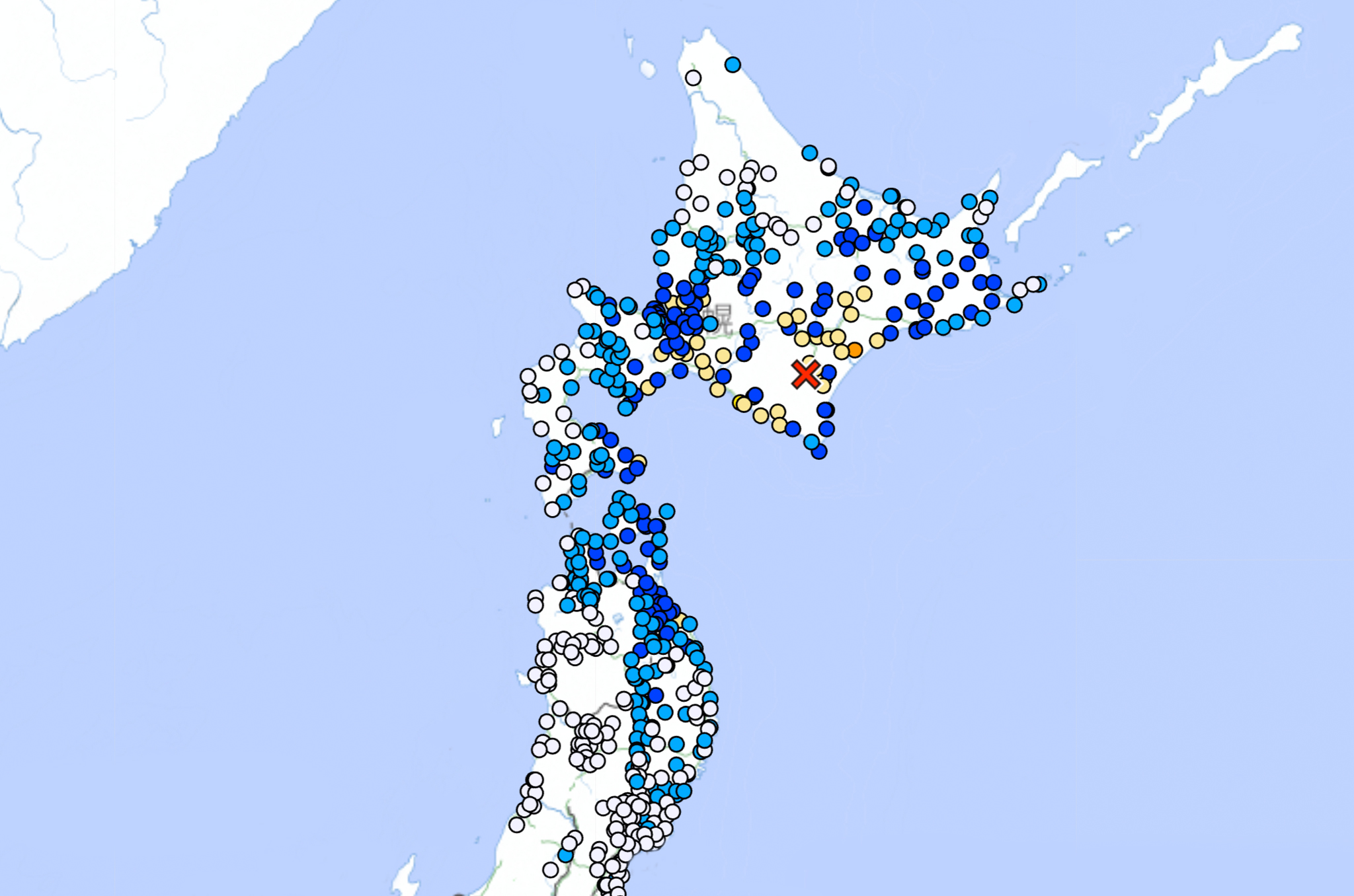
At 5:24 a.m. on Monday, an earthquake with a magnitude of 6.2 struck the northern Japanese prefecture of Hokkaido. The quake occurred at a depth of approximately 83 kilometers and registered upper 5 on the Japanese seismic intensity scale of 7 in the Tokachi region.
No Injuries or Nuclear Plant Abnormalities Reported After Hokkaido Quake
No tsunami warning was issued following the powerful jolt and no abnormalities were observed at the Tomari nuclear power plant. There were also no immediate reports of injuries. The Japan Meteorological Agency (JMA) and the US Geological Survey predicted that the damage to property and the threat to life were minimal.
However, a JMA official told reporters that, “in areas that experienced strong shaking the danger of falling rocks and landslides has increased.” The agency also warned that there is a high risk of more quakes, similar in strength, in the coming days.
Recent Seismic Activity Raises Concerns
The quake in Hokkaido comes less than a week after Iwate Prefecture was hit with a 7.7-magnitude jolt off the Sanriku Coast. Six people were injured as a result of the earthquake, which triggered tsunami waves of up to 80 centimeters.
The JMA subsequently issued a statement, warning that the likelihood of a megaquake — with a magnitude 8.0 or more — occurring was “relatively higher than during normal times.” The alert covered 182 municipalities across the prefectures of Hokkaido, Aomori, Iwate, Miyagi, Fukushima, Ibaraki and Chiba.
About Japan’s Seismic Intensity Scale
Japan’s seismic intensity scale, known as shindo, is a 10-level scale (0–7, with 5 and 6 split into lower and upper levels) measuring the intensity of ground motion at specific locations. Upper 5 is described as the level at which people find it difficult to walk without holding on to something.
Related Posts
Discover Tokyo, Every Week
Get the city’s best stories, under-the-radar spots and exclusive invites delivered straight to your inbox.
AloJapan.com