
ARMED DETERRENCE:
Japan’s newly muscular stance on defense is aimed at keeping the sabers of regional players in their scabbards, a Japanese lawmaker said
By Fion Khan
/ Staff writer, with CNA
Taiwan, Japan and the US must stand together and reinforce defense capabilities, not to wage a war, but to ensure China “cannot draw its sword,” Japanese House of Representatives Member Yasuhide Nakayama said at the 14th Global Taiwan National Affairs Symposium in Taipei yesterday.
In his speech, the former Japanese vice minister of defense said the struggle is democracy versus hegemonism.
For the past 80 years, Japan has been a “protected country,” he said, referring to the US-Japan Security Treaty.
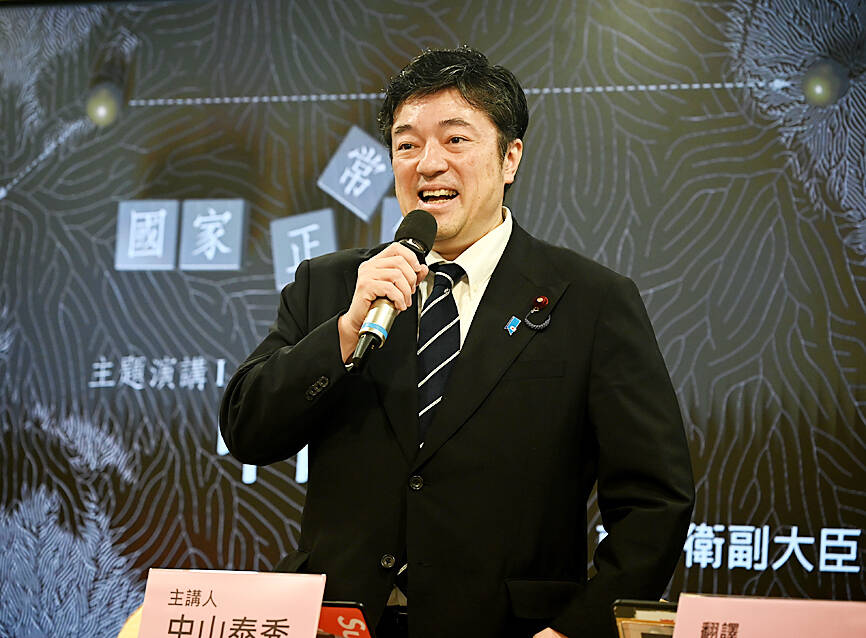
Photo: Wang Yi-sung, Taipei Times
Tokyo is seeking change, with new policies proposed by leaders such as Japanese Prime Minister Sanae Takaichi, he said.
The moves include defense reforms, including revising restrictions on arms exports and a reassessment of national security and defense strategies, as well as constitutional amendments, as the postwar constitution no longer reflects modern reality, he said.
Japan is transitioning from a “protected nation” to one capable of sharing responsibility and protecting its allies, he said.
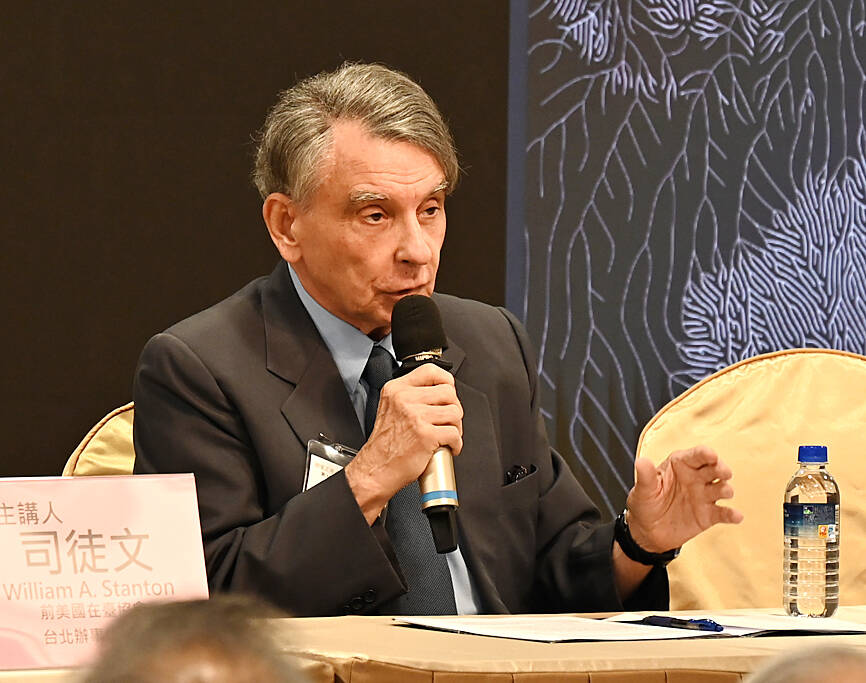
Photo: Wang Yi-sung, Taipei Times
China possesses intercontinental ballistic missiles that could strike the White House if launched from the South China Sea, while its mass production of robots could become lethal weapons platforms in wartime, he said.
Alongside traditional warfighting arenas of sea, land and air, China’s operational expansion into the domains of space, artificial intelligence and electromagnetic pulses makes it essential for Japan, the US and Taiwan to bolster their defenses, he said.
Former American Institute in Taiwan director William Stanton in his speech said the US and Taiwan are united not only by shared values, such as independence, freedom, rule of law and human rights, as well as shared interests.
US President Donald Trump has introduced greater uncertainty into US-Taiwan relations, he said, calling Trump inconsistent and his policies unpredictable.
Trump’s “America first” policy has made many in Taiwan and the US concerned about the US becoming an unreliable ally, in contrast to previous US presidents who were seen as more friendly to Taiwan, he said.
Trump’s statements and positions have increased skepticism toward the US from Taiwanese, he said, adding that if such doubts are allowed to deepen, they could harm US interests.
AloJapan.com