
Fossils of Octopus’s Tuck in Hokkaido Found
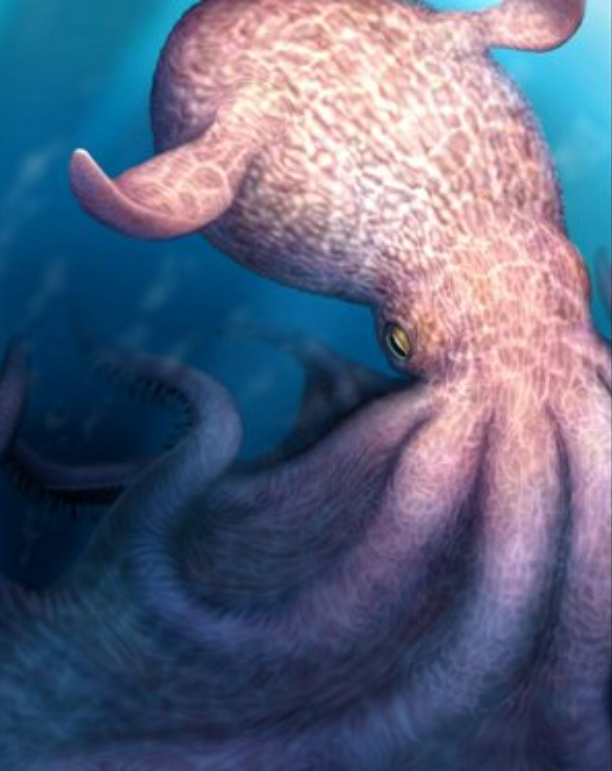 사진 확대 An imaginary view of the restoration of a giant octopus from the Cretaceous period. Courtesy of Hokkaido University
100 million years ago, the possibility was raised that a giant octopus up to 19 meters long lived in the sea. It is analyzed that it may have been larger than the giant squid, which is known as the largest invertebrate so far.
According to the Yomiuri Shimbun on the 24th, a research team at Hokkaido University analyzed the jaw fossils of octopuses in the late Cretaceous period and found that they may have grown to 7-19 meters in length at the time. The findings are published in the scientific journal Science.
The research team found a jaw fossil that forms the beak of an octopus in rocks about 100 to 72 million years ago collected in Hokkaido. The fossils left traces of biting and breaking hard prey. Based on this, the research team estimated that the giant octopus may have hunted creatures with hard shells like ammoniumites.
Octopuses have no bones, so they are difficult to leave as fossils. The hard jaw is usually only a few centimeters (cm), so there was a limit to estimating the size and ecology of octopuses in the past. The research team sliced the rock into 0.05 millimeters (mm) thick and took a cross-section, and then overlapped it to restore the three-dimensional structure of the fossil to a digital image. The cracks and wear marks left on the chin were analyzed by artificial intelligence (AI).
The research team investigated 27 fossils obtained from Japan and abroad. As a result, the size of the jaw fossil reached up to 10 cm. By comparing this with modern octopus, it was found that the Cretaceous octopus grew to about 7-19 m long. Considering that the giant squid, which is currently considered the largest invertebrate, has a body length of a few dozen meters (m), it is possible that the octopus was the largest invertebrate in history at the time.
In the Cretaceous Sea, the marine reptile Mosaurus, which is about 17 meters long, has been considered to have been at the peak of the food chain. However, the study shows that giant octopuses may also have played a top predator in the sea at the time.
Yasuhiro Iba, a professor at Hokkaido University who led the study, said, “We have confirmed that octopuses, which are vertebrates, can also become the top predators of the sea if they become huge.”
Makoto Manabe, director of the National Science Museum in Japan, said, “We look forward to revealing in the future what kind of competition the giant octopus and Mosaurus, who were the top predators of the sea at the same time, were in.”
AloJapan.com